AI patch compliance uses AI agents to connect vulnerability findings with endpoint identity, business criticality, exposure, deployment constraints and verification evidence, so applicable endpoints reach a verified compliant state. Agents prioritize risk, build canary cohorts, route approvals and verify outcomes, with human approval for critical or uncertain changes.
Why Does Enterprise Patch Compliance Require More Than Deployment?
A vulnerability scanner can identify thousands of missing patches within hours. The harder problem is deciding which findings represent immediate risk, which patch applies to each endpoint, when deployment is safe, who must approve the change, and whether installation actually removed the exposure. In a large enterprise, those answers sit across endpoint management, EDR, CMDB, identity, application catalogs, change calendars, service ownership records, and vulnerability data.
A device marked noncompliant may be offline, retired, misidentified, waiting for a reboot, covered by a superseding update, or excluded because a business application has not passed compatibility testing. Conversely, a dashboard may show an installed patch while the vulnerable component remains active or the endpoint has stopped reporting. Counting deployment commands does not establish risk reduction.
AI patch compliance improves this operating model by connecting each vulnerability to the endpoint, owner, business service, exposure path, dependency, maintenance window and verification evidence. AI agents can prepare cohorts, recommend treatment, obtain approvals, invoke bounded deployment tools, monitor health, stop a failing rollout and reconcile the outcome across systems.
AgenticAssetOps provides the operating architecture through ElixirData for trusted context, ElixirHub for reusable patching skills and ElixirClaw for governed execution. Security and IT operations teams can move from static compliance reporting to a closed loop in which remediation is prioritized, controlled, verified and auditable.
See how Context OS governs AI agent decisions
Context OS links vulnerabilities, endpoints, owners and change windows so patching agents act only within approved boundaries.
What Is the Enterprise Endpoint Risk Challenge?
Consider a global manufacturer with corporate laptops, remote employees, engineering workstations, branch kiosks, warehouse terminals, and data center servers. A critical operating-system vulnerability is added to the response queue. The scanner reports affected endpoints across several regions, but the population is not ready for one deployment job. Some devices support production scheduling, others run specialized engineering software, and a subset of servers belong to high-availability services with tightly controlled maintenance windows.
The endpoint platform shows current configuration for most devices, but several hundred have not checked in recently. The CMDB contains duplicate or incomplete ownership records. EDR shows active exposure on some endpoints, while the vulnerability scanner is still using yesterday's inventory. Change management lists a freeze for one business unit. Application owners have approved the patch for common productivity software but have not tested two specialist applications.
Security wants rapid remediation. Operations wants to avoid an outage. Service owners need to understand which systems support critical workflows, and the endpoint team needs a cohort plan it can execute through existing tools. Without shared context, the organization either delays too broadly or deploys too aggressively. Both responses leave avoidable risk: one extends exposure, while the other increases the chance of operational disruption.
Why Do Traditional Patch Operations Fall Short?
Patch tools are effective at packaging, distribution, installation, and reporting. They are less effective when a remediation decision depends on context outside their own inventory. Ticket workflows can enforce approval, but they rarely assemble the evidence needed to determine applicability, business impact, or successful verification.
-
Endpoint, vulnerability, service, owner, and application identifiers do not align consistently across security and IT systems.
-
Severity scores are often treated as the priority even when exposure, exploit evidence, business criticality, and compensating controls differ.
-
Static device groups become stale as employees, locations, applications, and service relationships change.
-
Maintenance windows and change freezes are stored separately from the endpoint and vulnerability records that need them.
-
A successful install status may hide pending reboots, failed services, missing prerequisites, or incomplete vulnerability rescans.
-
Exceptions remain open without a current owner, expiry date, compensating control, or evidence that the underlying risk was reviewed.
Traditional automation works well when the population and action are already known. The gap appears earlier and later: establishing the correct treatment before execution and proving the outcome afterward. Agentic AI is useful in those decision-heavy stages when it operates within explicit change, security, and access controls.
How Does Agentic AI Change Enterprise Patch Compliance?
The operating loop is Detect, Understand Context, Decide, Approve, Act, Verify, and Learn. Detection combines new vulnerability intelligence, scanner findings, endpoint drift, failed installations, and overdue exceptions. Understanding context resolves the affected component, endpoint identity, owner, service relationship, network exposure, current controls, maintenance constraints, and the age of each observation.
The decision step determines applicability and treatment. An agent may recommend expedited patching, a standard maintenance window, a configuration mitigation, isolation, an approved exception, or further testing. It also defines the deployment cohort and preflight checks. Approval applies the organization's change authority. Action invokes existing endpoint and service-management tools. Verification confirms installation, reboot state, endpoint health, service behavior, and reduced exposure. Learning updates cohort logic, failure patterns, and policy thresholds using reviewed outcomes.
This loop prevents a common control failure: treating the request to remediate as permission to patch every reported endpoint. The agent must preserve uncertainty, separate recommendations from authorization, and stop when the device identity, dependency, maintenance window, or rollback readiness is insufficient.
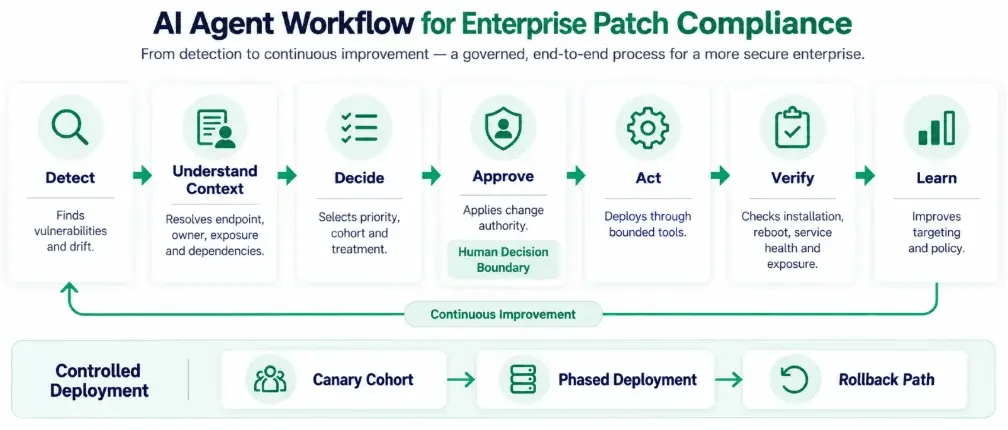
The governed patching loop uses a canary cohort, phased deployment, and rollback path before remediation is accepted as complete.
How Does the Agentic Patch Compliance Workflow Run?
The workflow begins when the vulnerability enters the enterprise response queue. A context agent resolves the affected product and version, removes duplicate findings, and links each observation to a known endpoint. It records the scanner timestamp and compares it with more recent endpoint and EDR data so that stale evidence does not drive a current change.
-
Confirm patch applicability from operating-system version, architecture, installed component, prerequisite, supersedence, and vendor guidance.
-
Prioritize endpoints using exposure, known exploitation evidence, business criticality, privilege level, user role and available compensating controls.
-
Exclude retired, duplicate, unsupported, or insufficiently identified records and open targeted data-quality tasks rather than inflating the deployment population.
-
Run compatibility preflight against critical applications, disk space, encryption state, power requirements, restart behavior, and rollback readiness.
-
Create canary and phased cohorts aligned with service ownership, maintenance windows, change freezes, geography, and support coverage.
-
Request the required change or risk approval, then deploy only through authorized endpoint-management operations and approved scripts.
-
Verify installation, reboot completion, endpoint check-in, critical service health, vulnerability status, and exception closure before marking the endpoint compliant.
If the canary cohort shows installation failures or service degradation, the execution agent pauses the next phase. It can invoke a tested rollback or mitigation path where policy permits, open an incident, and attach the affected endpoints and evidence. The remaining cohort stays unchanged until a human owner reviews the failure and authorizes the next step.
Get the Executive Blueprint for governed enterprise AI
A practical guide for CIOs, CAIOs and risk leaders on moving AI agents from pilot to production without losing control of context or decisions.
What Is the Enterprise Architecture for AI Patch Compliance?
A reliable architecture separates systems of record, decision context, reusable policy logic, and execution. Vulnerability scanners remain authoritative for their observations. Endpoint management supplies configuration and deployment state. EDR contributes runtime exposure. Identity establishes people and roles. CMDB and application catalogs relate endpoints to business services. ITSM and change platforms retain tickets, approvals, freezes, and maintenance windows.
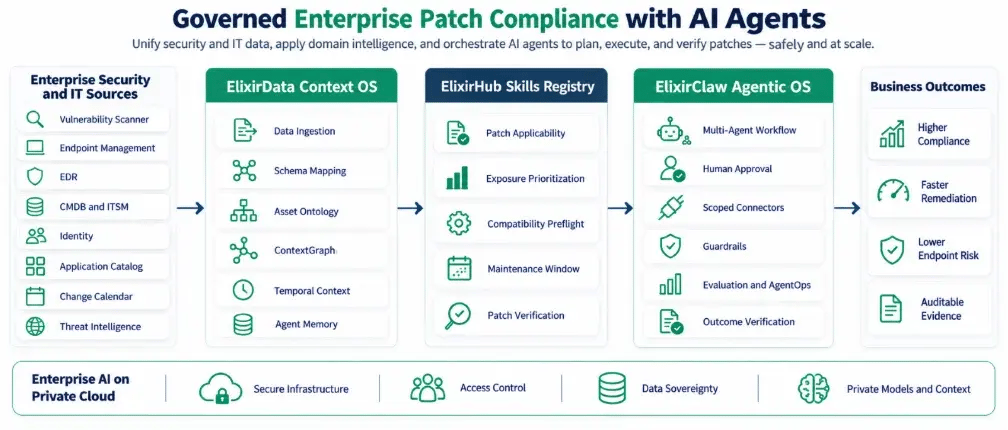
ElixirData, ElixirHub, and ElixirClaw connect security and IT sources to governed deployment, verified remediation, and auditable evidence.
The context layer does not collapse these sources into one unqualified status. It records who observed what, when the observation was valid, and which source owns the field. The skills layer contains tested patch decision logic. The agentic layer coordinates approved actions through scoped connectors. Identity, permissions, human approval, guardrails, evaluation, and audit apply across every layer.
How Does ElixirData Context OS Support Patch Decisions?
ElixirData provides the Context OS for patch operations. It ingests and synchronizes data from vulnerability scanners, endpoint management, EDR, CMDB, ITSM, identity, application catalogs, threat intelligence and change calendars. Schema and field mapping normalize device IDs, hostnames, software versions, vulnerability identifiers, business services, owners, locations, maintenance windows and remediation states.
Ontology management defines the relationships that matter: a vulnerability affects a component; a component runs on an endpoint; an endpoint supports a user or service; a service has an owner, criticality, maintenance policy, and dependencies. ContextGraph connects those records. Temporal context shows when a finding was observed, when a patch became available, when approval was granted, when installation occurred, and when verification completed.
Knowledge ingestion makes vendor guidance, change policies, application test notes, exception criteria, and rollback procedures available during the case. Graph and vector intelligence combine structured relationships with relevant technical documents. Context retrieval supplies the evidence needed for the current decision, while agent memory retains cohort progress and outstanding verification without treating an old scan as current truth.
How Does ElixirHub Provide Reusable Patch Operations Skills?
ElixirHub provides a governed registry for patching skills. Each skill declares required inputs, policy dependencies, output contract, evaluation criteria, permissions, and version. Approved skills can be reused across operating systems, business units, and endpoint teams while retaining platform-specific adapters and local change rules.
-
Patch Applicability Skill validates product, version, architecture, prerequisites, supersedence, and supported treatment.
-
Exposure and Business Impact Prioritization Skill ranks endpoints using technical risk, service context, and compensating controls.
-
Compatibility Preflight Skill checks application dependencies, device readiness, restart impact, and rollback requirements.
-
Maintenance Window and Cohort Skill creates canary and phased groups aligned with ownership, change windows, and support capacity.
-
Patch Verification and Rollback Skill validates installation and health evidence, pauses failing cohorts, and selects an approved recovery path.
Versioning makes every recommendation reproducible. The decision trace can show which skill and policy version classified an endpoint, why it entered a cohort, and which evidence supported verification. Governance controls who can author, evaluate, approve, publish, discover, and retire each skill.
How Does ElixirClaw Govern Patch Execution?
ElixirClaw provides the Agentic OS for coordinating patch workflows. A context agent assembles endpoint and service evidence. A risk agent evaluates exposure and business impact. A planning agent forms cohorts and preflight steps. A change agent routes approvals. An execution agent calls endpoint tools, and a verification agent checks technical and business outcomes. Multi-agent work can proceed in parallel, but all actions remain tied to one governed change state.
Connectors and MCP interfaces expose bounded operations such as creating a change record, launching an approved deployment, requesting a rescan, querying endpoint health, isolating a device, or opening an incident. Permissions restrict each agent by environment, endpoint class, action, and record scope. Human approval remains explicit for critical services, privileged systems, emergency changes, exception acceptance, isolation, and rollback decisions with material business impact.
Guardrails block deployment when evidence is stale, the target cohort differs from the approved cohort, required tests are missing, or the connector operation exceeds the agent's authority. Evaluations and AgentOps test applicability, prioritization, cohort selection, tool use, stop conditions, and verification. Agentic BI shows exposure age, approval delay, canary health, deployment failure, reboot backlog, exception ageing, and verification gaps.
Why Use Private Enterprise AI for Sensitive Patch Operations?
Patch operations expose sensitive details about software inventory, vulnerable components, privileged endpoints, users, network reachability, and critical business services. That context can become a useful attack map if mishandled. Enterprise AI on Private Cloud keeps models, context retrieval, agent memory, policy evaluation, and execution within the enterprise boundary.
Private-cloud or on-premises deployment allows existing identity, privileged access, encryption, key management, network segmentation, logging, and monitoring controls to govern the agent runtime. It also supports direct integration with internal endpoint, vulnerability, CMDB, and change platforms without exporting detailed asset and exposure data to an external service.
Regional context services can enforce data-residency requirements and limit which endpoint fields cross borders. Models and skills can be evaluated and promoted through the enterprise change process. Execution credentials remain in approved secret stores, and connectors expose specific operations rather than broad administrative access.
How Are Security Governance and Human Oversight Handled?
Patch automation should separate the authority to investigate, recommend, approve, deploy, verify, and accept residual risk. Read access may be broad enough to establish context, but write access should be narrow, time-bound, and tied to an approved workflow. The agent must stop when target identity, service dependency, approval, or rollback evidence is incomplete.
|
Patch condition |
Agent response |
Required control |
|
Standard endpoint and tested patch |
Run canary then phased deployment |
Approved cohort, health checks, and verification |
|
Critical or privileged system |
Prepare plan and request change approval |
Service owner, security, and operations authority |
|
Unknown dependency or conflicting state |
Hold deployment and open an exception |
Human resolution and refreshed context |
|
Endpoint offline or stale |
Keep status unresolved and schedule reassessment |
No compliant state without current evidence |
|
Verification or service health failure |
Stop expansion and invoke approved recovery |
Incident trace, rollback criteria, and owner decision |
The audit trace should preserve inputs, observation times, skill and policy versions, cohort membership, approvals, connector calls, installation results, health evidence, exceptions and the final risk state. This supports controls described in NIST SP 800-40 Revision 4 and CIS Control 7 without assuming that automation alone establishes compliance.
What Are the Business Outcomes and Patch Compliance KPIs?
Enterprises should compare AI patch compliance against a measured baseline. Useful indicators include time from detection to treatment decision, endpoints with current verification, canary failure rate, reboot backlog, exception age, deployment rework, and analyst effort per remediation campaign. Directional outcomes include the following.
|
Outcome |
How the workflow contributes |
Evidence to monitor |
|
Higher patch compliance |
Applicable endpoints move through controlled deployment and verification |
Verified compliance by asset class and evidence age |
|
Faster remediation |
Context and approvals are assembled before execution begins |
Time to decision, approval, deployment, and verification |
|
Lower endpoint risk |
Priority reflects exposure, criticality, and compensating controls |
Open exploitable findings and residual-risk decisions |
|
Fewer patch related outages |
Canary health and stop conditions limit failing rollouts |
Service incidents, paused cohorts, and recovery events |
|
Lower manual effort |
Agents reconcile evidence and target analysts to exceptions |
Investigation time, ticket handoffs, and repeat work |
|
Better audit readiness |
Each endpoint retains decision and outcome evidence |
Missing approvals, stale exceptions, and verification gaps |
The business case should use observed baselines rather than assumed savings percentages. A pilot should prove that the workflow reduces unresolved exposure while maintaining service health and producing stronger evidence before the enterprise expands autonomous actions.
What Does the Enterprise Adoption Roadmap Look Like?
Start with one operating system, one patch family, and a defined endpoint cohort that has clear ownership and reliable telemetry. Document the authoritative source for identity, software state, service relationship, change window, approval, and verification. Establish baseline performance and define which failures must stop the workflow.
-
Run the agent in recommendation mode and compare applicability, priority, and cohort decisions with experienced security and endpoint teams.
-
Evaluate historical successful and failed deployments, including false positives, reboot failures, application conflicts, and stale scans.
-
Enable evidence collection, change preparation, and canary planning before granting deployment permissions.
-
Use low-risk endpoint cohorts first, with explicit stop conditions and a tested recovery path.
-
Require independent verification before closing findings or promoting endpoints to compliant status.
-
Scale through approved skills, connectors, policy extensions, service mappings, and shared AgentOps evaluations.
A successful pilot leaves the enterprise with a patch ontology, decision boundaries, evaluation cases, cohort rules, connector scopes, and an auditable verification model. Those foundations can extend to configuration drift, software remediation, certificate renewal, endpoint isolation, and other governed risk-reduction workflows.
Conclusion
Enterprise patch compliance is a decision and verification problem as much as a software-distribution problem. The organization must know which endpoint is affected, how urgent the exposure is, whether deployment is safe, who has authority, and whether the action removed risk without damaging the service.
AgenticAssetOps supports this closed loop through ElixirData for trusted endpoint and vulnerability context, ElixirHub for governed patching skills and ElixirClaw for bounded execution with human oversight. Private enterprise AI keeps sensitive asset, exposure and service data inside the enterprise boundary.
The target outcome is measurable: more endpoints reach a verified compliant state sooner, failed rollouts stop before wider impact, and every residual-risk decision remains attributable.
Take the next step
Download the Executive Blueprint, or talk to our team about governed AI patch compliance for your endpoints.
ElixirData: Frequently Asked Questions
-
What is AI patch compliance?
AI patch compliance uses agents to connect vulnerability findings with endpoint identity, business criticality, exposure, deployment constraints and verification evidence. The objective is to move applicable endpoints to a verified compliant state, not simply count initiated patch jobs. -
How do AI agents improve enterprise patch compliance?
AI agents reconcile vulnerability, CMDB, EDR, endpoint and change data; prioritize risk; build deployment cohorts; route approvals; and verify outcomes. Human approval remains necessary for critical, privileged, uncertain or high-impact changes. -
Can AI agents deploy patches automatically?
Yes, but only within explicit policies, permissions and approval boundaries. Low-risk cohorts can move through approved canary and phased deployment workflows, while critical systems, conflicting evidence, stale telemetry or missing rollback plans should stop execution and require review. -
How should enterprises prioritize security patches?
Prioritization should combine severity with known exploitation, internet exposure, asset criticality, privilege level, service dependencies, compensating controls and patch availability. A severity score alone is not enough to determine operational priority. -
How do AI agents verify successful patch remediation?
Agents confirm installation, reboot completion, endpoint check-in, service health and updated vulnerability status. A finding should remain unresolved until current evidence shows that the exposure has been removed and the endpoint is operating normally.