What Is ITAM CMDB and MDM Reconciliation
ITAM CMDB and MDM reconciliation is the controlled process of linking records that represent the same asset, selecting authoritative values by field, identifying missing or duplicate records, and verifying every correction. AI agents improve this process by assembling identity, ownership, lifecycle, configuration, and live device evidence before recommending a change.
The records rarely align perfectly. A laptop may be active in MDM, assigned to a former employee in ITAM, and marked retired in the CMDB. A server may appear twice because discovery created a new configuration item after a hostname change. A device may exist in procurement and depreciation records but no longer report through MDM, network discovery, or endpoint security. Each system can be internally correct while the enterprise view remains wrong.
Effective ITAM CMDB MDM reconciliation requires more than copying fields into a warehouse. The organization must determine whether records describe the same physical or virtual asset, which source owns each attribute, how observation time changes the interpretation, and whether a correction could damage downstream service or financial relationships.
AgenticAssetOps supports this operating model through ElixirData for trusted identity and temporal context, ElixirHub for reusable reconciliation skills, and ElixirClaw for governed writeback and verification. The objective is a reliable asset identity and an accountable process for resolving exceptions across systems.
Common IT Asset Data Reconciliation Challenges
Consider a global enterprise with corporate laptops, mobile devices, engineering workstations, warehouse tablets, branch equipment, on-premises servers, and cloud workloads. Procurement feeds the ITAM platform when an asset is purchased or leased. Discovery and service-management processes create configuration items in the CMDB. MDM and endpoint tools enroll devices, apply policy, and report last-seen telemetry. HR and identity systems record employee status and organizational ownership.
During a quarterly asset review, finance reports devices that remain active on the asset register but have no current custodian. Security finds managed devices that do not exist in ITAM. Operations finds duplicate configuration items linked to different services. Several serial numbers match, but the model or manufacturer differs. Some records are valid exceptions: a motherboard replacement may change a hardware identifier, a virtual machine may never belong in the physical asset ledger, and a leased device may be managed without being capitalized.
The team exports each system to a spreadsheet and applies joins on serial number, hostname, user email, and device ID. Exact matches are easy. The difficult cases consume most of the effort because identifiers are missing, reused, reformatted, or observed at different times. A forced match can transfer ownership to the wrong employee, merge two legitimate devices, close an asset that still holds data, or disconnect a configuration item from a critical service.
These inconsistencies affect more than reporting. They delay offboarding and asset recovery, weaken security coverage, distort depreciation and lease obligations, increase software and support costs, and make audit evidence harder to defend. A current inventory also supports the asset-management outcomes described in CIS Control 1. The enterprise therefore needs a governed reconciliation process rather than another export and cleanup cycle.
Why Traditional ITAM Reconciliation Falls Short
Scheduled extracts and deterministic matching rules are useful, but they assume stable identifiers and a shared record model. Enterprise asset data does not meet those assumptions consistently. The systems differ in purpose, scope, update cadence, and definition of status.
-
Serial numbers may be missing, entered with different formatting, duplicated by a vendor, or changed after repair.
-
Hostnames and user assignments change more often than commercial ownership or financial lifecycle.
-
MDM may represent the current management state, while ITAM remains authoritative for acquisition, warranty, lease, and disposal evidence.
-
The CMDB may contain virtual, logical, or service configuration items that have no one-to-one ITAM record.
-
Discovery can create duplicate configuration items when identifiers change or data sources use different identification rules.
-
An old last-seen timestamp may indicate a lost device, a remote employee, a device under repair, or an integration failure.
-
Bulk correction scripts can propagate a bad match across systems faster than a manual process can detect it.
The missing capability is context-aware resolution. The reconciliation process needs field-level source authority, temporal evidence, relationship context, confidence scoring, and an approval boundary that becomes stricter as ambiguity or business impact increases.
How AI Agents Reconcile ITAM CMDB and MDM Data
The operating loop is Detect, Understand Context, Decide, Approve, Act, Verify, and Learn. Detection identifies new records and deviations such as an MDM device without an ITAM asset, an ITAM asset with no recent operational signal, duplicate CMDB items, conflicting owners, or a lifecycle state that disagrees with current activity.
Understanding context assembles stable identifiers, softer matching signals, source provenance, timestamps, user status, device history, location, service relationships, procurement evidence, and management state. The decision step classifies the case and estimates match confidence. It may recommend linking records, merging a duplicate, creating a missing record, correcting a field, opening a recovery investigation, marking a justified exception, or requesting more evidence.
Approval applies the organization's data stewardship and change policy. Action updates only the authorized system and fields. Verification re-queries the sources, checks that relationships remain intact, and confirms that the exception is closed. Learning uses reviewed outcomes to improve match rules and evaluation cases without turning one analyst decision into an unrestricted global rule.
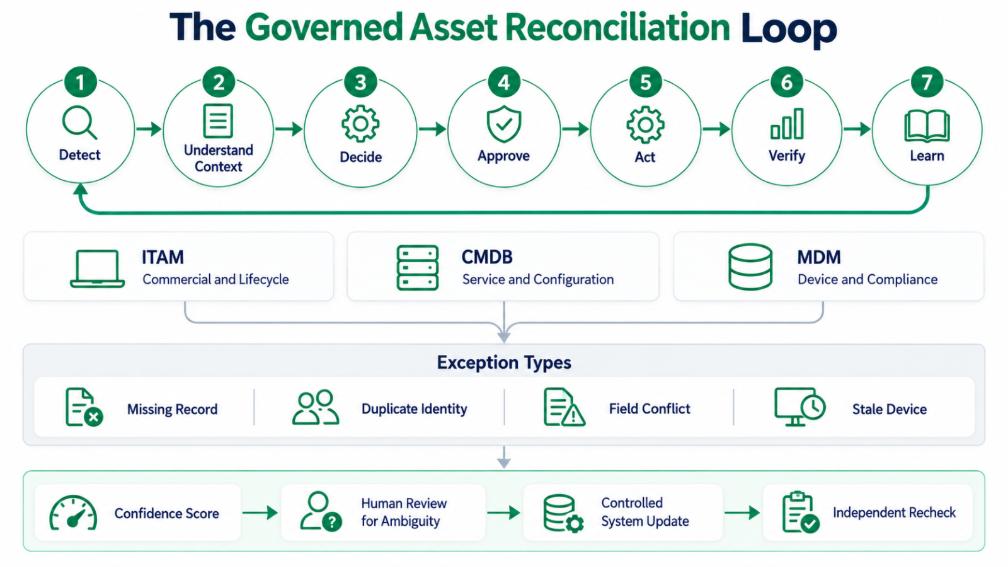
The reconciliation loop combines confidence scoring, human review for ambiguity, controlled writeback, and an independent recheck.
AI Asset Data Reconciliation Workflow
The workflow ingests incremental changes and periodic snapshots from ITAM, CMDB, MDM, identity, HR, procurement, network discovery, endpoint security, and directory services. For Microsoft-managed endpoints, the Microsoft Graph managedDevice resource can provide current management and device evidence. The context layer retains the source record and observation time instead of flattening them into an unexplained master row.
-
Normalize serial numbers, device IDs, hostnames, MAC addresses, IMEI values, directory IDs, employee identifiers, locations, models, and lifecycle states.
-
Generate identity candidates using strong identifiers first, then add model, user, location, enrollment, purchase, repair, and service context when strong identifiers are incomplete.
-
Build an evidence graph that shows which records may represent one asset and which relationships would be affected by a merge or correction.
-
Apply field-level source authority so financial ownership, operational state, user association, service relationship, and compliance state can come from different trusted sources.
-
Calculate confidence and classify the exception as missing, duplicate, mismatched, stale, unmanaged, unassigned, or legitimately out of scope.
-
Route ambiguous or high-impact cases to the correct steward with the evidence, proposed change, alternatives, and affected downstream relationships.
-
Execute the approved update through scoped connectors, then re-read all relevant sources and confirm that the exception did not reappear in the next synchronization cycle.
For example, an exact serial and manufacturer match between MDM and ITAM may justify linking records automatically when no conflicting asset exists. The same serial with different models and overlapping active dates should remain unresolved. A retired CMDB record that is still active in MDM should trigger investigation rather than an automatic lifecycle change because the CMDB status may be stale or the device may have been redeployed.
Enterprise Architecture for Asset Reconciliation
A dependable architecture separates source systems, decision context, operational skills, and execution. ITAM remains responsible for commercial and lifecycle evidence, the CMDB retains configuration and service relationships, and MDM supplies current management state. Existing reconciliation controls, including the ServiceNow Identification and Reconciliation Engine, can remain in place while agents prepare evidence, route decisions, and invoke only approved corrections.
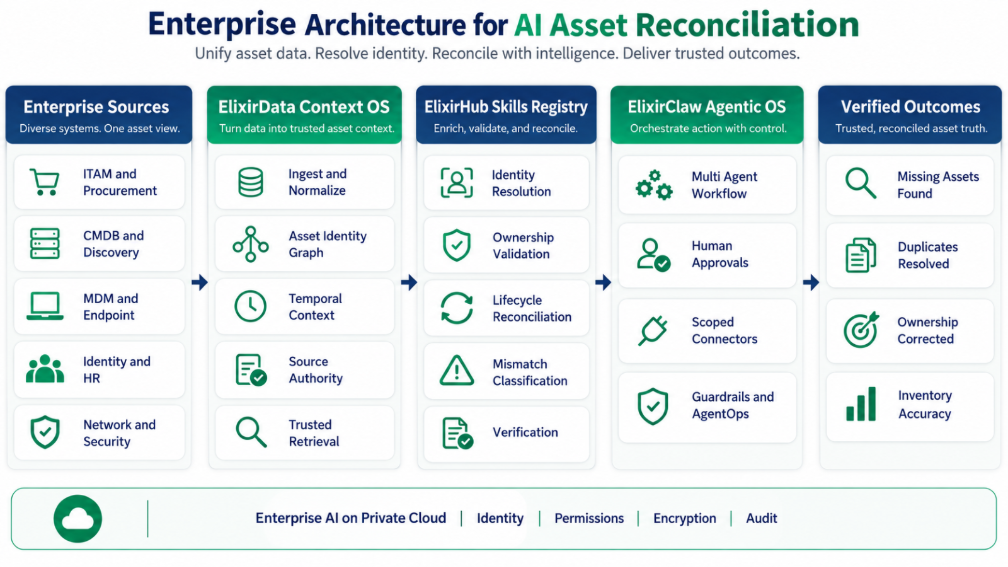
ElixirData, ElixirHub, and ElixirClaw connect enterprise sources to explainable identity resolution, governed correction, and verified inventory outcomes.
The contextual layer does not declare one source universally correct. It maintains a source-authority matrix by entity and field. It also preserves lineage: the enterprise can trace a resolved asset identity back to each contributing record, observation time, matching rule, skill version, approval, and writeback operation.
How ElixirData Creates Trusted Asset Context
ElixirData provides the Context OS for asset reconciliation. It synchronizes asset registers, purchase orders, lease records, configuration items, discovery evidence, managed devices, user directories, HR status, endpoint security, network observations, support contracts, and disposal records into a traceable context model.
Ontology management defines the relationships that matter. A physical asset can have procurement records, device identities, management enrollments, configuration items, users, locations, support contracts, and service dependencies. It can be repaired, reassigned, stored, lost, retired, or disposed. ContextGraph connects these facts and allows an agent to examine the surrounding relationships before it proposes a merge or correction.
Temporal context is essential. A user assignment may be correct for one period and wrong for another. A device can disappear during repair and return under a new identifier. Knowledge ingestion adds naming standards, lifecycle policies, ownership rules, exception definitions, audit requirements, and operational runbooks. Graph and vector intelligence retrieve both the linked records and the relevant policy. Context retrieval and agent memory maintain the reconciliation case until verification is complete.
Reusable Asset Reconciliation Skills with ElixirHub
ElixirHub stores reconciliation logic as governed skills with declared inputs, output contracts, authority rules, evaluation cases, permissions, and versions. This allows the enterprise to reuse proven logic across business units while retaining local lifecycle and approval policies.
-
Asset Identity Resolution Skill links records using deterministic identifiers, contextual evidence, conflict detection, and calibrated confidence.
-
Source Authority and Field Selection Skill determines which source can supply each attribute under the current asset type and lifecycle state.
-
Ownership and Custody Validation Skill compares ITAM assignment, MDM user, identity status, location, and recent activity.
-
Lifecycle Reconciliation Skill evaluates received, deployed, stored, repair, lost, retired, returned, and disposed states against current evidence.
-
Missing and Mismatched Asset Verification Skill confirms the exception, selects the permitted response, and tests whether the correction persists.
Skill versioning makes decisions reproducible. A steward can see which rules linked two records, why another pair remained separate, and what evidence caused a mismatch to reopen. Publishing, discovery, evaluation, and retirement controls prevent experimental matching logic from changing production inventories.
Governed Asset Reconciliation with ElixirClaw
ElixirClaw provides the Agentic OS for multi-agent reconciliation. Ingestion agents monitor source changes, identity agents form match candidates, policy agents apply source authority and lifecycle rules, exception agents classify mismatches, and verification agents confirm that approved corrections persist across synchronization cycles.
Connectors and MCP interfaces expose bounded operations such as creating an ITAM record, updating an approved field, linking a configuration item, merging a confirmed duplicate, requesting device synchronization, opening an investigation, assigning a steward, or recording an exception. Sensitive actions such as remote lock, wipe, disposal confirmation, financial write-off, or bulk merge remain outside the agent's authority unless a specific policy and human approval permit them.
Guardrails block a write when identity confidence is below policy, source evidence is stale, the target field is owned by another system, the proposed merge would break active service relationships, or the action exceeds the approved scope. Evaluations and AgentOps test match precision, false merges, false missing-asset classifications, authority selection, tool use, and verification. Agentic BI shows unresolved exceptions, confidence distribution, stale sources, ownership gaps, duplicate recurrence, and correction ageing.
Private AI for Sensitive Asset Data
Asset reconciliation combines security-sensitive device identifiers with employee assignments, locations, network observations, service relationships, commercial values, and lifecycle evidence. The joined context is more sensitive than any single export because it can reveal where devices are, who uses them, which services they support, and where management coverage is missing.
Enterprise AI on Private Cloud keeps models, ContextGraph retrieval, agent memory, policies, and execution inside the enterprise boundary. On-premises or private-cloud deployment supports data-sovereignty and regulatory requirements while allowing direct integration with internal ITAM, CMDB, MDM, identity, HR, procurement, and security systems. Regional deployments can restrict which employee and location attributes cross borders.
Existing identity, privileged access, encryption, key management, segmentation, retention, and monitoring controls can govern the agent runtime. Credentials remain in approved secret stores, and connectors expose narrow operations instead of broad administrative access. Models and skills pass enterprise evaluation and change control before they can influence production records.
Asset Data Governance and Human Oversight
Reconciliation governance should define who owns each field, which evidence is sufficient, and which corrections can occur automatically. Read access may cover several systems, but write access should be restricted by source, field, asset type, action, and business impact. Every exception requires a decision state, owner, evidence age, and resolution target.
|
Reconciliation condition |
Agent response |
Required control |
|
Exact stable identifier with consistent supporting data |
Link records and propose approved field updates |
Confidence threshold, no competing active identity, full trace |
|
Duplicate identifier with conflicting model or active dates |
Keep records separate and request review |
Asset steward validates repair, reuse, or data error |
|
Active MDM device assigned to a departed user |
Open custody and recovery investigation |
HR status confirmation and authorized endpoint action |
|
ITAM asset with no recent operational evidence |
Classify as unaccounted and seek attestation |
Age threshold, custodian review, and loss policy |
|
CMDB only virtual or logical item |
Apply documented scope exception |
CI class and service owner validation |
The audit trace should preserve source records, timestamps, normalized values, candidate matches, confidence, skill and policy versions, rejected alternatives, human decisions, connector calls, and verification results. This supports enterprise inventory controls such as NIST SP 800-53 Revision 5 and CIS Control 1 without assuming that an automated match is correct merely because it completed successfully.
Business Outcomes of ITAM Data Reconciliation
The enterprise should compare the agentic workflow with a measured baseline. Useful indicators include unmatched-record age, duplicate recurrence, records with current owners, assets without operational evidence, unmanaged devices, correction cycle time, false merge rate, source freshness, and analyst effort per exception. Expected benefits should remain directional until observed in a controlled pilot.
|
Outcome |
How the workflow contributes |
Evidence to monitor |
|
Fewer missing assets |
Agents compare commercial records with current operational evidence |
Unaccounted assets, attestation status, and recovered custody |
|
Higher inventory accuracy |
Field authority and identity resolution reduce conflicting records |
Verified matches, duplicate recurrence, and reopened exceptions |
|
Lower manual effort |
Agents assemble evidence and route people to ambiguous cases |
Research time, handoffs, and exceptions resolved per cycle |
|
Better security coverage |
Unmanaged and stale devices become explicit remediation cases |
Devices without current management or security telemetry |
|
Stronger financial control |
Lifecycle evidence supports lease, depreciation, return, and disposal review |
Assets with unsupported financial or disposal status |
|
Better audit readiness |
Every correction retains its decision and source lineage |
Missing approvals, stale evidence, and incomplete traces |
The business case should focus on verified inventory improvement and shorter exception cycles rather than assumed savings percentages. A trustworthy reconciliation process also prevents the cost and risk of incorrect merges, premature disposal, and unsupported write-offs.
How to Adopt AI Asset Reconciliation
Start with one asset class, such as corporate laptops, in a business unit with reliable ITAM, CMDB, and MDM feeds. Define the identity keys, source-authority matrix, lifecycle states, exception types, confidence thresholds, and approval roles. Establish a baseline from current unmatched, duplicate, stale, and ownership-conflict queues.
-
Run the agents in recommendation mode and compare proposed matches and corrections with experienced asset and configuration stewards.
-
Evaluate historical cases that include repairs, reimages, reassignments, hostname changes, leases, returns, losses, and disposals.
-
Measure false merges and false missing-asset classifications separately from overall match coverage.
-
Enable case creation and evidence gathering before granting record-write permissions.
-
Introduce bounded writeback for high-confidence, reversible corrections and retain human approval for merges and high-impact lifecycle actions.
-
Scale by adding asset classes, business units, source systems, approved skills, and shared AgentOps evaluations.
A successful pilot leaves the enterprise with a reusable asset ontology, field-authority matrix, tested identity rules, stewardship workflow, connector scopes, evaluation suite, and verified definition of inventory accuracy. Those assets matter more than a one-time cleanup because they keep reconciliation operating as data and devices change.
Building Trusted Enterprise Asset Records
ITAM, CMDB, and MDM disagree because they observe different parts of the asset lifecycle. The enterprise needs those distinct perspectives, but it also needs a controlled way to determine when records represent one asset, which value to trust, and what action closes the exception.
AgenticAssetOps supports this operating model through ElixirData for identity and temporal context, ElixirHub for governed reconciliation skills, and ElixirClaw for approved writeback and verification. Private enterprise AI keeps sensitive device, employee, location, service, and financial context within the enterprise boundary.
The target outcome is clear: missing and unmanaged assets become visible, mismatched records move through an accountable resolution process, and every corrected asset identity remains explainable from source evidence to verified result.
Frequently Asked Questions
-
What is ITAM CMDB and MDM reconciliation?
ITAM CMDB and MDM reconciliation links records that represent the same enterprise asset, identifies missing or duplicate records, resolves conflicting attributes, and verifies corrections. It preserves each system's purpose instead of forcing every field into one universal master source. -
Why do ITAM CMDB and MDM records disagree ?
The systems observe different parts of the asset lifecycle and update at different times. ITAM may own financial and custody data, the CMDB may own configuration and service relationships, and MDM may provide the latest management state, user association, and device activity. -
How do AI agents identify the same asset across systems?
AI agents start with stable identifiers such as serial numbers, device IDs, IMEI values, and hardware addresses. When those identifiers are incomplete, they evaluate supporting evidence such as model, user, location, enrollment, purchase, repair, timestamps, and service relationships before assigning a confidence score. -
Can AI agents correct asset records automatically?
Yes, but only within defined confidence thresholds, field ownership rules, permissions, and approval policies. Ambiguous identities, destructive merges, sensitive lifecycle changes, stale evidence, or corrections that affect active service relationships should require human review. -
How is asset reconciliation accuracy verified?
The workflow re-reads the affected systems after an approved correction, checks that relationships remain intact, and confirms that the exception does not return during the next synchronization cycle. Teams should measure false merges and false missing-asset classifications separately from overall match coverage.