
Fleet Intelligence That Moves Governed
Transportation operators manage complex networks of vehicles, drivers, routes, and regulations. ElixirData's Context Graph maps fleet assets, driver qualifications, route constraints, and compliance requirements — so AI agents optimize operations while structurally enforcing safety and regulatory boundaries.

The Challenge
Fleet AI Optimizes Routes But Ignores Regulations and Safety
Route optimization algorithms minimize distance and time. They don't inherently understand driver hours-of-service limits, hazmat routing restrictions, vehicle maintenance requirements, or customer delivery windows
Blind Optimization
AI routing systems optimize for distance and speed but ignore critical regulatory and safety compliance constraints
Hazmat restrictions unseen
Tunnel access violations
Route-level safety risks
Regulatory context missing
Post-incident corrections

Outcome: Optimization without compliance awareness creates preventable operational risk
Hours Violations
Driver hours-of-service violations are discovered during audits instead of being prevented before load assignment
ELD audit discovery
Post-load violation flags
Fatigue risk exposure
Dispatch blind spots
Manual compliance reviews
Outcome: Structural awareness of driver hours prevents violations before dispatch
Maintenance Cascades
Vehicles flagged for maintenance are removed from service without visibility into fleet-wide operational consequences
Load reassignment chaos
Driver schedule disruption
SLA breach risk
Fleet-wide ripple effects
Manual coordination overload
Outcome: Fleet-wide context prevents cascading disruptions from single maintenance events

How It Works
How AI Agents and Context Graph Transform Transportation
ElixirData compiles fleet assets, driver qualifications, route networks, regulatory requirements, and customer commitments into a Context Graph that governs every operational decision
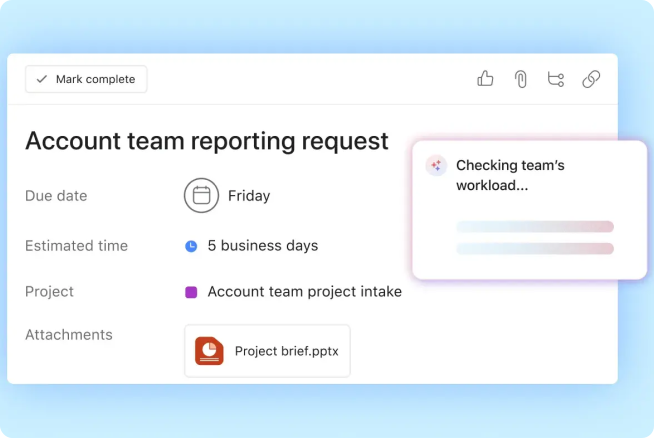
Governed Fleet Agents
AI agents execute routing, dispatch, and maintenance decisions within embedded regulatory, safety, and operational guardrails
HOS compliance enforcement
Hazmat routing governance
Load-driver matching rules
Maintenance window governance

Structural guardrails prevent violations before they occur
Governed Logistics Agents
AI agents optimize operations within trade compliance boundaries, ensuring route, customs, and warehouse actions follow structural authority and regulations
Trade compliance enforcement
Customs declaration governance
Route optimization governance
Inventory authority limits
Structural governance ensures compliant and efficient logistics execution
Fleet Decision Traces
Every dispatch, assignment, route, and maintenance action generates verifiable decision trails for compliance and transparency
Dispatch decision evidence
Route compliance proof
Driver assignment records
DOT audit packages
Complete traceability for regulators, customers, and safety teams
Capabilities
What ElixirData Delivers for Transportation
ElixirData embeds real-time fleet context into every AI-driven decision. Agents operate within regulatory and operational guardrails, ensuring safety, compliance, efficiency, and accountability at scale
Context-Aware Route Optimization
AI routing uses the full Context Graph to evaluate distance, fuel, tolls, driver hours, vehicle restrictions, hazmat rules, customer windows, and weather
Optimization shifts from shortest-path logic to governed decision-making, ensuring routes balance efficiency, compliance, safety, and service commitments
Governed routing fully replaces isolated optimization logic
Structural HOS Compliance
Driver hours are continuously tracked within the Context Graph, embedding eligibility directly into dispatch workflows before any load assignment occurs
AI agents cannot create hours-of-service violations because real-time policy gates enforce assignments, not after-the-fact ELD audits
Compliance is enforced during load assignment, not afterward in audits
Predictive Fleet Maintenance
Maintenance predictions use operational context to identify critical vehicles, available alternatives, and impacts on driver schedules
Service events are intelligently timed to minimize disruption, protect SLAs, and prevent cascading reassignment chaos across the fleet network
Maintenance decisions aligned with fleet-wide commitments
Real-Time Fleet Visibility
The Context Graph unifies vehicle telemetry, driver status, load progress, ETA accuracy, compliance, and maintenance into a single operational view
Leaders gain clear visibility into risks and bottlenecks, enabling proactive interventions instead of reactive troubleshooting
Unified visibility across vehicles, drivers, and commitments
Fuel & Emissions Optimization
Fuel optimization incorporates terrain, load weight, traffic patterns, and driver behavior data, ensuring efficiency decisions reflect real-world operating conditions
Emissions compliance constraints are embedded directly into routing and driving policies, balancing sustainability goals with operational performance requirements
Efficiency governed by environmental compliance standards
DOT Audit Readiness
Every dispatch, route, assignment, and maintenance event produces structured Decision Traces stored continuously within the operational system
Audit packages compile instantly with driver qualification files, inspection records, HOS evidence, and compliance documentation ready for regulators or customers
Continuous audit readiness with no manual preparation required
Use Cases
Transportation Scenarios
ElixirData enables context-driven fleet operations. AI agents use the Context Graph to make compliant, efficient, and minimally disruptive decisions, keeping every operation governed and traceable





Integrations
Connects to Your Transportation Stack
ElixirData integrates seamlessly with your existing transportation stack, connecting TMS, telematics, ELDs, and mapping systems to enable unified, context-driven fleet operations
TMS
Telematics
ELD/Compliance
Route & Map
FAQ
Frequently Asked Questions
The Context Graph tracks drivers’ hours in real-time. Dispatch agents block assignments that would violate HOS limits, preventing violations before ELD review
Yes. The Context Graph maps route restrictions (tunnel limitations, bridge weight limits, residential area prohibitions, state-specific hazmat rules) and vehicle certifications (hazmat endorsements, placarding requirements)
Pure predictive maintenance predicts failures, while the Context Graph adds operational context, guiding AI to schedule maintenance without disrupting loads or SLAs
Yes. ElixirData integrates with Oracle TMS, SAP TM, Blue Yonder, MercuryGate, and other TMS platforms. Your TMS remains the system of record for shipments and loads
Ready to Transform Transportation?
See how ElixirData's Context OS and AI agents deploy in your transportation environment in 4 weeks