SAP ERP modernization with agentic AI keeps SAP as the transactional core and adds an intelligent context layer (ElixirData), reusable skills (ElixirHub) and governed agent execution (ElixirClaw), so agents can investigate exceptions across SAP and non-SAP systems and take approved, verified actions.
Key Takeaways
- SAP ERP modernization with Agentic AI keeps SAP as the transactional core while adding governed reasoning and action across connected enterprise systems.
- An intelligent context layer connects SAP and non-SAP records, policies, events, and relationships so Agentic AI can interpret exceptions with business meaning.
- ContextGraph, reusable skills, and governed agent capabilities let enterprises extend SAP Joule without embedding every rule or integration in the user interface.
- Agentic AI on Private Cloud keeps sensitive context, models, permissions, approvals, and execution evidence within enterprise-controlled infrastructure.
- Keep sensitive enterprise data and retrieved context inside approved infrastructure boundaries.
- Use private or approved LLMs, embedding models, vision models, and specialized model capabilities according to workload requirements.
- Apply authentication, authorization, agent permissions, decision boundaries, and human approval before business actions are executed.
- Observe model calls, context retrieval, agent execution, tool usage, failures, and outcomes as one governed operating environment.
- Preserve flexibility to modernize SAP incrementally without giving up enterprise security and sovereignty requirements.
See how Context OS governs AI agent decisions
See how Context OS connects SAP and non-SAP context so agents act on governed business meaning.
SAP ERP Modernization Is Entering a New Phase
For years, SAP modernization programs have focused on simplifying the core, moving workloads to S/4HANA, standardizing processes, reducing custom code, and improving user experience. Those priorities remain important. But a new architectural challenge is emerging as enterprises move from transactional automation toward agentic AI.
The challenge is not simply how to put an Agentic AI assistant on top of SAP. It is how to give Agentic AI enough enterprise context to understand what a transaction means, why an exception occurred, what systems are related, which policies apply, and what action is permitted. In most large organizations, that context does not live in one application.
A purchase order may be managed in SAP, while the supplier contract is stored in a document platform, the latest communication is in email, the delivery signal comes from a logistics application, a policy sits in a knowledge repository, and risk information comes from an external service. SAP remains essential, but the business context surrounding an SAP transaction is broader than SAP itself.
The next stage of ERP modernization is not “Agentic AI inside SAP” alone. It is an intelligent context and control layer across SAP and the wider enterprise.
Keep SAP as the Transactional Core
The strongest architecture does not try to replace SAP. It keeps SAP as the system of record and transaction engine for the processes it already owns, while adding an enterprise layer that can connect context, invoke Agentic AI capabilities, and govern actions across SAP and non-SAP systems.
The supplied integration architecture positions Joule as the SAP-native front door and Elixirdata as an extension layer around it. A user can remain in the SAP experience, while enterprise context is retrieved from SAP and other approved systems, agentic logic is executed in ElixirClaw, and grounded results return to the user.
This separation protects existing SAP investments and avoids creating another disconnected interface. It also allows organizations to modernize incrementally. Deterministic ERP processes can remain deterministic. Agentic AI is introduced where business exceptions, cross-system reasoning, natural-language access, or dynamic recommendations create measurable value.
Build the Intelligent Context Layer with ElixirData
The first requirement for reliable Agentic AI is context. ElixirData provides the Context OS that ingests, maps, normalizes, and connects enterprise information into a shared ContextGraph. The SAP integration material identifies S/4HANA, SuccessFactors, Ariba, SAP PM, and SAP Workflow as important data and event sources, with OData, CDS Views, and BTP Integration Suite as possible integration paths.
S/4HANA can contribute purchase orders, finance records, and material master data. SuccessFactors contributes workforce and organizational context. Ariba contributes procurement, supplier, and contract information. SAP PM contributes asset and maintenance records. SAP Workflow contributes event history, approvals, and status. ElixirData can then connect this information with non-SAP applications, documents, databases, APIs, messaging systems, and other enterprise sources.
The purpose is not to make another data lake. It is to create a decision-ready representation of the enterprise. ElixirData adds ontology management, temporal context, knowledge ingestion, graph and vector intelligence, data quality, and lineage so that agents can retrieve not only records but the meaning and relationships around those records.
From a record to an enterprise context
Consider the question: “Why is this purchase order delayed?” A transactional lookup may reveal that the order is blocked or overdue. A context-aware investigation may need to connect the purchase order to the supplier, contract, approval path, production dependency, logistics status, previous exceptions, supplier communications, and applicable business policy.
That is where ContextGraph becomes useful. It represents people, processes, data, events, policies, documents, and relationships as a connected operational model. Temporal context adds another dimension by preserving what was true at a specific point in time, which is critical for audit, exception analysis, and reasoning over changing business states.
Extend Joule with Enterprise Context and Agentic Capabilities
The integration material defines a clear interaction pattern for Joule. A business user asks a question in Joule. A Joule Skill or agent routes the request through an SAP BTP Destination. Authentication and routing take place in BTP. ElixirClaw then receives the request as an agent or MCP-enabled capability, retrieves SAP and non-SAP context through ElixirData, and returns a grounded response to Joule.
This matters because users do not have to abandon their SAP-native experience. Joule remains the SAP work assistant, while Elixir extends the reachable context, capabilities, and controls beyond the SAP boundary. The same principle can be applied to procurement, finance, maintenance, HR, and other SAP-adjacent workflows.
The integration pattern also reduces the temptation to embed every enterprise rule and data connection inside the front-end assistant. Context, specialized model capabilities, workflows, and governance remain independent layers that can evolve without redesigning the user experience each time.
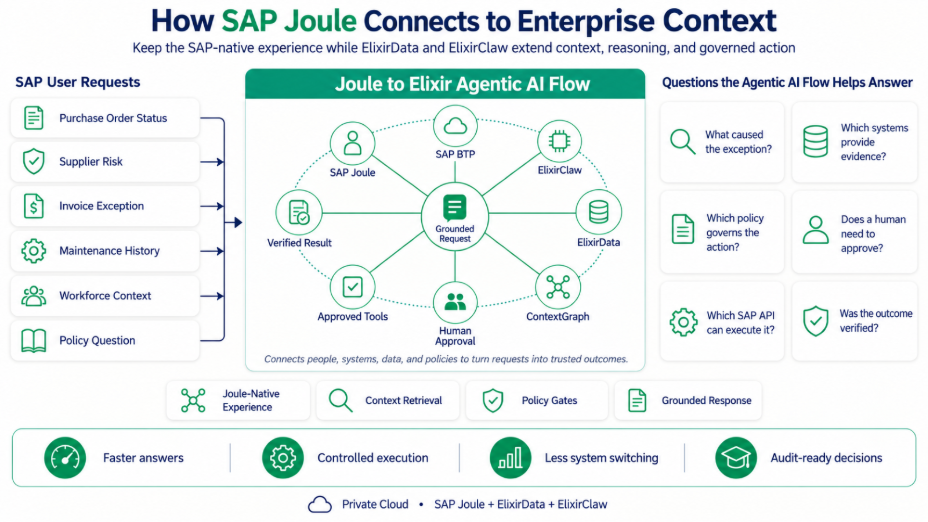
Figure 2: SAP Joule remains the SAP-native experience while ElixirData and ElixirClaw extend enterprise context, reasoning, policy checks, and verified outcomes.
Move from Answers to Governed Business Action
The real value of agentic ERP modernization begins when the system can do more than answer questions. It should be able to investigate an exception, recommend an action, and, when allowed, execute that action through approved interfaces.
ElixirClaw owns this agentic operating layer. It manages governed agents and private assistants, the Agent Gateway, authentication and authorization, agent permissions, MCP Gateway, connectors, tool execution, decision boundaries, human-in-the-loop controls, guardrails, LLM gateway functions, prompt management, AgentOps, evaluation, and secure execution.
For SAP, a governed action flow can follow a simple pattern: the agent proposes an action, the action is evaluated against a decision boundary, a human approval step is inserted when required, the approved SAP API action is executed, and the resulting state is verified. Example actions from the integration material include creating a purchase requisition, updating a vendor record, raising a service ticket, triggering an approval workflow, generating an SAP report, and validating an invoice mismatch.
Understand → Reason → Recommend → Check Policy → Approve When Required → Execute → Verify
Decision boundaries are essential
An agent that can explain a payment exception should not automatically have permission to release a payment. An agent that can identify supplier risk should not automatically be able to change vendor master data. The runtime needs to evaluate the proposed action, the requester, the data accessed, the tool being invoked, and the business risk before anything changes in the source system.
This makes governance part of the architecture rather than a separate policy document. Low-risk actions can be automated. Higher-risk actions can be escalated for approval. Unsafe or prohibited actions can be blocked. Every step can be observed and audited.
The NIST AI Risk Management Framework offers an external reference for identifying, measuring, managing, and governing risk across these Agentic AI workflows.
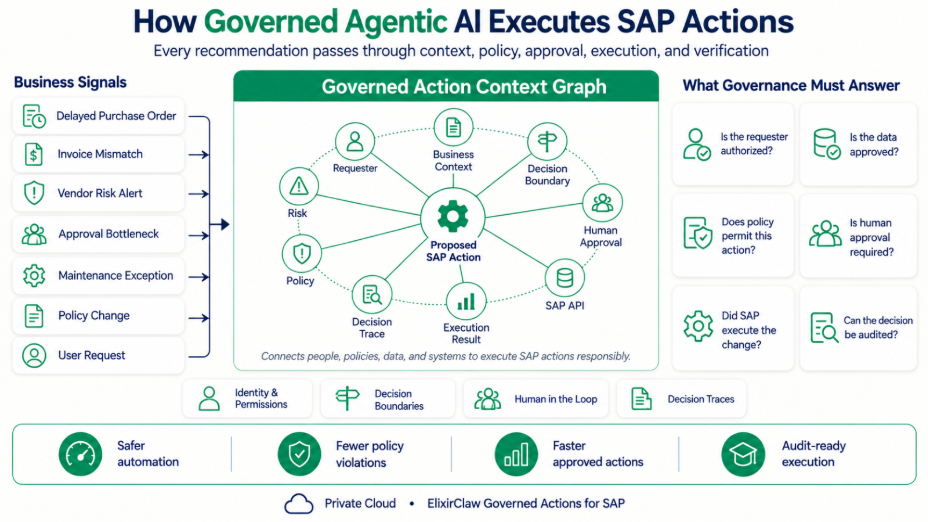
Figure 3: Governed Agentic AI evaluates identity, context, policy, and approval requirements before executing and verifying an SAP action.
Preserve SAP Build Process Automation Investments
ERP modernization does not require replacing deterministic workflow automation with agents. The supplied architecture shows how SAP Build Process Automation can call Elixir capabilities through Action Projects, receive an agent result, and continue the SAP-native workflow. This is particularly useful for exception handling, approval automation, and agent-assisted business processes.
The design preserves the existing SAP user experience and process investments while adding intelligence where it is needed. A traditional workflow can continue to govern predictable steps, while an agent handles ambiguous exceptions, gathers context, or recommends the next action. Humans can remain in the approval loop where business policy requires them.
Get the Executive Blueprint for governed enterprise AI
A practical guide for CIOs, CAIOs and risk leaders on moving AI agents from pilot to production without losing control of context or decisions.
Use ElixirHub to Make Enterprise Skills Reusable
As the number of use cases grows, enterprises need to avoid rebuilding the same logic for every agent and application. ElixirHub serves as the reusable Skill Registry. It owns skill publishing, discovery, versioning, installation, metadata, reuse, composition, and lifecycle management.
For SAP-related workloads, reusable skills might include invoice validation, vendor risk checking, purchase-order matching, policy retrieval, contract verification, or maintenance history analysis. The skill itself is reusable; runtime connectors, permissions, workflows, and approvals remain in ElixirClaw, while data mapping and enterprise context remain in ElixirData.
This separation is important because large enterprises may ultimately operate many agents across many business functions. A governed skill registry allows validated capabilities to be reused consistently instead of being recreated as isolated logic in each new agent project.
Add Agentic AI for Context-Aware ERP Intelligence
Not every use case needs an agent to take action. Business leaders and operational teams still need analytics. Agentic BI provides natural-language analytics, context-aware analytics, dashboards, and operational insights using enterprise context from ElixirData and agent outputs from ElixirClaw.
A procurement user could ask which suppliers are creating the largest delivery exposure. A finance user could ask which invoice exceptions are most likely to delay month-end processing. A maintenance leader could ask which open requisitions are creating risk for critical assets. The analytics layer does not own prediction or recommendation models; those remain specialized model capabilities exposed to ElixirClaw through MCP.
Why Agentic AI on Private Cloud Belongs in the Design
SAP environments contain some of the most sensitive data in the enterprise: financial transactions, supplier terms, employee information, pricing, procurement history, operational records, and approval trails. As governed agents gain access to more systems and tools, the security boundary expands beyond the model itself.
Agentic AI on Private Cloud addresses this by placing data, context, models, agents, tools, and operational controls inside enterprise-controlled infrastructure. Depending on policy, that may mean on-premises infrastructure, private cloud, a customer-controlled AWS, Azure, or Google Cloud environment, or an approved hybrid architecture.
The objective is broader than hosting a private LLM. A production environment needs to control which models can be used, what data can be retrieved, which agents can act, which tools can be called, how approvals work, how activity is observed, and how outcomes are verified.
What private deployment enables
- Keep sensitive enterprise data and retrieved context inside approved infrastructure boundaries.
- Use private or approved LLMs, embedding models, vision models, and specialized model capabilities according to workload requirements.
- Apply authentication, authorization, agent permissions, decision boundaries, and human approval before business actions are executed.
- Observe model calls, context retrieval, agent execution, tool usage, failures, and outcomes as one governed operating environment.
- Preserve flexibility to modernize SAP incrementally without giving up enterprise security and sovereignty requirements.
Procurement Exception Management as a High Value Starting Point
Procurement exception management is a strong first use case because it naturally crosses SAP and non-SAP boundaries. A delayed purchase order can start with S/4HANA data, but the investigation may also require supplier contracts, correspondence, logistics status, previous exceptions, and risk information.
ElixirData connects those sources into an enterprise context. ElixirClaw investigates the case and, where necessary, invokes specialized model capabilities through MCP. A reusable procurement skill from ElixirHub applies the approved investigation procedure. The system generates a recommendation, evaluates the proposed action against policy, requests approval where required, and then executes the approved SAP action through the appropriate connector or API.
The result is not simply a more conversational interface. It is a context-aware business workflow that connects insight to action while preserving governance and auditability.
Measure Outcomes Instead of Counting Agents
ERP modernization with Agentic AI should be evaluated through business outcomes. The number of agents deployed is not a useful success metric by itself. A stronger measurement framework focuses on exception-resolution time, manual investigation effort, decision velocity, automation rate, user productivity, policy compliance, action traceability, reuse of skills, and the time required to expand a successful pattern into another business function.
| Business Area | Outcome to Measure |
| Process efficiency | Exception-resolution time, cycle time, and manual reconciliation effort |
| Decision velocity | Time from business signal to evidence-backed recommendation |
| Automation | Percentage of approved low-risk decisions executed automatically |
| Governance | Traceable actions, approval compliance, and blocked policy violations |
| User productivity | Reduced search, reconciliation, and cross-application hand-offs |
| Scale | Time to reuse context, skills, and workflows across functions |
| Architecture | Reduced duplication of integrations and agent logic |
A Practical Modernization Path
A phased rollout is more effective than attempting to redesign the entire SAP estate around Agentic AI at once. The supplied integration material recommends beginning with a small number of Joule-adjacent workflows and expanding once context, skills, governance, and evaluation are proven.
Discover
Identify SAP workflows where employees spend material effort gathering information across systems, resolving exceptions, or waiting for approvals. Prioritize problems with measurable business impact.
Connect Context
Bring the required SAP and non-SAP information into ElixirData, define the ontology, establish data-quality expectations, and create the ContextGraph relationships required by the use case.
Govern Production
Expose the required model capabilities through MCP, configure ElixirClaw permissions and decision boundaries, define approval requirements, evaluate the agent, and establish observability before production release.
Scale
Package validated behavior as reusable skills in ElixirHub and expand the pattern across additional processes and business functions without recreating the architecture from scratch.
From ERP Modernization to Enterprise Intelligence
The next phase of SAP modernization is not another application sitting beside the ERP. It is an intelligent enterprise layer around the ERP. SAP continues to manage critical business transactions. Joule continues to provide a SAP-native user experience. ElixirData creates an enterprise context across SAP and non-SAP information. ElixirHub makes validated capabilities reusable. ElixirClaw governs agents, MCP capabilities, workflows, permissions, and actions. Agentic BI turns context and agent outputs into operational insight.
Agentic AI on Private Cloud provides the deployment and control foundation for that architecture, keeping sensitive context, models, agents, and operational actions inside the enterprise boundary.
The strategic shift is therefore straightforward: modernize SAP as the transactional core, but design Agentic AI around the full business context. That is how ERP modernization moves from system transformation to enterprise intelligence.
Build an intelligent context and agentic control layer across SAP and enterprise systems - with private deployment, reusable skills and governed actions.
Take the next step
Download the Executive Blueprint, or talk to our team about SAP ERP modernization with governed agents.
Frequently Asked Questions
What is an intelligent context layer for SAP ERP?
It is an enterprise layer that connects SAP transactions with related policies, documents, events, identities, and non-SAP data. It preserves relationships and time so Agentic AI can interpret a business exception before recommending or taking action.
Does Agentic AI replace SAP S/4HANA?
No. SAP S/4HANA remains the transactional system of record for the processes it owns. The context and agentic layers extend it with cross-system investigation, governed recommendations, and approved actions without moving core transaction control into a separate platform.
How can SAP Joule use enterprise context outside SAP?
A Joule skill can route an approved request through SAP BTP to a governed agent runtime. The runtime retrieves permitted SAP and non-SAP context, applies policies, and returns grounded results while Joule remains the SAP-native user experience.
How are Agentic AI actions governed in SAP workflows?
Each proposed action is checked against identity, permission, policy, and risk boundaries. High-risk actions can require human approval, prohibited actions can be blocked, and successful execution can be verified against the resulting SAP state.
Why deploy Agentic AI on a private cloud for SAP modernization?
Private or customer-controlled deployment keeps sensitive financial, supplier, employee, and operational context within approved infrastructure. It also centralizes control over models, tools, agent permissions, decision traces, and human approval requirements.
Where should an enterprise begin?
Start with one cross-system exception that has a measurable operational impact, such as delayed purchase orders or invoice mismatches. Establish the required context, policies, approval path, and outcome measures before reusing the pattern across more SAP processes.