

Short answer: A governed AI stack is an enterprise AI architecture in which every layer (the gateway, data protection, policy, agents, model routing, models, knowledge retrieval and system integration) acts as a control point for identity, data, permissions, autonomy, cost and audit. It lets organisations scale AI and AI agents into production while proving what the AI did, why, and under whose authority.
Key Takeaways
- Most enterprise AI pilots stall on trust, not intelligence. The missing pieces are control, reliability and accountability.
- A governed AI stack has eight layers plus observability and audit running across all of them.
- Tiered autonomy matches the level of human oversight to the business risk of each AI action, from fully automated (Tier 0) to two-person approval (Tier 3).
- Model routing sends each task to the most cost-effective model that can do it well, which is usually the largest single lever on AI cost.
- Governance supports compliance with the EU AI Act, ISO/IEC 42001 and the NIST AI Risk Management Framework as a by-product of the architecture.
- ElixirData designs, builds and operates governed AI stacks. An indicative plan reaches a governed foundation and first production use cases in about 90 days, depending on scope.
Why Is AI Governance Now a Board-Level Priority?
AI governance is now a board-level priority because AI has moved from advising people to taking actions inside business systems, regulators require proof of oversight, and ungoverned AI spend and data exposure are growing fast. Leaders need to know, and be able to show, what their AI systems are doing.
Most enterprises have already shown that AI works. Engineers ship code faster with AI assistants, analysts summarise contracts in minutes, and service teams triage tickets automatically. The question has changed from "Can AI do this?" to "Can we let AI do this across the business and stand behind the result?"
The market has noticed. Deloitte's Ascend™ Agentic Harness, built on Anthropic's Claude models, is deployed to 35,000 Deloitte engineers. Deloitte describes it as turning AI-assisted software development into a governed, measurable and repeatable process. When a global systems integrator leads with governance rather than capability, it signals that governance has become the deciding factor in whether AI scales.
Four shifts drive this:
| Shift | What changed | Business risk if ungoverned |
|---|---|---|
| AI now acts | Agents connect to CRM, ERP, code and ticketing through standards like the Model Context Protocol (MCP) | Wrong record updates, code changes or transactions |
| Regulation is enforceable | The EU AI Act, sector regulators and data-sovereignty laws require oversight and traceability | Fines, failed audits, blocked deployments |
| Costs grow invisibly | Teams default to the most expensive model for every task | Unforecastable AI spend with no attributable ROI |
| Shadow AI spreads | Teams wire up their own models, prompts and data sources | Sensitive data leaving the organisation unmonitored |
What Is a Governed AI Stack?
A governed AI stack is the AI equivalent of the controls enterprises already require for finance and cybersecurity: identity, permissions, approvals, budgets and audit trails, built into the AI architecture rather than added after an incident.
Most AI programmes optimise for one question: "Which model is smartest?" A governed AI stack answers the questions leadership actually asks:
| Leadership question | How a governed AI stack answers it |
|---|---|
| Who is using AI, and for what? | Every request is identified and logged at a single AI gateway |
| Is our sensitive data protected? | Data is screened, masked and kept in approved regions before any model sees it |
| What is AI allowed to do on its own? | Actions are classified by risk; high-impact actions require human approval |
| Are we overpaying for AI? | Each task is routed to the most cost-effective model that does it well |
| Can we prove what happened? | Every decision, data source, action and cost is recorded in a tamper-evident audit trail |
| Are we locked in to one AI vendor? | Models are interchangeable behind a common control layer |
How is a governed AI stack different from AI guardrails?
AI guardrails filter what goes into and comes out of a model. A governed AI stack governs the entire system: who can use AI, what data and systems it can reach, which actions need human approval, what each task costs, and how every decision is recorded.
What Are the Layers of a Governed AI Stack?
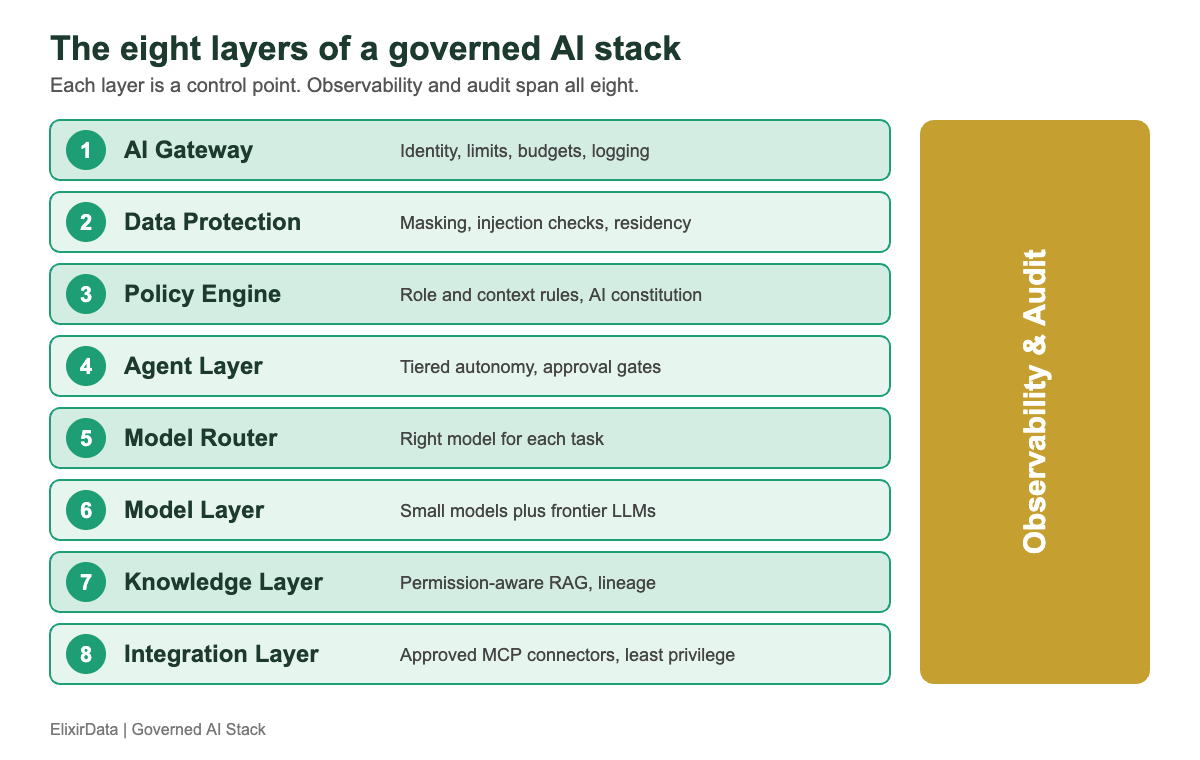
The ElixirData Governed AI Stack has eight layers, from the user-facing AI gateway down to integration with business systems, with observability and audit spanning every layer.
| # | Layer | What it does | Business value |
|---|---|---|---|
| 1 | AI Gateway | Single entry point; verifies identity via SSO, enforces usage limits and budgets, logs every request | Complete AI usage inventory; ends shadow AI; cost allocation by business unit |
| 2 | Data Protection | Screens inputs for prompt injection; masks PII, PHI, card data and secrets; enforces data residency | Lower breach and privacy risk; demonstrable GDPR, HIPAA and PCI DSS compliance |
| 3 | Policy Engine | Role- and context-based rules (RBAC/ABAC) for models, data and tools; a fixed "AI constitution" no prompt can override | Existing access and risk policies apply to AI automatically |
| 4 | Agent Layer | Plans and executes multi-step work under tiered autonomy and human approval gates | Automation speed for low-risk work; human accountability for high-risk work |
| 5 | Model Router | Classifies each task and sends it to the most cost-effective capable model | Largest single lever on AI cost |
| 6 | Model Layer | Combines specialised small language models (SLMs) with frontier LLMs such as Anthropic's Claude | Model choice becomes a reversible business decision; no vendor lock-in |
| 7 | Knowledge Layer | Permission-aware retrieval-augmented generation (RAG) with source attribution and data lineage | Fewer hallucinations; no accidental exposure of confidential data |
| 8 | Integration Layer | Registry of approved MCP connectors with least-privilege access and logged actions | Connected-agent productivity without unrestricted system access |
| All | Observability & Audit (all layers) | Logs, metrics, traces, evaluations, cost dashboards and alerts | Real-time visibility for leaders; reconstructable decisions for auditors |
Layer 1 (AI Gateway): what does it control?
The AI gateway is the single front door for all AI requests. It authenticates every employee, customer application and partner system through existing single sign-on, applies rate limits and budgets, and records each request before it reaches any model. See Agent Identity & Access.
Layer 2 (Data Protection): how is sensitive data kept safe?
The data protection layer treats all input as untrusted. It detects prompt injection (hidden instructions that try to hijack an AI system), masks sensitive data such as personal and health information, and enforces data residency so regulated data is only processed in approved locations. See Data Residency & Isolation.
Layer 3 (Policy Engine): who decides what AI may do?
The policy engine decides what is permitted before any AI runs. Central rules define which people and agents may use which models, data and tools. A fixed "AI constitution" of core behavioural rules sits above everything else and cannot be overridden by users, prompts or retrieved documents. Related: What Is AI Policy Enforcement for Enterprise Agents? and Runtime Policy Enforcement for AI Agents.
Layer 4 (Agent Layer): how much autonomy should AI agents have?
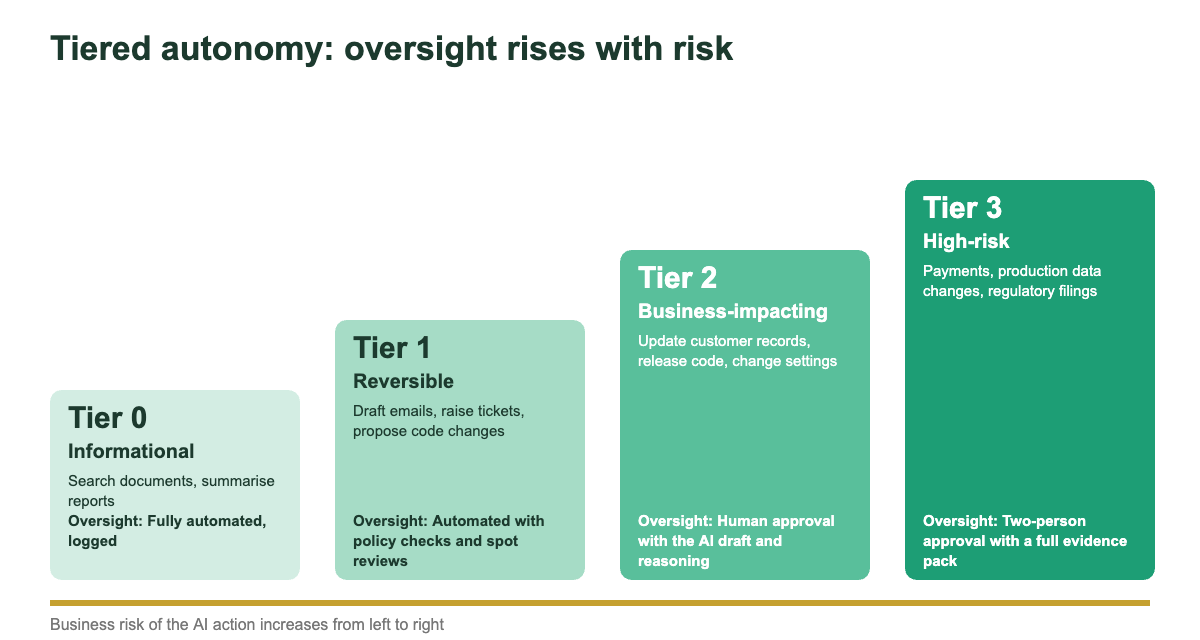
AI agents should have autonomy proportional to the business risk of each action. ElixirData uses four risk tiers (see Policy Gates for Enterprise AI Governance and Governed Agentic Actions):
| Risk tier | Example actions | Required oversight |
|---|---|---|
| Tier 0: Informational | Search documents, summarise reports | Fully automated, logged |
| Tier 1: Reversible | Draft emails, raise tickets, propose code changes | Automated with policy checks and spot reviews |
| Tier 2: Business-impacting | Update customer records, release code, change settings | Human approval with the AI's draft and reasoning attached |
| Tier 3: High-risk | Payments, production data changes, regulatory filings | Two-person approval with a full evidence pack |
Layer 5 (Model Router): how does it reduce AI cost?
The model router reduces AI cost by sending each task to the smallest model that can do it well: a fast, low-cost model for classification and triage, a mid-tier model for most business and engineering work, and a top-tier reasoning model only where complexity justifies it. Because per-token prices differ substantially between model tiers, routing routine work away from premium models changes the unit economics of every use case.
Layer 6 (Model Layer): which models should enterprises use?
Enterprises should combine specialised small language models, often privately hosted for sensitive workloads, with frontier large language models such as Anthropic's Claude, accessed directly or through major cloud providers. A common control layer keeps models interchangeable as prices, capabilities and regulations change.
Layer 7 (Knowledge Layer): what is governed RAG?
Governed RAG is retrieval-augmented generation that respects existing data permissions, links every answer to its sources and tracks data lineage. Employees only receive answers drawn from information they are entitled to see, and every answer can be verified. Related: Decision-Grade Context for AI Agents.
Layer 8 (Integration Layer): how is MCP governed?
MCP is governed by registering, versioning and permission-scoping every connector. Each agent sees only the tools its role permits, with minimum necessary access, and every tool call is logged.
Observability & Audit: how do leaders see what AI is doing?
Observability and audit span all eight layers, recording every decision, data source, action, cost and policy outcome in a tamper-evident form. Leaders get real-time dashboards; auditors can reconstruct any decision months later. Related: How Decision Traces Build Trust in AI Agents, How AI Agent Audit Trails Support Bank Compliance and AgentOps.
How Do You Govern AI-Assisted Software Engineering?
AI-assisted software engineering is governed through four controlled stages: Plan, Build, Validate and Operate, with human and automated checkpoints and traceability from business requirement to production code.
- Plan: Requirements are broken into tasks with acceptance criteria and agent guardrails set before any code is written.
- Build: AI agents generate code within your engineering standards, reusing approved components.
- Validate: Automated testing, security scanning and structured human reviews confirm quality and compliance before release.
- Operate: Changes are monitored in production with full requirement-to-code traceability.
This approach makes AI engineering productivity consistent across teams, measurable at portfolio level, and safe to apply to legacy modernisation.
Which KPIs Should Executives Track for Governed AI?
Executives should track seven dimensions of governed AI: speed to value, adoption, cost, quality, risk, oversight and compliance.
| Dimension | KPI |
|---|---|
| Speed to value | Time from AI use-case idea to approved production deployment |
| Adoption | Active users and agents; share of AI usage through governed channels |
| Cost | AI cost per transaction or use case; share of work routed to lower-cost models |
| Quality | Answer accuracy and agent task success rate from continuous evaluation |
| Risk | Policy violations blocked; sensitive-data exposures prevented; incidents |
| Oversight | Share of high-risk actions with documented human approval; approval turnaround time |
| Compliance | Share of AI systems with complete audit trails and risk classification |
How Does a Governed AI Stack Support Regulatory Compliance?
A governed AI stack supports compliance by building risk classification, human oversight, data controls and audit trails into the architecture. Evidence for frameworks is produced as the system runs, rather than through separate documentation exercises. See Audit Evidence for Enterprise AI Agent Governance and Risk & Compliance.
| Framework | What it expects | Where the stack provides it |
|---|---|---|
| EU AI Act | Risk classification, human oversight, logging, transparency | Agent Layer risk tiers; Observability & Audit |
| ISO/IEC 42001 | An AI management system with defined controls and continual improvement | Policy Engine; KPIs and evaluation |
| NIST AI RMF | Govern, Map, Measure, Manage functions | All layers, with Observability for Measure |
| GDPR / HIPAA / PCI DSS | Protection, minimisation and residency of sensitive data | Data Protection; Knowledge Layer permissions |
Which Industries Need a Governed AI Stack Most?
Regulated and high-stakes industries benefit most: banking, insurance, healthcare, manufacturing, telecommunications and the public sector. For banks, see AI Agent Governance for Banks in 2026: A Practical Guide.
| Industry | Example governed AI use cases | Key controls |
|---|---|---|
| Banking & Financial Services | KYC, credit operations, fraud investigation | Two-person approvals; explainability; model risk documentation |
| Insurance | Claims triage, underwriting support | Policy-grounded retrieval; auditable decision trails |
| Healthcare & Life Sciences | Clinical documentation, member services | PHI masking; in-region processing; clinician review |
| Manufacturing | Maintenance, quality, supply chain agents | Strict approval tiers for production-affecting actions |
| Telecommunications | Customer care, network operations | Cost-aware routing at very high volumes |
| Public Sector & Sovereign AI | Citizen services, internal knowledge | On-premises or in-country deployment; private models |
How Does ElixirData Deliver the Governed AI Stack?
ElixirData helps enterprises design, build and operate governed AI stacks, from initial assessment to production at scale.
- AI Readiness & Governance Assessment: an inventory of AI use cases, data flows, models and tools; a gap analysis; and a roadmap prioritised by value and risk.
- Platform Implementation: the Governed AI Stack on cloud, hybrid or on-premises infrastructure, integrated with your identity, security and data platforms.
- Use-Case Delivery: production AI agents and AI-assisted engineering, including legacy modernisation, document intelligence and operations automation.
- Embedded Engineering Teams: ElixirData engineers working inside your environment to move from prototype to production and build internal capability.
- Flexible Engagement Models: fully managed service, client-owned platform, or embedded team augmentation.
ElixirData is Context OS, the decision harness for enterprise AI agents: context, governance and memory for every AI decision. ElixirData is a XenonStack product. Learn more about Context OS.
How Long Does It Take to Implement a Governed AI Stack?
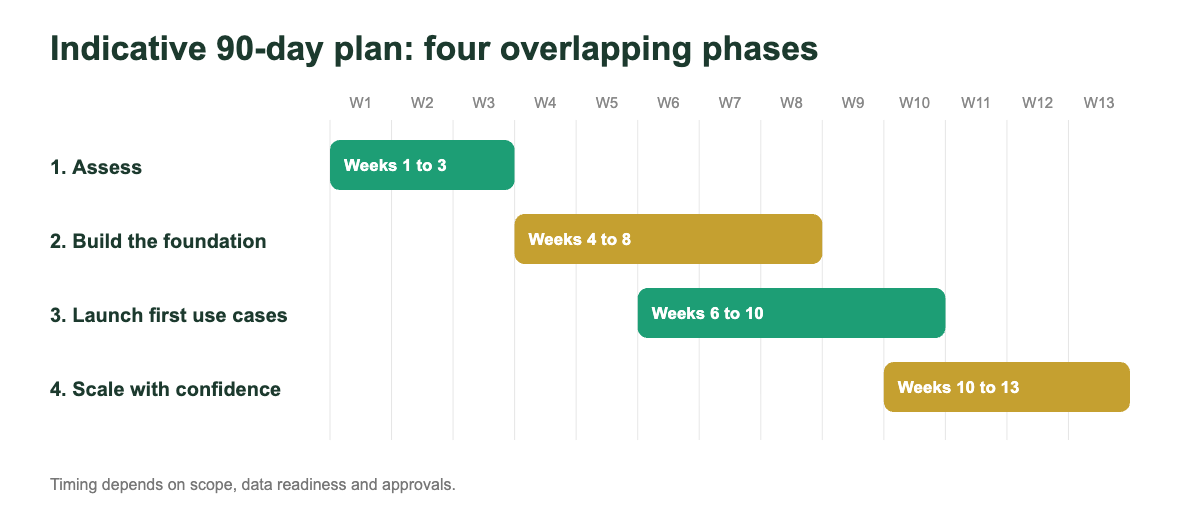
A governed AI foundation with two or three production use cases can be planned over about 90 days, in four overlapping phases. Actual timing depends on scope, data readiness and approvals.
| Phase | Timing | Deliverables |
|---|---|---|
| 1. Assess | Weeks 1–3 | AI use-case and risk inventory; governance gap analysis; target architecture; success metrics |
| 2. Build the foundation | Weeks 4–8 | Gateway, policy controls, model routing, data protection and audit logging live |
| 3. Launch first use cases | Weeks 6–10 | Two or three priority AI use cases in production with risk-tiered approvals |
| 4. Scale with confidence | Weeks 10–13 | Executive dashboards, cost controls, quality monitoring and a repeatable playbook |
What Should Leaders Ask Their Teams Before Scaling AI?
Leaders should ask six questions to test whether their AI programme is ready to scale:
- Can we name every application and agent using AI in our organisation today?
- Do we know which data each AI system can access, and does it respect existing permissions?
- Which actions can our AI take without human approval, and who signed off on that?
- Could we reconstruct why an AI system made a specific decision six months ago?
- Do we know our AI cost per use case, and are we paying premium prices for routine work?
- Could we switch AI providers without rebuilding our applications?
If more than one answer is "we're not sure," governance, not intelligence, is what's limiting the programme.
Glossary
- Agentic AI: AI systems that plan and carry out multi-step tasks and take actions in software systems, rather than only generating text.
- AI gateway: A single, authenticated entry point through which all AI requests pass for identity checks, limits and logging.
- Tiered autonomy: Classifying AI actions by business risk and requiring more human oversight as risk increases.
- Human-in-the-loop (HITL): A design in which a person reviews or approves an AI output or action before it takes effect.
- Model router: A component that selects which AI model handles each task based on complexity, cost and policy.
- Small language model (SLM): A compact, often domain-specialised model that is cheaper to run and can be privately hosted.
- Retrieval-augmented generation (RAG): Grounding AI answers in an organisation's own documents and data.
- Model Context Protocol (MCP): An open standard for connecting AI applications to tools and data sources.
- Prompt injection: An attack in which hidden instructions in input content try to make an AI system ignore its rules.
Frequently Asked Questions
What is a governed AI stack?
A governed AI stack is an enterprise AI architecture in which identity, data protection, policy, AI autonomy, model selection, data access and system integration are each controlled, with monitoring and audit across every layer.
How is a governed AI stack different from AI guardrails?
Guardrails filter model inputs and outputs. A governed AI stack controls the whole system: who can use AI, what data and systems it can reach, which actions need human approval, what it costs, and how every decision is recorded.
Does AI governance slow down AI adoption?
No. Well-designed governance speeds adoption, because pre-approved controls and reusable components mean each new use case doesn't need a fresh security and risk review from scratch.
Can a governed AI stack use multiple AI model providers?
Yes. A common control layer above the models lets enterprises combine providers such as Anthropic's Claude with open-source or private models and switch between them as needs change.
Can a governed AI stack run on-premises or in a sovereign cloud?
Yes. Every layer can run in a private data centre, a private cloud or an in-country region to meet data residency and sovereignty requirements.
How does a governed AI stack help with the EU AI Act?
It builds risk classification, human oversight, logging and data controls into the architecture, so the evidence the EU AI Act requires is produced as the system operates.
How long does it take to implement a governed AI stack?
An indicative ElixirData plan reaches a governed foundation and two or three production use cases in about 90 days, depending on scope, data readiness and approvals.
Build AI You Can Trust, and Prove It
The next phase of enterprise AI won't be won by whoever has the smartest model; every organisation will have access to that. It will be won by organisations that can deploy AI broadly and prove exactly what it did, why, and under whose authority.
Ready to pressure-test your AI initiative? Talk to ElixirData about a Governed AI Assessment: a clear view of where your AI programme stands today and a practical roadmap to scaling it with confidence.
Book a Governed AI Assessment →
Related reading
- How AI Agent Audit Trails Support Bank Compliance
- AI Agent Governance for Banks in 2026: A Practical Guide
- What Is AI Policy Enforcement for Enterprise Agents?
- How Decision Traces Build Trust in AI Agents
- Policy Gates for Enterprise AI Governance
- Context OS, Governed Agentic Actions, Decision Traces


