

Every enterprise moving AI agents into production hits the same two questions.
The first: does the agent understand our business? What "revenue" means here. Which table is certified. Who owns the customer record.
The second: is the agent allowed to do this? Approve this refund. Change this firewall rule. Release this payment.
Atlan answers the first question, and answers it well. ElixirData answers the second. This post explains the difference, where each one fits, and why most regulated enterprises will end up running both.
The short answer: Atlan is a context layer — it governs what your agents know. ElixirData is a decision layer — it governs what your agents are allowed to do, checks it before the action runs, and keeps the evidence.
What Atlan does well
Atlan has earned its place. It is a Leader in the 2026 Gartner Magic Quadrant for Data & Analytics Governance Platforms and in the 2025 Magic Quadrant for Metadata Management. Its strengths are real:
- A metadata lakehouse and Enterprise Data Graph that unify technical, business and operational metadata across 75+ data systems.
- Context Engineering Studio and Context Repos (launched April 2026) that treat business context like code: versioned, tested, simulated before it ships to an agent.
- An MCP server that delivers governed definitions, lineage, ownership and policy to agents in Claude, Cursor, Copilot Studio and other runtimes.
- Context Agents that bootstrap a data estate's documentation in weeks instead of a year.
If your problem is "our agents give wrong answers because they don't understand our data", Atlan is a strong choice.
The gap: knowing is not the same as being allowed
Context makes an agent accurate. It does not make an agent authorised.
Consider an agent in a bank's operations team. Atlan can tell it what a "high-value customer" is, which table holds the exposure data, and that the column is PII. All correct. Then the agent decides to waive a fee, extend a credit line or close an alert.
Three questions now matter, and they are not metadata questions:
- Does policy allow this action, right now, for this customer? Thresholds, limits and exceptions change by the day.
- Does this agent have the authority to do it alone? Or does delegation-of-authority say a human must approve above a limit?
- Can we prove it later? If a regulator asks in 18 months why this happened, what do we hand them?
Atlan's context graph records decisions and feeds them back as memory, so the next agent answers better. That is valuable — but it is learning after the fact. A regulated enterprise also needs a control before the fact: a gate that can allow, modify, escalate or block an action before it executes, and a record built as evidence, not as memory.
That is the decision layer, and it is what ElixirData was built for.
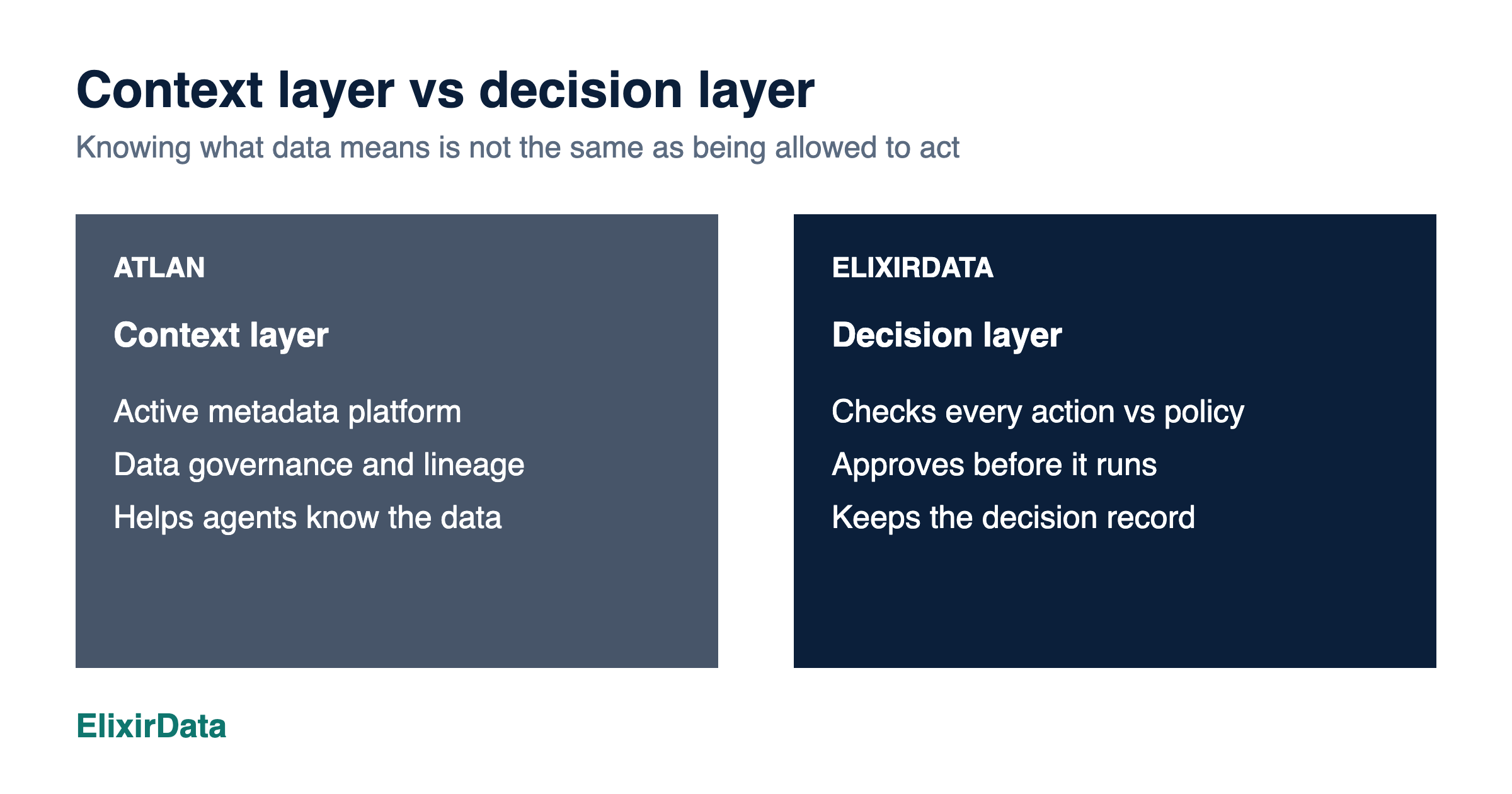
Atlan vs ElixirData at a glance
| Atlan | ElixirData | |
|---|---|---|
| Category | Context layer / active metadata platform | Decision layer / Context OS for governed agent actions |
| Core question answered | "What does this mean, and can I trust it?" | "Is this agent allowed to do this, right now — and can we prove it?" |
| Primary buyer | CDO, data governance and data platform teams | CIO, Chief AI Officer, CRO, CISO, COO |
| Core asset | Enterprise Data Graph, Context Repos | Context Graph, dual-gate policy engine, Decision Traces |
| When it acts | While the agent reasons (context delivery) | Before the agent reasons (Gate 1) and before it executes (Gate 2) |
| Outcome of a check | Better context for the answer | Allow, modify, escalate or block the action |
| Decision records | Traces promoted into governed memory for future agents | Full-lineage Decision Traces: inputs, policy version, authority, approver, result — exportable for audit |
| Autonomy model | Not a focus | Trust Graduation: from shadow mode to bounded autonomy |
| Regulatory mapping | Data governance and AI readiness | OCC SR 11-7, EU AI Act, US Treasury AI guidance, regional regulators |
| Deployment | SaaS | SaaS, customer VPC, on-premises, hybrid, edge |
| Pricing | Sales-led | Published plans; billed per governed decision |
The table is not a scorecard. The two products sit at different points in the agent's path, which is why the next section matters more.
Better together: Atlan context, ElixirData control
You do not have to choose. In a well-designed agent stack, Atlan and ElixirData do different jobs in the same request:
- An agent receives a task — for example, "approve this vendor invoice".
- Atlan supplies the context — what "approved vendor" means, which ledger is certified, who owns the data.
- ElixirData Gate 1 checks before reasoning — is this agent permitted to work on invoices of this value, for this entity, today?
- The agent reasons and proposes an action — "pay $480,000".
- ElixirData Gate 2 checks before execution — against spend thresholds and delegation of authority. Above the limit, it escalates to a named approver.
- ElixirData writes the Decision Trace — the context used, the policy version, the gate results, the approver and the outcome.
- The pattern feeds back — repeated escalations become a policy refinement, and Atlan's context stays the single source of meaning.
Atlan makes the agent right. ElixirData makes the action safe and provable. Together, they move an agent from pilot to production in a regulated business.
One platform: ElixirData, ElixirClaw and ElixirHub
ElixirData is the decision layer. Two companion products complete the platform, so an enterprise can govern, run and supply its agents from one stack:
- ElixirData (Context OS) — compiles business context, enforces policy and authority with dual gates, and writes Decision Traces. It governs what agents know and how decisions are made.
- ElixirClaw (Agentic OS) — the operating system agents run on. Orchestration, 200+ pre-built skills, and digital workers for SOC, GRC, IAM and FinOps, with autonomy levels set per skill and enforced by policy. Runs in managed cloud, VPC/hybrid, on-premises or air-gapped.
- ElixirHub (agent supply chain) — a registry of signed, attested, version-pinned skills, agents, evaluators, MCP tools, policy templates (OPA/Rego bundles for SOX, IFRS and segregation of duties) and ontologies, with Official, Verified Partner and Community trust tiers.
| Need | Atlan | Elixir platform |
|---|---|---|
| Govern what agents know | Context layer, Enterprise Data Graph | ElixirData Context Graph — and it can work alongside Atlan's context |
| Govern what agents may do | Not its focus | ElixirData dual gates, authority checks, Decision Traces |
| Run the agents | Delivers context to your chosen runtime via MCP | ElixirClaw Agentic OS and digital workers |
| Version and distribute reusable assets | Context Repos: semantic models, skills, SOUL.md files | ElixirHub: signed, attested skills, agents, policies and ontologies with trust tiers |
Atlan's Context Repos version your context. ElixirHub signs and attests everything an agent runs on — including the policies that constrain it — so an auditor can trace exactly which version of which skill acted, under which rule.
From demo to production: where each fits across the 5 layers
Enterprise agent programmes follow the same path — prototype, pilot, production, scale — across five layers: scope, architecture, observability, operations and optimisation. The architecture layer itself has four jobs: Know (retrieval), Act (tools and actions), Remember (memory) and Coordinate (orchestration). Mapping both platforms onto that path shows where each earns its place.
| Layer | The question it asks | Atlan | Elixir platform |
|---|---|---|---|
| 1. Scope & assumptions | Who is the user, what outcome improves, what stays human, how much autonomy? | Defines the data domains and business meaning | Decision Readiness Assessment maps workflows to policy; the agency–control trade-off is set as autonomy levels per workflow |
| 2a. Know | Does the agent retrieve the right, trusted context? | Strongest here — Enterprise Data Graph, semantic models, MCP delivery | ElixirData Context Graph; can consume Atlan's context |
| 2b. Act | Approved tools, least privilege, trust boundaries, prompt-injection defence? | Not its focus | ElixirData dual gates and Agent Identity & Access; ElixirClaw zero-trust runtime and prompt firewall; ElixirHub signed MCP tools with scopes |
| 2c. Remember | What does the agent keep, and why? | Context Repos; traces promoted into governed memory | Decision Traces kept as evidence, with retention by plan |
| 2d. Coordinate | Single agent first; multi-agent only when earned? | Leaves orchestration to your runtime | ElixirClaw orchestration and digital workers, with trust tiers per agent |
| 3. Observability & evals | Are inputs, tool calls, retries, costs and errors logged and scored? | Context Engineering Studio simulates and tests context | Every gate check and tool call written to a Decision Trace; ElixirHub evaluators; human review through escalation |
| 4. Production & ops | Scale, latency, reliability, freshness, security, audit? | Keeps context fresh across 75+ systems | AgentOps, audit trails, SLAs, and VPC, on-prem or air-gapped deployment |
| 5. Advanced optimisation | Lower latency and cost, higher quality, complexity only when earned? | Better context raises answer quality | Per-decision pricing, model-agnostic routing, reusable signed assets, and autonomy raised only on evidence |
Atlan is strongest at Know. The Elixir platform covers Act, Coordinate and the evidence side of Remember and Observability — the layers that decide whether an agent ever leaves the pilot. A prototype proves an agent can work. Production proves it can be trusted.
Which do you need, Atlan or ElixirData?
- Choose Atlan first if your agents mostly answer questions over data, and the pain is wrong answers, inconsistent metrics or undocumented data.
- Choose ElixirData first if your agents take actions — payments, approvals, access changes, incident remediation — and someone in risk, audit or compliance has to sign off on them.
- Run both if you are a bank, insurer, government agency or critical-infrastructure operator putting agents into workflows that a regulator can inspect.
A simple test: if the worst outcome of a mistake is a wrong number on a dashboard, start with context. If the worst outcome is money moved, access granted or a regulator's letter, start with control.
Atlan vs ElixirData: Frequently asked questions
Is ElixirData an Atlan alternative?
Only partly. ElixirData compiles business context, but its core job is governing agent actions. Most customers with Atlan keep it as their context source and add ElixirData as the control and evidence layer.
Atlan also talks about decision traces. What's different?
Atlan uses traces to improve future agent behaviour through governed memory. ElixirData creates Decision Traces at the moment of the gate check, as audit evidence: which policy version applied, who had authority, what was allowed or blocked.
Can ElixirData read context from Atlan?
ElixirData is model-agnostic and connects to 50+ enterprise systems. Talk to us about connecting your Atlan context to ElixirData's policy gates.
Does ElixirData run on-premises?
Yes. ElixirData deploys as managed SaaS, in your own cloud account, or on-premises and hybrid for full data sovereignty.
How is ElixirData priced?
By governed decisions executed, not by seats. Plans are published on our pricing page.
Your agents already know your business. Do they know their limits?
Book a Decision Readiness Assessment and we will map your first three agent workflows to policy gates and Decision Traces — working alongside the context platform you already run.
Atlan is a trademark of its respective owner. Product details are based on Atlan's public materials as of October 2026.


