Automated patch remediation for Windows and Linux uses Agentic AI to connect vulnerability evidence, asset context, change policy, deployment controls, and post-install validation across heterogeneous device fleets. The goal is to reduce exposure faster without treating a successful installation as proof that risk is gone.
The central problem is coordination. Vulnerability scanners identify exposure, endpoint and server tools report configuration, package repositories publish fixes, service maps describe dependencies, and ITSM systems retain approvals and maintenance windows. These systems often disagree on device identity, software version, ownership, or observation time. A green deployment status in one console may coexist with a pending Windows restart, an old Linux process still using a vulnerable library, or a host that has stopped reporting.
A governed Windows and Linux patch remediation program resolves conflicting evidence before action and verifies the resulting state afterward. Agentic AI can determine applicability, prioritize risk, form deployment cohorts, obtain approval, invoke existing tools, monitor service health, and preserve an auditable decision trail.
AgenticAssetOps supports this operating model through ElixirData as the Context OS, ElixirHub as the governed skills registry, and ElixirClaw as the Agentic OS. Together, they connect heterogeneous systems without replacing the platforms that already manage Windows and Linux devices.
See how Context OS governs AI agent decisions
Context OS reconciles vulnerability, asset and change evidence so patch agents act only on verified, approved context.
Cross-Platform Patch Remediation Challenges
Consider a multinational enterprise with Windows 11 laptops, virtual desktop hosts, Windows application servers, several Linux distributions, container hosts, and cloud virtual machines. The estate supports finance, engineering, customer operations, warehouses, and digital services. A new vulnerability is actively exploited, and security identifies affected Windows components and Linux packages across multiple regions.
The first report is not an executable plan. Some Windows devices are in managed update rings, while others connect intermittently through VPN. Several Windows servers belong to clustered services and cannot restart together. Linux hosts use different distribution releases and repository channels. A kernel update is available for one population, but another requires a backported package from its approved vendor repository. Production nodes are managed through immutable images, while traditional servers are patched in place.
The business context is equally fragmented. The CMDB does not contain a current owner for every host. The service map shows which servers support a revenue process, but endpoint records use different identifiers. The change calendar includes a freeze for quarter-end processing. Security wants rapid remediation because exploitation is known, while operations needs proof that packages are authentic, dependencies are satisfied, failover is available, and rollback or mitigation can be executed.
Manual coordination across these systems extends exposure and consumes scarce engineering time. A single global deployment job is also unsafe because the same vulnerability can require different actions by operating system, version, workload pattern, and service criticality.
Why Traditional Patch Management Falls Short
Windows and Linux management platforms are effective at distributing approved updates. The gap appears when the enterprise must decide what to deploy, to which exact assets, in what order, under which authority, and with what proof of success. Spreadsheets, tickets, and static device collections cannot keep those decisions synchronized at enterprise scale.
-
Windows update identifiers, Linux package names, CVEs, installed versions, and scanner findings do not map cleanly across tools.
-
A severity score does not reflect internet exposure, active exploitation, business service criticality, privilege, or compensating controls.
-
Windows cumulative updates and supersedence behave differently from Linux package dependencies, repository streams, and backports.
-
Reboot requirements vary across endpoints, clustered servers, kernels, libraries, and long-running services.
-
Static collections become stale as devices change owner, network location, workload role, operating-system version, or maintenance policy.
-
Install success does not prove that the vulnerable code is no longer active or that the service remained healthy.
-
Patch exceptions often persist without a current owner, expiry date, mitigation, or renewed risk acceptance.
Traditional automation is reliable once an approved package, target, and schedule are known. Agentic AI adds value in the decision-heavy work around that automation: reconciling context, selecting the correct treatment, controlling execution, and validating the outcome.
How Agentic AI Automate Windows and Linux Patching
The operating loop is Detect, Understand Context, Decide, Approve, Act, Verify, and Learn. Detection combines vendor advisories, known exploited vulnerability intelligence, scanner results, endpoint telemetry, repository metadata, configuration drift, and failed deployment events. Context resolution identifies the component, operating system, installed version, asset owner, business service, exposure, dependency, maintenance window, and age of each observation.
The decision step selects a treatment for each asset. The agent may recommend a Windows quality update, a Linux package update, a rebuilt image, a live-patch path, a scheduled kernel restart, an interim configuration control, isolation, or a time-bound exception. It then creates platform-specific cohorts and preflight criteria. Approval applies change authority and risk policy. Action uses existing management tools and approved automation. Verification confirms technical state and service health. Learning updates tested cohort rules, failure signatures, and evaluation cases after human review.
This model keeps Windows and Linux differences intact while applying one governance framework. It also preserves uncertainty. If package applicability, device identity, repository trust, service dependency, or rollback readiness is unresolved, the agent stops and routes the case to an accountable owner.
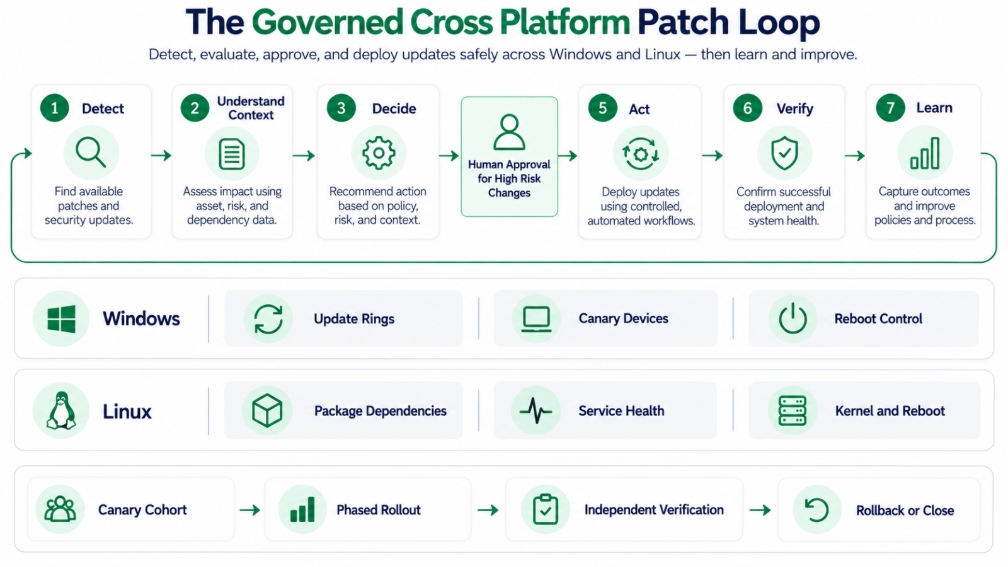
One governed loop coordinates platform-specific checks, canary deployment, phased rollout, independent verification, and recovery.
Automated Patch Remediation Workflow with AI
The workflow begins when a vulnerability, vendor update, or compliance breach enters the remediation queue. A context agent resolves affected product versions and normalizes scanner observations against current Windows inventory and Linux package data. It removes duplicate findings, retains the time and source of each observation, and flags endpoints that cannot be identified confidently.
-
Confirm Windows applicability from edition, build, architecture, component state, cumulative-update level, supersedence, prerequisites, and vendor guidance; then place eligible devices into governed Windows update rings.
-
Confirm Linux applicability from distribution, release, package epoch and version, approved repository, advisory mapping, dependencies, kernel state, and backport guidance. For RHEL estates, validate the treatment against official DNF update guidance.
-
Prioritize by known exploitation, exposure path, business criticality, privilege, data sensitivity, blast radius, and strength of compensating controls.
-
Run preflight checks for disk space, power and connectivity, encryption state, cluster quorum, service redundancy, application compatibility, repository trust, backup, and rollback readiness.
-
Create Windows update rings and Linux host cohorts using service role, maintenance policy, geography, support coverage, and failure isolation boundaries.
-
Deploy first to representative canaries, observe installation and service health, and pause automatically when a defined stop condition is met.
-
Verify the installed state through an independent inventory or rescan, confirm required reboots and process restarts, and close only when exposure and service health evidence agree.
A failed canary never becomes a larger rollout by default. The agent records the error, compares it with known failure patterns, protects the remaining cohort, and invokes only an approved rollback or mitigation. A human owner decides whether to revise the package, narrow the cohort, accept temporary risk, or reschedule the change.
Enterprise Architecture for Cross-Platform Patching
The architecture separates systems of record, contextual reasoning, reusable operational policy, and execution. Microsoft Intune, Configuration Manager, Windows Server Update Services, or another endpoint platform may remain responsible for Windows distribution. Linux repositories, Red Hat Satellite, Canonical Landscape, Ansible, or existing orchestration may manage Linux updates. Vulnerability, EDR, CMDB, identity, service mapping, monitoring, ITSM, and change systems contribute their own evidence.
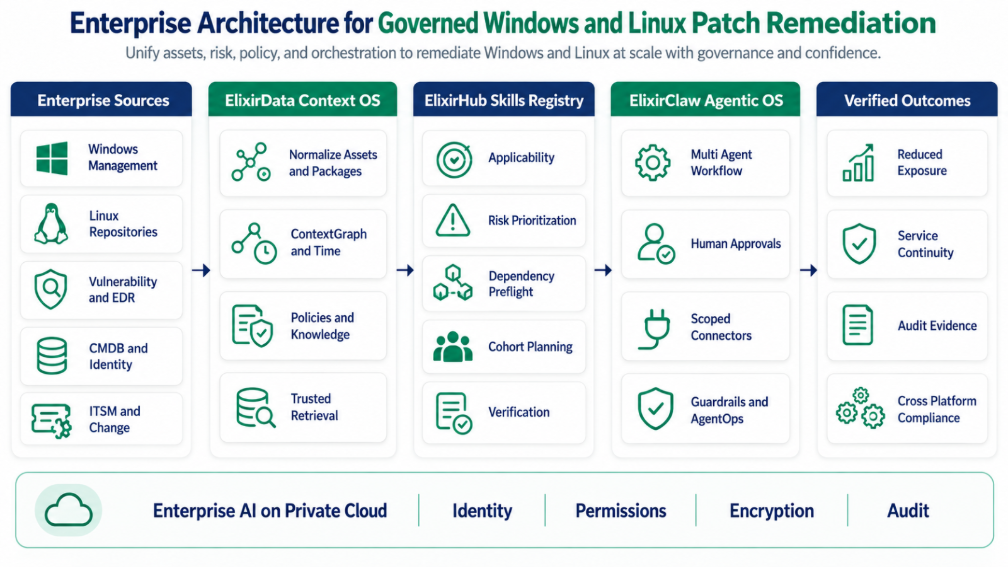
ElixirData, ElixirHub, and ElixirClaw connect enterprise sources to governed cross-platform decisions, bounded execution, and verified outcomes.
No source is converted into an unquestioned master record. The architecture records which system observed a condition, when it observed it, and whether the source is authoritative for that field. This matters when a scanner reports yesterday's Linux package state, the configuration platform reports today's installed version, and monitoring shows that the old process is still running.
Get the Executive Blueprint for governed enterprise AI
A practical guide for CIOs, CAIOs and risk leaders on moving AI agents from pilot to production without losing control of context or decisions.
How ElixirData Unifies Patch Context
ElixirData creates the trusted enterprise context required for cross-platform remediation. It synchronizes Windows inventory, Linux package manifests, vendor advisories, vulnerability findings, EDR exposure, identity, CMDB relationships, service dependencies, monitoring signals, change records, and maintenance calendars into a time-aware view.
Ontology management defines meaningful relationships. A vulnerability affects a component. The component is delivered by a Windows update or Linux package. The component runs on an asset, the asset participates in a service, and the service has an owner, criticality, dependency, and maintenance policy. ContextGraph makes those relationships available to an agent. Temporal context distinguishes the scan time, package publication time, approval time, deployment time, restart time, and verification time.
Knowledge ingestion adds vendor release notes, repository policies, application test records, runbooks, exception criteria, and rollback procedures. Graph and vector intelligence retrieve the right structured relationships and supporting documents for a specific asset. Context retrieval and agent memory retain the current campaign state without allowing an old observation to overwrite newer evidence.
Reusable Patch Automation Skills with ElixirHub
ElixirHub stores patching logic as governed operational skills rather than embedding it in one agent prompt. Every skill declares its inputs, outputs, policy dependencies, permissions, test cases, and version. Shared governance remains consistent, while platform-specific logic can evolve independently.
-
Windows Update Applicability Skill resolves builds, prerequisites, supersedence, servicing state, deployment ring, and reboot behavior.
-
Linux Package and Dependency Skill resolves distribution advisories, repository channels, package versions, dependencies, backports, and kernel requirements.
-
Exposure and Service Risk Prioritization Skill combines exploit evidence with business impact, network reachability, privilege, and compensating controls.
-
Cross Platform Cohort Planning Skill forms canaries and rollout waves around service boundaries, maintenance windows, redundancy, and support capacity.
-
Remediation Verification and Recovery Skill checks installed state, process and kernel state, service health, rescan evidence, stop conditions, and approved rollback paths.
Publishing and discovery controls prevent untested skills from entering production workflows. Versioning preserves reproducibility: the audit trace can show which applicability logic, risk policy, cohort rule, and verification method produced each decision. The same approved skill can be reused by different agents and business units without duplicating policy code.
Governed Patch Execution with ElixirClaw
ElixirClaw coordinates the multi-agent patch workflow. A context agent resolves the estate and evidence; platform specialists determine Windows and Linux applicability; a risk agent prioritizes; a planning agent builds cohorts and preflight checks; a change agent routes approval; and execution and verification agents reconcile the outcome.
Enterprise connectors and MCP interfaces expose specific actions such as creating a change record, assigning a device to an approved update ring, launching a package job, draining a node, requesting a rescan, querying service health, or opening an incident. They do not give every agent broad administrative access. Permissions restrict the environment, operating-system class, target cohort, action, credential, and time window.
Guardrails block execution when evidence is stale, the artifact signature or repository is untrusted, the target differs from the approved cohort, required preflight checks are missing, or the observed failure rate breaches a stop condition. Evaluations and AgentOps test applicability, dependency reasoning, tool selection, authorization, recovery behavior, and verification. Agentic BI exposes remediation age, approval delay, cohort progress, reboot backlog, package failure, exception age, and evidence gaps.
Private AI for Secure Patch Automation
Cross-platform patching exposes a detailed map of enterprise risk. The context includes vulnerable software, device identities, administrative tiers, service dependencies, network reachability, maintenance schedules, and known control gaps. Sending that combined context outside the enterprise boundary can create a security and sovereignty concern even when each source is already approved internally.
Enterprise AI on Private Cloud keeps models, ContextGraph retrieval, agent memory, skill execution, and audit data within the organization's controlled environment. It supports on-premises or private-cloud deployment when Windows servers, Linux repositories, privileged management planes, or regulated workloads cannot be exposed to a public service. Existing identity, privileged access, encryption, key management, segmentation, monitoring, and data-retention controls can govern the agent runtime.
The architecture also reduces integration risk. Agents can reach internal package repositories, endpoint systems, and ITSM platforms through private network paths. Credentials stay in approved secret stores. Connectors expose constrained operations, and regional deployments can enforce data-residency rules. Models and skill versions move through the same evaluation and change-control process as other enterprise software.
Patch Governance and Human Oversight
Governance should separate the authority to investigate, recommend, approve, execute, verify, and accept residual risk. Routine workstation updates may qualify for policy-based execution after a successful canary. Domain controllers, privileged access systems, production databases, clustered services, and kernel changes may require named approval. Any exception needs an owner, rationale, mitigation, expiry, and review date.
Patch condition |
Agent response |
Required control |
Standard Windows endpoint with tested update |
Use approved ring and phased rollout |
Canary health, restart policy, and independent verification |
Linux package with resolved dependencies |
Patch the approved cohort and restart affected services |
Trusted repository, service checks, and rollback readiness |
Critical clustered or privileged system |
Prepare plan and request explicit approval |
Service owner, security authority, and coordinated maintenance |
Conflicting identity or package evidence |
Hold action and open a data-quality task |
Human resolution and refreshed source evidence |
Canary failure or service degradation |
Stop expansion and invoke approved recovery |
Incident trace, rollback criteria, and owner decision |
The decision trace should preserve source observations, timestamps, skill and policy versions, package provenance, cohort membership, approvals, connector calls, deployment results, restart evidence, service telemetry, exceptions, and final risk state. NIST SP 800-40 Revision 4 describes enterprise patch management as identifying, prioritizing, acquiring, installing, and verifying patches. The agentic workflow supports that lifecycle, but a deployment event alone is not proof of compliance.
Business Outcomes of AI Patch Remediation
The enterprise should measure results against its own baseline. Relevant measures include time from detection to treatment decision, assets with current verification, canary failure rate, pending restart age, package deployment failure, exception age, rework, and engineer effort per campaign. Expected outcomes should remain directional until a pilot provides credible data.
Outcome |
How the workflow contributes |
Evidence to monitor |
Faster risk reduction |
Agents assemble cross-platform context and approvals before execution |
Time to decision, approval, deployment, and verification |
Higher patch compliance |
Applicable assets proceed through governed treatment and evidence checks |
Verified state by platform, service, and evidence age |
Lower endpoint and server risk |
Priority reflects exploitation, exposure, criticality, and controls |
Open exploitable findings and residual-risk decisions |
Fewer patch related outages |
Canaries, dependency checks, and stop conditions constrain failures |
Service incidents, paused cohorts, and recovery actions |
Lower manual effort |
Agents reconcile records and route engineers to exceptions |
Investigation time, ticket handoffs, and repeated analysis |
Stronger audit readiness |
Every asset retains decision, approval, and outcome evidence |
Missing approvals, stale exceptions, and verification gaps |
The strongest business case is not a claimed automation percentage. It is evidence that exposed assets reach a verified state sooner, engineering effort moves from record reconciliation to exception handling, and service health remains within agreed limits.
How to Adopt AI Patch Remediation
Start with one Windows update family and one Linux distribution in a defined service area. Select cohorts with reliable inventory, clear ownership, stable monitoring, and known maintenance policies. Establish authoritative sources for identity, software state, vulnerability, service dependency, approval, and verification. Record the current operating baseline before enabling agent decisions.
-
Run agents in recommendation mode and compare applicability, risk, and cohort decisions with experienced Windows, Linux, security, and service teams.
-
Evaluate historical successful and failed changes, including supersedence errors, repository issues, dependency conflicts, restart failures, and stale scans.
-
Enable evidence gathering, change preparation, and canary planning before granting any patch deployment permission.
-
Introduce bounded execution for low-risk cohorts with explicit target limits, stop conditions, and tested recovery paths.
-
Require independent verification before closing findings or reporting a compliant state.
-
Scale by approving additional distributions, update types, service classes, connectors, skills, and AgentOps evaluation suites.
A successful pilot produces reusable architecture, not a one-off script. The deliverables include a cross-platform patch ontology, authoritative-source map, decision boundaries, skill versions, connector scopes, evaluation cases, recovery rules, and an auditable definition of verified remediation.
Build Verified Windows and Linux Patch Compliance
Patching thousands of Windows and Linux devices is not a single distribution problem. It is a continuous sequence of applicability, risk, dependency, change, execution, and verification decisions. Each operating system needs its own technical treatment, but the enterprise needs one governance model and one traceable view of residual risk.
AgenticAssetOps provides the architecture through ElixirData for trusted cross-platform context, ElixirHub for governed operational skills, and ElixirClaw for bounded action with human oversight. Private enterprise AI keeps sensitive asset and exposure intelligence within the enterprise boundary.
The target state is practical and measurable: critical exposure is treated sooner, failed changes stop before wider impact, Windows and Linux evidence is reconciled, and no asset is marked compliant until the organization can prove that the risk was reduced and the service remained healthy.
Take the next step
Download the Executive Blueprint, or talk to our team about governed Windows and Linux patch remediation.
Frequently Asked Questions
-
What is automated Windows and Linux patch remediation?
It is a governed process that identifies applicable updates, prioritizes risk, deploys through platform-specific tools, and independently verifies the resulting state across Windows and Linux fleets. Agentic AI coordinate the evidence and decisions while existing endpoint and server platforms perform approved actions -
How do Agentic AI automate patch remediation across Windows and Linux?
Agentic AI reconcile vulnerability, asset, package, service, and change data; select the appropriate treatment; build deployment cohorts; route approvals; monitor rollout health; and verify remediation. They preserve platform-specific differences while applying one governance and audit model. -
Can one patch workflow manage both Windows and Linux endpoints?
Yes. One workflow can enforce common controls for risk, approval, canary deployment, stop conditions, verification, and evidence, while separate skills handle Windows supersedence and restart behavior or Linux repositories, dependencies, backports, kernels, and services. -
How should enterprises prioritize Windows and Linux patches?
Prioritization should combine severity with known exploitation, internet exposure, asset and service criticality, privilege, data sensitivity, blast radius, patch availability, and compensating controls. A severity score alone is not an operational priority. -
How do Agentic AI verify that patch remediation succeeded?
Agents compare post-deployment inventory or rescan evidence with the intended state, confirm required reboots or process restarts, and check service health. A finding remains open until current evidence shows the exposure has been removed and the workload is healthy.