In brief
A bank AI agent is controlled when, for every action it takes, you can show who it was, what it was allowed to do, which policy was checked before it acted, what context it used, who approved anything beyond its limit, and what evidence remains afterwards. This guide sets out eight controls that deliver that, how to test each one, and where to start.
Who this is for: CIOs, CISOs, chief risk officers, heads of AI platforms and internal audit teams at banks and other regulated financial institutions.
Disclosure: ElixirData publishes this guide and sells Context OS, which addresses several of these controls. Check any vendor's current capabilities before you decide.
Why do AI agents need different controls from AI models?
A model gives an answer. An agent takes an action: it reads systems, calls tools and changes records. Controls built for models, such as validation and monitoring of outputs, do not stop an agent from doing something it should not do.
In April 2026 a coding agent working on a routine task in a staging environment tried to fix a credential mismatch and, in a single API call, deleted a production database volume and its backups, according to its founder's account [1]. The lesson is not the model. It is that the agent could reach more than its task needed, with no hard stop before an irreversible action.
For a bank the stakes are higher: customer money, credit decisions, sanctions screening and regulatory reporting all sit behind the systems an agent might touch.
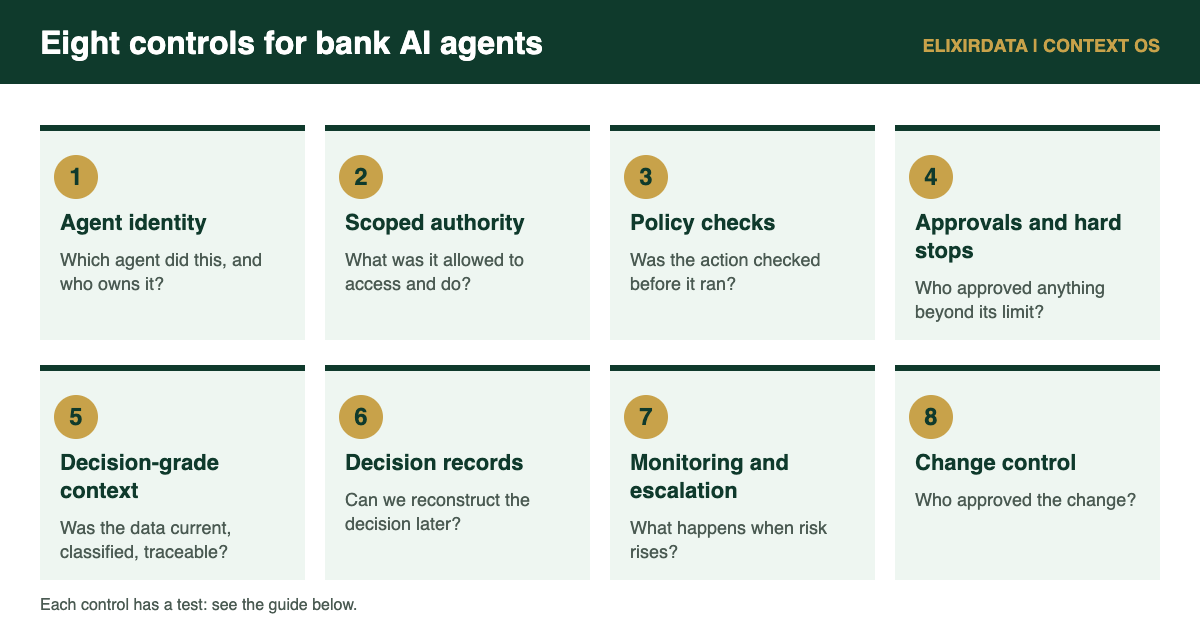
What are the eight bank AI agent controls?
| # | Control | The question it answers |
|---|---|---|
| 1 | Agent identity | Which agent did this, and who owns it? |
| 2 | Scoped authority | What was it allowed to access and do? |
| 3 | Policy checks before action | Was the action checked against policy before it ran? |
| 4 | Approval thresholds and hard stops | Who approved anything beyond its limit? |
| 5 | Decision-grade context | Was the data it used current, classified and traceable? |
| 6 | Decision records | Can we reconstruct the decision months later? |
| 7 | Runtime monitoring and escalation | What happens when risk rises or behaviour changes? |
| 8 | Change control | Who approved the change to the agent, its policies or its tools? |
1. Agent identity
Give every agent its own identity, not a shared service login. Each run should use short-lived credentials tied to a named owner. Test it: pick any action in a log and name the agent and its accountable owner in under a minute.
2. Scoped authority
Limit each agent to the systems, data and actions its task needs, and set those limits outside the agent so the agent cannot rewrite them. Default to deny. Test it: list what the agent can reach and compare it with what the task requires. Anything extra is a finding.
3. Policy checks before action
Check each action against policy before it runs, not afterwards in a report. Record which policy and which version was evaluated. This is what stops an unsafe action instead of describing it later. See AI policy enforcement for enterprise agents and runtime policy enforcement for AI agents. Test it: try an action the policy forbids and confirm it is blocked and logged.
4. Approval thresholds and hard stops
Define the limits beyond which a named person must approve: transaction size, customer segment, irreversible actions. Put a hard stop before anything that cannot be undone. Test it: confirm an over-limit action waits for an approver and that the approver, time and reason are recorded.
5. Decision-grade context
An agent is only as reliable as the context it reads. Context should carry lineage, classification and freshness, and respect policy, so a stale or restricted record does not drive a decision. Test it: for a sample decision, show where each input came from and how current it was.
6. Decision records
Keep a structured record of each decision: the inputs, sources, rules applied, approvals and outcome. This is the evidence an auditor or regulator asks for. See decision traces: how they build trust in AI agents and anatomy of a decision trace. Test it: pick a decision from three months ago and reconstruct why it happened without asking the engineers.
7. Runtime monitoring and escalation
Monitor behaviour while the agent runs, with stop conditions and escalation to a named person when risk increases or behaviour drifts. See AI agent runtime operational controls. Test it: simulate a risk trigger and measure how long it takes for a person to be alerted and the agent to be paused.
8. Change control
Treat changes to an agent, its prompts, its policies and its tools like any other production change: reviewed, approved, versioned and reversible. Test it: show who approved the last change to a production agent and how to roll it back.
What do regulators and standards point to?
- The EU AI Act includes requirements on risk management, documentation, logging, human oversight, robustness and cybersecurity for applicable high-risk systems.
- The NIST AI Risk Management Framework organises AI risk work around governing, mapping, measuring and managing risk.
- ISO/IEC 42001 sets out requirements for an AI management system.
- OWASP's Top 10 for Agentic Applications 2026 names risks specific to agents, including goal hijacking and tool misuse.
Which rules apply depends on the bank's jurisdiction and the use case. Confirm with your compliance and legal teams.
How should a bank start?
- Inventory agents. List every agent in production or pilot, its owner and what it can reach.
- Rank by risk. Agents that move money, decide credit or touch customer data come first.
- Close the gaps in order. Identity and scoped authority first, then policy checks and approvals, then decision records.
- Test each control with the tests above, and keep the results as audit evidence.
- Review every quarter, and after any incident or material change.
For how to evaluate platforms, see AI agent governance for banks and our AI agent audit trails for bank compliance.
How does Context OS fit?
ElixirData is Context OS, the decision harness for enterprise AI agents: context, governance and memory for every AI decision, a XenonStack product. It sits above existing systems. It enforces decision boundaries before every action, records decision traces (inputs, sources, rules applied, approvals and outcome), and gives agents governed context through context graphs. It does not replace identity, network or application security; it adds the decision layer. See Context OS for financial services and what is a governed AI stack.
Frequently asked questions
What are AI agent controls in banking?
They are the technical and procedural measures that limit what an AI agent can do, check each action against policy, require approval beyond set limits, and keep evidence of every decision.
How are AI agent controls different from model risk management?
Model risk management focuses on whether a model's outputs are sound. Agent controls govern the actions an agent takes with tools and systems, and they have to work before the action runs.
Which control should a bank implement first?
Start with agent identity and scoped authority. Without them, policy checks and decision records cannot be tied to a specific agent or limited to what it should reach.
Do banks need a human to approve every agent action?
No. Set thresholds so routine, low-risk actions proceed under policy checks and a named person approves anything above the limit or irreversible.
What evidence will an auditor expect?
For each decision: the agent and owner, the policy and version checked, the context used, any approval, and the outcome, available months later.
Sources
- Decrypt, "AI agent deletes startup database in 9 seconds, founder says" (28 Apr 2026): decrypt.co/365897
- European Commission, EU regulatory framework for AI: digital-strategy.ec.europa.eu
- NIST, AI Risk Management Framework: nist.gov
- ISO/IEC 42001:2023: iso.org/standard/42001
- OWASP, Top 10 for Agentic Applications 2026: genai.owasp.org
Talk to us: Book a demo