A ContextGraph for enterprise AI connects entities, documents, events, relationships, policies and decisions into a governed model of a business situation. This post explains how it differs from knowledge graphs and RAG, and how ElixirData serves it to agents with provenance, time and permissions.
Enterprise AI has a context problem
A service agent investigating a delayed order may need a CRM account, an ERP transaction, a support case, the latest shipping event and the policy that governed a prior exception. Those records sit in separate systems. Retrieving relevant passages helps, but the agent still needs to know which records refer to the same order, what was true at the time and who can approve the next action.
A ContextGraph connects enterprise entities, documents, events, relationships, policies and decisions into a governed model of a business situation. It lets an agent retrieve both evidence and the conditions under which an answer or action is valid. ElixirData explains the decision-aware model in its guide to context graphs.
Research on retrieval reinforces this need. Microsoft Research combines text extraction, network analysis and language-model summarization in GraphRAG. Google Research describes why a single retrieval step can miss multi-source questions that require following an identifier into another system. Those approaches inform retrieval design; a production ContextGraph also needs current enterprise state, authority and policy.
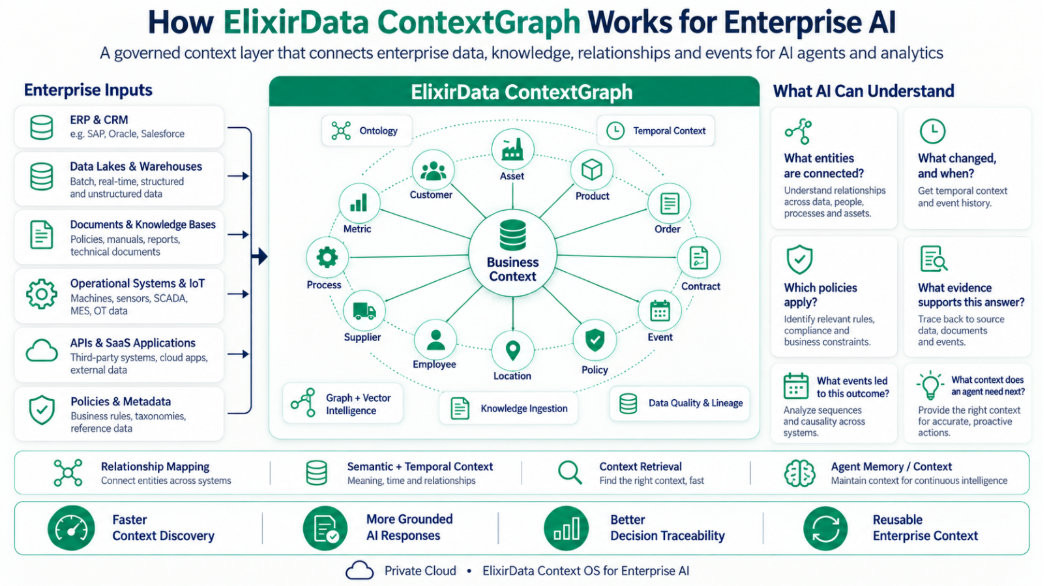
See how Context OS governs AI agent decisions
Context OS maintains the ContextGraph that gives agents governed evidence, policy and authority before they act.
What is a ContextGraph for enterprise AI?
A knowledge graph represents entities and relationships, such as an asset at a site or a contract with an obligation. A semantic model defines shared business meaning. A ContextGraph brings those structures together with events, time, source evidence, permissions and the record of prior decisions that matter to a particular task. XenonStack’s guide to knowledge graphs for LLMs explains the graph foundation.
For a decision, the graph should identify the applicable policy version, the evidence used, the authority for the action, when the facts were valid and the result. That record helps an agent determine whether a previous exception can be reused or needs fresh approval.
Consider the question, “Why did this production line stop, and what should we check first?” Vector search may retrieve a relevant manual. A knowledge graph can connect the line to machines and sensors. The ContextGraph adds alarm sequence, current operating state, recent maintenance, approved procedures and prior decisions, each linked to its source. The agent can then investigate the event instead of merely summarizing a document.
The same approach applies beyond manufacturing. Banking questions may involve an account, transaction, policy, risk signal and approval history. A service request may involve a customer, entitlement, case and recent product event. What connects these examples is the need to resolve identity, time and policy across systems.
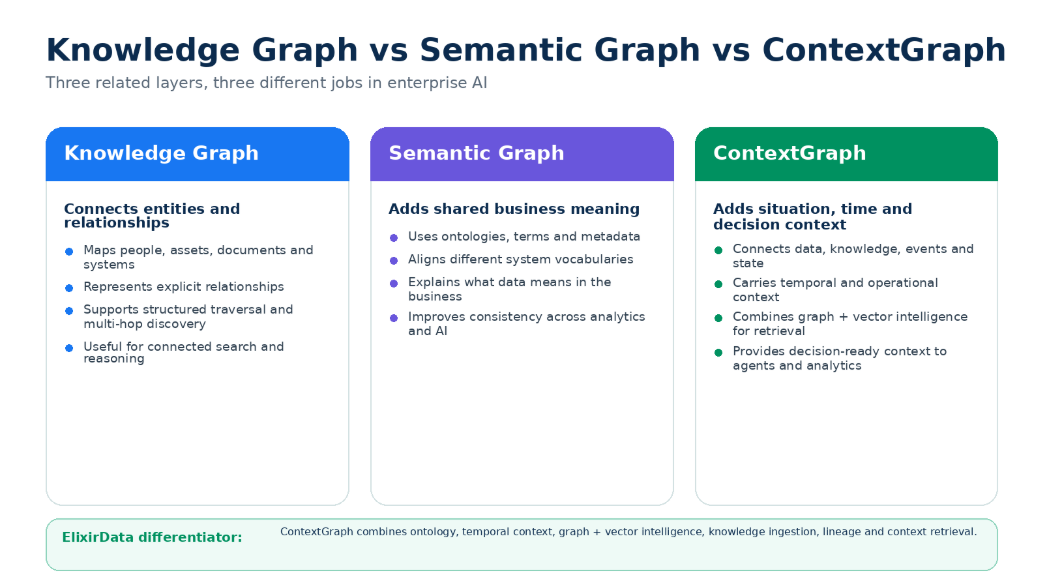
Figure 2. Knowledge graphs, semantic graphs and ContextGraphs are complementary rather than interchangeable.
Why RAG alone is not enough for complex enterprise questions
Retrieval-augmented generation (RAG) is useful when an answer is in a few relevant passages. It becomes harder when an answer depends on a chain across documents or systems. In an AWS GraphRAG example, a compliance analyst traces a delayed milestone through a master agreement, an amendment and a risk memo. The dependency is not contained in any one retrieved chunk.
Microsoft Research also describes “global” questions that require themes across a corpus, not a handful of local matches. GraphRAG uses entities, relationships and community summaries for that retrieval problem. Google’s agentic RAG research illustrates iterative searching across sources. These are complementary techniques; neither automatically supplies an organization’s policy authority or current operational state.
Choose retrieval by question. Vector search finds semantically similar content, structured queries obtain current facts and measures, and graph traversal follows explicit relationships. A governed context layer compiles their results with provenance, time and permissions before the agent relies on them.
Get the Executive Blueprint for governed enterprise AI
A practical guide for CIOs, CAIOs and risk leaders on moving AI agents from pilot to production without losing control of context or decisions.
ElixirData differentiation: a Context OS, not a standalone graph database
ElixirData can maintain the enterprise context model across ingestion, identity mapping, semantic definitions, quality checks, lineage, temporal state and retrieval. The ContextGraph is useful when those mappings remain current as source systems and policies change. For the ontology and semantic foundations, see ElixirData’s overview of semantic AI.
The context layer combines structured records, operational events and relevant knowledge with graph and vector retrieval. It should show where each fact came from, when it was valid and which policy applies. This lets teams assess whether a context package is complete enough for a proposed decision.
In the illustrated architecture, ElixirData maintains and serves context; ElixirHub registers reusable skills; ElixirClaw runs agents, checks permissions, executes tools and records approval and action; Agentic BI presents analytics. That division makes it easier to test the evidence and approval path independently of any one model.
Forecasting, anomaly detection and recommendations can remain separate models. An agent may call them through approved interfaces, but their outputs must be interpreted against source context, policy and an appropriate human approval boundary.
How the architecture works from context to action
The context path starts with enterprise systems. ElixirData ingests structured and unstructured information, maps fields, normalizes records and applies ontology so that the same business concept can be understood across sources. Entity resolution and relationship modeling connect records that describe the same customer, asset, supplier, contract or process. Temporal context records how state and relationships change over time. Data quality and lineage preserve trust and traceability.
When an agent receives a task, the context layer should retrieve only the relevant entities, relationships, event sequence, policies and supporting evidence within its access scope. Source references and timestamps let a reviewer inspect how the answer was assembled. ElixirData’s article on the context layer for AI describes the broader architecture.
ElixirClaw can use the retrieved context inside a workflow. Before a system write, it should check identity, permissions, decision boundaries and any required human approval. The resulting trace records the evidence, tool call, approval and outcome so the decision can be audited and evaluated.
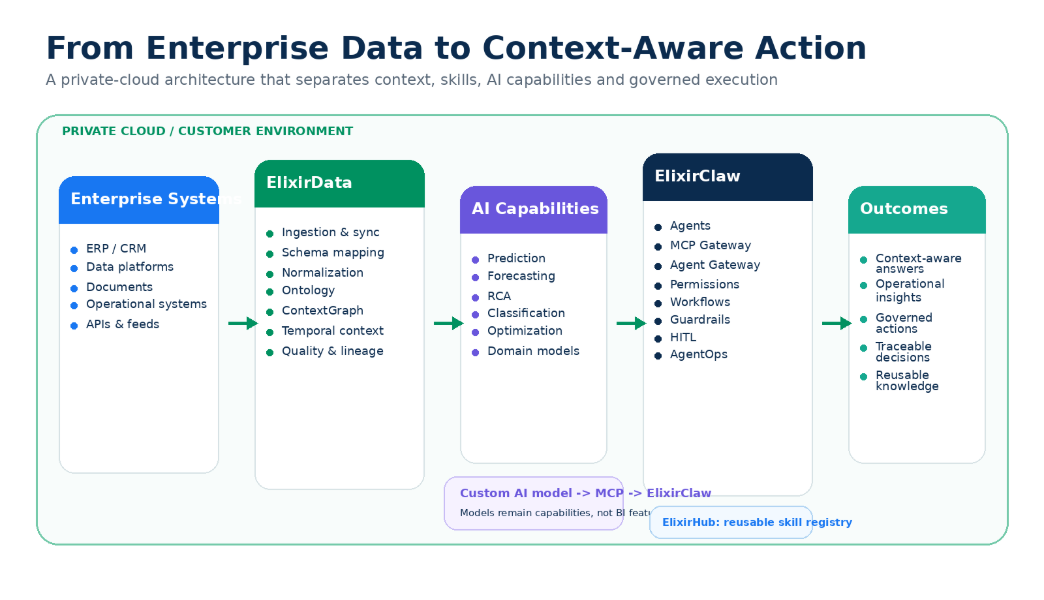
Figure 3. Canonical Elixir architecture: enterprise context in ElixirData; reusable skills in ElixirHub; AI capabilities through MCP; agents and governed actions in ElixirClaw.
Why the context layer becomes more important on private cloud
Private-cloud deployment can keep source connections, context stores and agent execution inside a customer-approved environment. The more consequential design question is how sources are joined, how permissions are enforced and which evidence and policy versions an agent used. Those controls require implementation and testing regardless of hosting location.
A reusable context model can outlast a particular language model or prompt. Entity mappings, definitions, event history, policy versions and approved skills remain available as teams test new models, provided the context is maintained and validated.
With context in ElixirData, reusable skills in ElixirHub and governed execution in ElixirClaw, teams can assign ownership to each part of the decision path. That separation helps them investigate errors in data, retrieval, reasoning or action without treating every failure as a model problem.
Where ContextGraph creates business value
Manufacturing operations: Connect machines, alarms, process parameters, maintenance history, work orders and engineering knowledge so an operations agent can investigate downtime with the full event and asset context.
ERP modernization: Create a context layer across ERP, CRM, procurement, finance and documents so agents can reason over business processes without replacing the systems of record.
Data quality operations: Connect a quality issue to upstream sources, schemas, owners, lineage and downstream dashboards so an agent can investigate impact and launch a governed remediation workflow.
Contract and legal intelligence: Link matters, contracts, clauses, obligations, amendments, counterparties and regulations to support cross-document discovery, renewal tracking and risk analysis.
Customer and service operations: Connect customers, products, cases, entitlements, interactions and operational events so service agents can respond with account-specific context instead of generic guidance.
Asset and infrastructure operations: Relate assets, locations, ownership, telemetry, incidents, maintenance windows and policy to support context-aware investigations and actions.
Outcomes to measure
Measure whether ContextGraph improves a specific business decision. Establish a baseline for time spent gathering evidence, answer accuracy on multi-system questions, time to investigate incidents and the rate of actions completed within policy. Node and edge counts describe implementation size, not the outcome.
Supporting measures include retrieval precision, multi-hop answer accuracy, evidence coverage, freshness, entity resolution quality, policy adherence and escalation rates. Review failed cases with business owners to identify whether the gap came from source data, mapping, retrieval or approval rules.
Frequently Asked Questions
How is a ContextGraph different from a knowledge graph?
A knowledge graph represents entities and relationships. A ContextGraph also captures the operating state, applicable policy, decision authority and evidence needed to understand or act in a particular situation.Does ContextGraph replace RAG or a vector database?
No. Vector retrieval can find relevant passages, while graph traversal follows explicit links and structured queries obtain current facts. ContextGraph can combine these results with provenance, time and governance.Why does temporal context matter?
A contract amendment, machine state or access permission may change. An agent must know which version was valid when an event or decision occurred and whether it still applies now.Can agents act directly on ContextGraph answers?
The graph supplies decision context. A separate execution workflow should check permissions and policy, require approval when needed, and record the action and outcome.Where should an enterprise start?
Choose one decision that repeatedly requires cross-system research. Identify its source records, entities, event sequence, policies and approvers, then measure evidence-gathering time and decision quality against a baseline.
Context is becoming the operating substrate for enterprise AI
Enterprise AI depends on more than model capability. It needs a reliable way to determine which facts are current, how records relate, what policy applies, who has authority and what happened after a decision.
ContextGraph connects entity and semantic models with events, evidence and decision history. ElixirData can serve that context to agents and analytics; ElixirClaw can then apply governed workflows, while ElixirHub manages reusable skills. Each layer has a distinct role in making an answer traceable and an action reviewable.
Take the next step
Download the Executive Blueprint, or talk to our team about a ContextGraph for your enterprise AI.