Employee offboarding creates risk when access is closed in one system while company devices remain outside enterprise custody. A departing employee may have a laptop, phone, security key, engineering workstation, loaner device, or specialist equipment. Some assets are recorded in ITAM, others appear only in MDM or endpoint security, and still others are known to the manager or service desk but not linked to the employee record.
The operational sequence spans several teams. HR establishes the departure and effective time. Identity teams disable accounts and sessions. Security decides whether a device should be locked or preserved. Asset teams arrange recovery. Logistics tracks shipment and custody. Endpoint teams inspect, sanitize, and re-enroll the returned device. Finance and ITAM teams need a final status that supports lease, depreciation, redeployment, or loss treatment.
Traditional workflows break this sequence into tickets and checklists. A completed identity ticket can make the case look closed even though a laptop is still active, a courier label was never used, or ITAM still assigns the device to the former employee. Automated device recovery needs one governed case that links the person, accounts, devices, risk, logistics, evidence, and final asset state.
AgenticAssetOps supports this operating model through ElixirData for trusted context, ElixirHub for reusable offboarding skills, and ElixirClaw for controlled execution. AI agents coordinate the work, but sensitive actions remain subject to policy, human approval, privacy requirements, and evidence that the requested action is appropriate.
Real World Operational Challenge
Consider a global engineering company whose employees work across offices, customer sites, and home locations. A remote engineer leaves at the end of the week. HR records the separation date. Identity shows a standard account, a privileged engineering role, active application sessions, and access to sensitive design repositories. ITAM lists a laptop and mobile phone. MDM reports the laptop as encrypted and recently active, but the phone has not checked in for several days. The service desk also issued a loaner laptop that was never linked back to the asset record.
The manager knows the employee moved recently, while logistics still has the original shipping address. A legal review requires retention of project data, so wiping the laptop at termination would be inappropriate. The security team wants access revoked at the effective time and the devices placed under control. The asset team needs a return kit, tracking number, reminders, and escalation if the shipment is not accepted. Finance needs to know whether each device was recovered, written off, returned to a lessor, or prepared for redeployment.
No single platform contains the full decision. HR has the exit event but not the device list. Identity has accounts but not physical custody. MDM has live telemetry but may not include accessories or loaners. ITAM has financial records but may hold stale assignments. Courier systems confirm movement but not device identity. A manual coordinator must compare all these records, decide which controls apply, and chase each exception until closure.
If the process stalls, the organization carries several forms of exposure: active credentials, data on an unrecovered endpoint, weak chain of custody, lost equipment, inaccurate inventory, continued lease or support cost, and incomplete audit evidence.
Why Traditional Offboarding Falls Short
Most offboarding processes automate individual tasks rather than the complete outcome. They can disable an account, create a service ticket, or send a return label, but they do not always reconcile whether the right device was recovered and whether every source now agrees.
-
HR events may be future-dated, corrected, cancelled, or recorded in a different time zone from the access action.
-
Scheduled resignations and immediate high-risk terminations require different timing, approvals, and communication paths.
-
ITAM, CMDB, MDM, endpoint security, service desk, and manager records can list different devices for the same person.
-
A device can be offline, unmanaged, under repair, shared, leased, personally owned, or subject to legal hold.
-
Return labels do not prove shipment, shipment does not prove receipt, and receipt does not prove sanitization or inventory correction.
-
Remote lock or wipe can destroy required evidence, affect personal data, or interrupt an approved handover if used without context.
-
Cases are often closed when access is disabled even though device recovery, custody, and final lifecycle status remain unresolved.
The enterprise needs an operating model that treats access closure and device recovery as related but independently verified obligations. Agentic AI is useful when it resolves the context around those obligations and remains constrained by explicit decision boundaries.
How Agentic AI Changes the Operating Model
The operating loop is Detect, Understand Context, Decide, Approve, Act, Verify, and Learn. Detection begins with a validated HR or contractor exit event and can also identify orphaned devices assigned to an inactive identity. Understanding context links the person to accounts, privileges, assigned assets, management telemetry, data sensitivity, employment type, work location, legal restrictions, and recovery policy. This governed pattern reflects the production requirements described in XenonStack's Agentic AI infrastructure guidance.
The decision step creates an offboarding plan for the specific case. It determines which access actions occur at the effective time, which devices require recovery, whether a control such as remote lock is justified, how the return will be arranged, and which evidence is needed for closure. Approval applies HR, security, legal, privacy, finance, and asset authority where relevant.
Action invokes approved identity, endpoint, service-management, communication, and logistics operations. Verification confirms that access is closed, sessions and tokens are handled, the correct devices entered the recovery chain, returned serial numbers match the case, required data was preserved or sanitized, and the asset records reflect the final state. Learning improves rules and exception handling using reviewed outcomes.
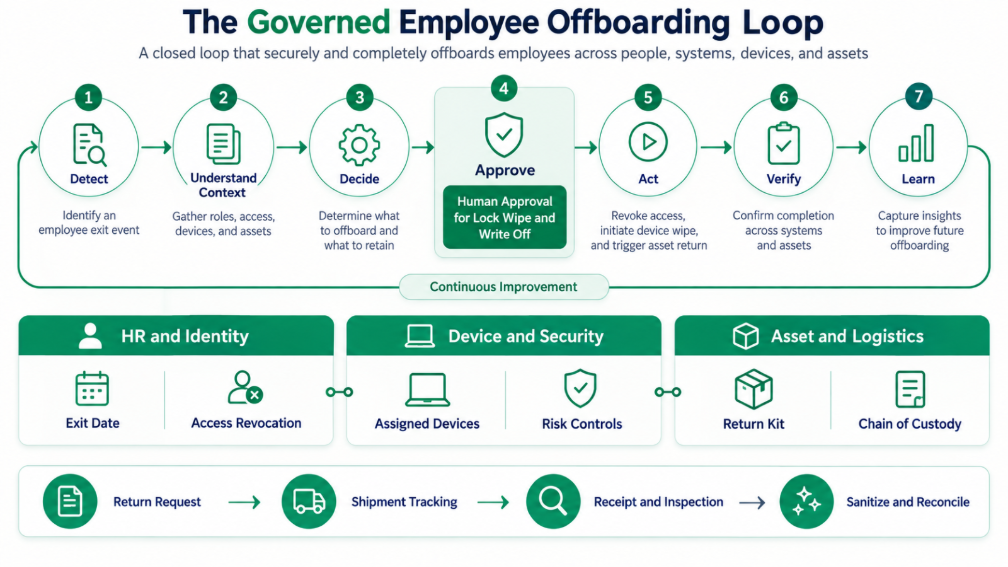
The governed loop coordinates HR timing, access closure, device controls, recovery logistics, chain of custody, sanitization, and reconciliation.
Target Use Case Workflow
The workflow starts when the source-of-record exit event reaches an approved state. The agent validates employee identity, departure type, effective timestamp, manager, legal entity, country, work arrangement, and whether the event can still change. It then creates one offboarding case and correlates the employee with all known accounts and assets.
-
Reconcile devices from ITAM, CMDB, MDM, endpoint security, directory registration, service-desk loaners, procurement, and manager attestation.
-
Classify each item as company owned, leased, shared, personally owned, virtual, accessory, security token, or out of scope.
-
Assess risk from privilege, sensitive data, recent activity, encryption, management status, device location, offline duration, and separation type.
-
Create a timed access plan that separates account revocation from device actions and preserves approved handover, legal hold, or investigation requirements.
-
Verify the recovery address through an authorized privacy-aware process, then create the return request, packaging instructions, courier label, and communication schedule.
-
Track label creation, pickup, carrier scans, delivery, receiving scan, serial confirmation, physical inspection, and chain-of-custody evidence.
-
Route the returned device to quarantine, preservation, sanitization, reimage, repair, redeployment, lessor return, disposal, or loss review according to policy.
-
Reconcile ITAM, CMDB, MDM, service desk, and financial status only after independent verification of the final outcome.
When a device is not returned, the agent does not invent a disposition. It escalates reminders according to policy, verifies whether the package was delivered, requests manager or asset-steward attestation, evaluates current device telemetry, and opens a loss or recovery investigation. Financial write-off, insurer notification, legal escalation, and remote wipe remain separate governed decisions.
Enterprise Architecture for the Use Case
A reliable architecture separates systems of record, contextual reasoning, reusable policy, and action. HR remains authoritative for employment state and effective time. Identity systems own accounts and entitlements. ITAM owns commercial custody and lifecycle. CMDB contributes configuration and service relationships. MDM and endpoint security provide management and protection state. Logistics and service-management platforms retain return and custody events.
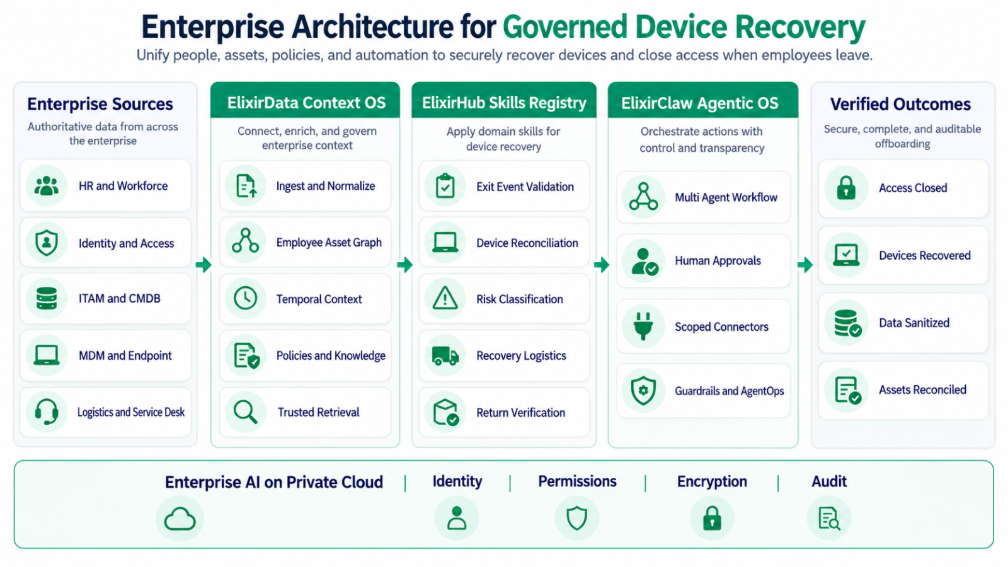
ElixirData, ElixirHub, and ElixirClaw connect workforce, identity, asset, endpoint, and logistics systems to governed device recovery and verified closure.
The context layer keeps each source's ownership and time validity. An HR event does not become authority over endpoint evidence, and an MDM user association does not automatically replace ITAM custody. The architecture relates these facts so that the offboarding case can detect disagreement, request review, and retain the complete decision trace.
Role of ElixirData
ElixirData provides the Context OS for employee offboarding automation. Data ingestion and synchronization bring together HR events, contractor records, identities, entitlements, privileged roles, assigned assets, configuration items, endpoint telemetry, support history, shipping addresses, courier events, receiving scans, legal holds, and sanitization evidence. Schema and field mapping normalize employee IDs, device identifiers, serial numbers, user accounts, locations, timestamps, and lifecycle states.
Ontology management defines the relationships needed for the case. A person holds a role, owns accounts, has entitlements, uses devices, and may be responsible for assets. A device contains data, has a management state, moves through custody events, and ends in a verified lifecycle state. ContextGraph connects these records and exposes gaps such as an active device with an inactive identity or an ITAM assignment without a corresponding recovery task.
Temporal context prevents premature action. It distinguishes notice date, last working time, access cutoff, last device contact, label creation, carrier pickup, receipt, inspection, sanitization, and reconciliation. Knowledge ingestion adds offboarding policies, regional privacy rules, legal-hold instructions, device-return procedures, escalation paths, and sanitization standards. Graph and vector intelligence retrieve the facts and policy relevant to each case, while agent memory retains open obligations until closure.
Reusable Operational Skills with ElixirHub
ElixirHub stores offboarding logic as governed skills with defined inputs, permissions, output contracts, evaluations, and versions. This supports a consistent enterprise control model while allowing regional logistics and employment policies to vary.
-
Exit Event Validation Skill confirms the person, departure type, effective time, source status, and required decision authorities.
-
Employee Device Reconciliation Skill links ITAM, CMDB, MDM, endpoint, service-desk, procurement, and manager evidence into an assigned-device set.
-
Offboarding Risk and Control Skill evaluates privilege, data sensitivity, management state, legal restrictions, and permitted endpoint actions.
-
Device Recovery Logistics Skill prepares return instructions, validates delivery details, tracks shipment milestones, and escalates overdue returns.
-
Return Inspection and Sanitization Verification Skill validates identity, custody, condition, data treatment, and final asset reconciliation.
Versioning makes each case reproducible. The enterprise can show which policy classified the separation, which skill identified a device, why a control was recommended, who approved it, and which evidence closed the case. Publishing and evaluation controls prevent untested skills from changing production offboarding workflows.
Governed Execution with ElixirClaw
ElixirClaw provides the Agentic OS for coordinating specialized agents. An event agent validates the exit. An identity agent builds the access plan. An asset agent reconciles assigned devices. A risk agent applies security and legal constraints. A logistics agent manages return steps. A verification agent confirms access, custody, sanitization, and asset status before closure.
Connectors and MCP interfaces expose bounded operations such as creating an offboarding case, scheduling approved access changes, requesting endpoint synchronization, creating a return label, sending an approved communication, checking shipment status, recording a receiving scan, updating a permitted asset field, or opening an incident. Permissions limit each operation by system, field, device, action, region, and time.
Guardrails prevent execution when the exit event is unconfirmed, the effective time is ambiguous, the device identity is disputed, a legal hold applies, the requested action exceeds policy, or required approval is missing. Evaluations and AgentOps test device matching, timing, approval routing, privacy handling, tool selection, escalation, and closure evidence. Agentic BI shows access exceptions, unrecovered devices, shipment delays, missing custody events, sanitization backlog, loss reviews, and reconciliation gaps.
Enterprise AI on Private Cloud
Offboarding context combines sensitive employment events, personal contact and address data, privileged access, device locations, endpoint security state, commercial values, service relationships, and legal instructions. Bringing those records together increases the impact of unauthorized access or cross-border data movement.
Enterprise AI on Private Cloud keeps models, ContextGraph retrieval, agent memory, policy evaluation, and execution within the enterprise boundary. On-premises or private-cloud deployment supports data-sovereignty and regulatory requirements and allows direct private integration with HR, identity, ITAM, CMDB, MDM, security, service desk, and logistics systems. Regional deployments can limit which personal attributes leave a jurisdiction. For related operating-model guidance, see XenonStack's autonomous IT infrastructure approach.
Existing identity, privileged access, encryption, key management, segmentation, retention, monitoring, and records-management controls can govern the runtime. Credentials stay in approved secret stores, and connectors expose narrow operations rather than unrestricted administration. Models and skills pass enterprise testing and change control before they can influence live offboarding cases.
Security Governance and Human Oversight
Offboarding governance should separate the authority to confirm employment status, revoke access, apply endpoint controls, release personal data to logistics, preserve evidence, accept loss, write off an asset, and approve sanitization or disposal. The agent can prepare evidence and execute authorized steps, but it should stop when the case crosses one of these boundaries.
|
Offboarding condition |
Agent response |
Required control |
|
Scheduled standard departure |
Prepare return and timed access plan |
Validated effective time, manager review, and policy checks |
|
Immediate or high risk termination |
Prioritize access closure and protective controls |
HR and security authority with recorded timing |
|
Personally owned or mixed use device |
Remove only approved enterprise access or data |
Privacy policy, ownership proof, and scoped endpoint action |
|
Legal hold or active investigation |
Preserve data and block destructive actions |
Legal or investigation owner approval |
|
Device offline or not recovered |
Keep case open and escalate recovery or loss review |
No closure without custody or approved disposition evidence |
The audit trace should preserve the exit event, effective time, device inventory, source timestamps, risk decision, policy and skill versions, approvals, communications, access operations, endpoint actions, shipment events, custody transfers, inspection, sanitization, exceptions, and final asset status. This supports asset-inventory controls, account-management controls, and media-sanitization controls without assuming that one completed ticket proves the entire outcome.
Business Outcomes
The enterprise should compare the agentic workflow with a measured baseline. Useful indicators include time from validated exit to access closure, devices identified per case, return-request lead time, overdue shipment age, recovery completion, missing custody events, sanitization cycle time, unreconciled asset records, and analyst effort. Outcomes should remain directional until a pilot supplies credible data.
|
Outcome |
How the workflow contributes |
Evidence to monitor |
|
Lower offboarding risk |
Access device and custody obligations stay in one governed case |
Open access exceptions and unresolved device controls |
|
Higher device recovery |
Agents identify assets and manage return milestones |
Requested shipped received and overdue devices |
|
Faster closure |
Parallel work begins from shared context and timed decisions |
Time to access closure recovery receipt and reconciliation |
|
Better inventory accuracy |
Returned serials and final states reconcile across systems |
Former employees with assigned assets and mismatched status |
|
Lower manual effort |
Agents assemble evidence and target teams to exceptions |
Research time handoffs reminders and reopened cases |
|
Stronger audit readiness |
Every decision and custody event retains traceable evidence |
Missing approvals custody gaps and incomplete sanitization |
The business case should use observed baselines instead of assumed recovery or savings percentages. The first proof point is whether the enterprise can close access and recover or formally dispose of devices with complete, consistent evidence.
Enterprise Adoption Approach
Start with one employee population, one country, and a small set of corporate laptops with reliable HR, identity, ITAM, and MDM data. Define the event source, effective-time semantics, device ownership rules, risk classes, approval matrix, recovery service levels, custody evidence, and closure criteria. Record the current baseline before enabling agent recommendations.
-
Run agents in recommendation mode and compare device lists, risk classifications, and recovery plans with HR, security, identity, and asset teams.
-
Evaluate historical scheduled departures, immediate terminations, contractors, remote workers, loaners, repairs, BYOD, legal holds, and unrecovered devices.
-
Enable case creation, evidence gathering, return logistics, and reminders before granting endpoint or asset-write permissions.
-
Introduce bounded actions for reversible, low-risk steps and retain named approval for lock, wipe, loss, write-off, and disposal decisions.
-
Require independent verification of access closure, device receipt, sanitization, and asset reconciliation before case completion.
-
Scale through approved regional policies, additional device classes, connectors, skills, and AgentOps evaluation suites.
A successful pilot leaves the enterprise with a reusable employee-asset graph, offboarding ontology, policy matrix, evaluation cases, connector scopes, custody model, exception workflow, and auditable definition of closure. Those foundations can also support contractor exits, internal transfers, extended leave, device refresh, and lost-device response.
Conclusion
Employee offboarding is complete only when access, devices, data, custody, and asset records reach verified end states. Closing the identity ticket is necessary, but it does not recover a laptop, confirm a returned serial number, preserve required data, or correct the asset register.
AgenticAssetOps provides the architecture for this closed loop through ElixirData for trusted workforce and asset context, ElixirHub for governed offboarding skills, and ElixirClaw for approved action and verification. Enterprise AI on Private Cloud keeps sensitive employee, access, device, and logistics context inside the enterprise boundary.
The target outcome is measurable: access closes at the right time, company devices move through a traceable recovery process, destructive actions remain governed, and each offboarding case ends with evidence that the asset is recovered, sanitized, redeployed, returned, disposed, or formally accepted as a loss. In this model, employee offboarding automation becomes a verified control process rather than a collection of disconnected tickets.
Frequently Asked Questions
-
What is employee offboarding automation?
Employee offboarding automation coordinates the tasks required when an employee or contractor leaves, including identity closure, device recovery, logistics, endpoint controls, asset reconciliation, and audit evidence. The goal is not simply to close tickets, but to verify that access, devices, data, custody, and asset records reach an approved end state. -
How does automated device recovery reduce offboarding risk?
Automated device recovery creates a governed case that connects the exit event with assigned devices, return logistics, chain-of-custody evidence, endpoint status, and final asset disposition. This reduces the chance that a laptop or mobile device remains active, untracked, or incorrectly assigned after access has been removed. -
How can AI reconcile ITAM, CMDB, and MDM data during employee offboarding?
AI agents can compare employee-to-device relationships across ITAM, CMDB, MDM, endpoint security, service-desk, procurement, and manager records. A context layer can preserve source ownership, timestamps, and confidence so discrepancies are surfaced for review rather than silently overwritten. -
Should an enterprise wipe a departing employee's device immediately?
Not always. A wipe may be inappropriate when legal hold, investigation, data-retention, BYOD, privacy, or approved handover requirements apply. The safer pattern is to evaluate device ownership, data sensitivity, management state, and authority before a destructive action, then require the appropriate approval and evidence. -
What evidence should be required before an offboarding case is closed?
Closure evidence should typically confirm the effective exit event, access revocation, assigned-device inventory, shipment or custody events, returned serial numbers, inspection results, sanitization or preservation status, required approvals, and reconciled asset records. Unrecovered devices should remain open until recovery or a formally approved loss disposition is recorded.