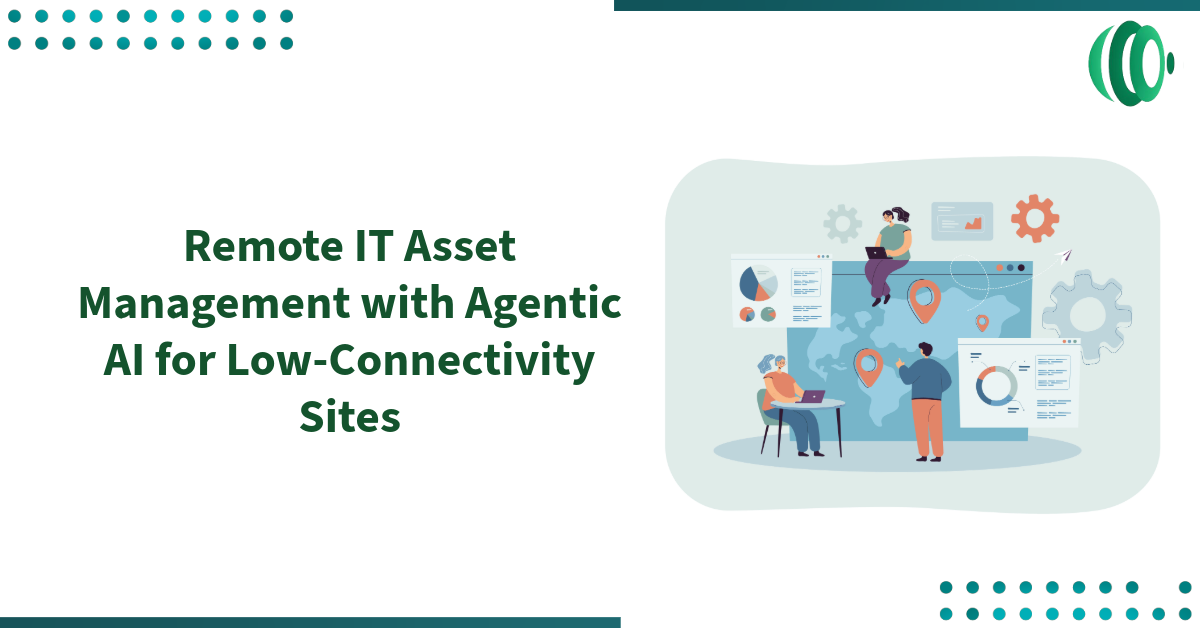
What Is Remote IT Asset Management with Agentic AI
Remote IT asset management maintains accurate custody, location, configuration, and lifecycle evidence for devices operating at branch offices, plants, project sites, field locations, and other low-connectivity environments. Agentic AI enables approved local workflows to capture and validate events during outages, while central systems are updated only after governed synchronization and reconciliation.
The problem is operational, not merely technical. A plant may delay a maintenance task because the approved device cannot be located. Security may treat a legitimate replacement as an unknown endpoint. Finance may continue depreciating equipment against the wrong site. Central teams may ship additional stock even though usable assets already exist locally. The longer the evidence remains outside enterprise systems, the harder it becomes to establish custody, configuration, and accountability.
This operating model separates local continuity from enterprise authority. With Agentic AI for IT asset management, governed workflows can capture evidence at the edge, support offline IT asset management, reason over the most recent trusted context, apply preapproved rules, queue actions safely, and perform IT asset reconciliation when a connection becomes available. High-risk decisions still wait for current policy, complete evidence, or human approval. The result is remote asset tracking that remains useful during disruption and becomes consistent after synchronization.
AgenticAssetOps supports this model through ElixirData for trusted context, ElixirHub for reusable operational skills, and ElixirClaw for governed execution. Together, these layers create a distributed IT asset management architecture that supports bounded autonomous asset operations across intermittent networks without treating either the local register or the central database as automatically correct.
Remote Asset Risks at Low Connectivity Sites
Consider an engineering company operating project sites in mountainous regions. Each site uses rugged laptops, tablets, handheld scanners, wireless access points, switches, printers, and specialist test equipment. The primary connection is cellular, with a slower satellite link for essential traffic. Weather and terrain can interrupt both. Central endpoint telemetry may disappear for several days, while local staff continue issuing devices, replacing failed equipment, and moving assets between crews.
At one site, a supervisor issues a spare tablet after the assigned device fails. The asset label is readable, but its local record still shows the previous custodian. The central CMDB lists the tablet at another project, endpoint management last observed it twelve days earlier, and procurement associates it with a contract that has just closed. A pending security update is recorded centrally, but the site does not know whether the update package completed before the connection failed.
The supervisor needs a decision before the next shift. Waiting for every central system may stop work, but proceeding without controls may create duplicate assignments or put a noncompliant device into service. The operating model must support a safe provisional state and later prove what happened.
Why Traditional Remote IT Asset Management Fails
Most IT asset management processes assume continuous access to a central application. Mobile screens may cache a form, but the underlying workflow still depends on a live identity check, current policy, or immediate database update. When that assumption fails, staff create side processes that central teams cannot see or govern.
-
Batch uploads show the final record but often lose the sequence of issue, return, repair, replacement, and receipt events.
-
Last-write-wins synchronization can overwrite a valid local observation with an older central value, or accept an unverified local change as authoritative.
-
Asset identifiers vary across barcode labels, serial numbers, endpoint IDs, hostnames, purchase records, and locally assigned tags.
-
A stale policy or user record may be mistaken for current authorization when the site cannot reach identity and compliance systems.
-
Central dashboards report missing telemetry but cannot distinguish a network outage from a lost device, a powered-down spare, or an unauthorized move.
-
Manual reconciliation consumes specialist time and often closes discrepancies without preserving the evidence behind the decision.
Conventional rules remain useful for deterministic validation and data movement. Agentic AI adds value when remote IT asset management must combine partial evidence, conflicting timestamps, site procedures, delayed telemetry, and approval boundaries while staying within explicit policy and permissions. This is where Agentic AI for IT asset management can move the operating model beyond offline forms and batch synchronization toward evidence-aware remote asset operations.
How Agentic AI Supports Remote IT Asset Management
The operating loop is Detect, Understand Context, Decide, Approve, Act, Verify, and Learn. At a remote site, detection may begin with a barcode scan, an endpoint event, a local stock count, a repair request, or a missing-device exception. Understanding context means resolving the physical asset and comparing locally observed state with the last verified enterprise state. The agent must preserve the age, source, and confidence of each fact rather than merging them into one unqualified record.
The decision step classifies the request and determines whether the site may proceed. A low-risk reassignment within an approved project may be permitted provisionally under a current policy pack. Issuing a sensitive device, changing financial ownership, wiping data, or moving an asset across a jurisdiction may require a live approval and must wait. Action is limited to the operations allowed for that class. Verification checks local evidence immediately and central evidence after synchronization. Learning identifies recurring conflicts, weak site procedures, and assets that repeatedly disappear from reliable observation.
Locally observed state records what the site saw. Enterprise verified state records what the organization accepted after policy and reconciliation. The agent connects these states without implying that a disconnected event already updated every system of record.
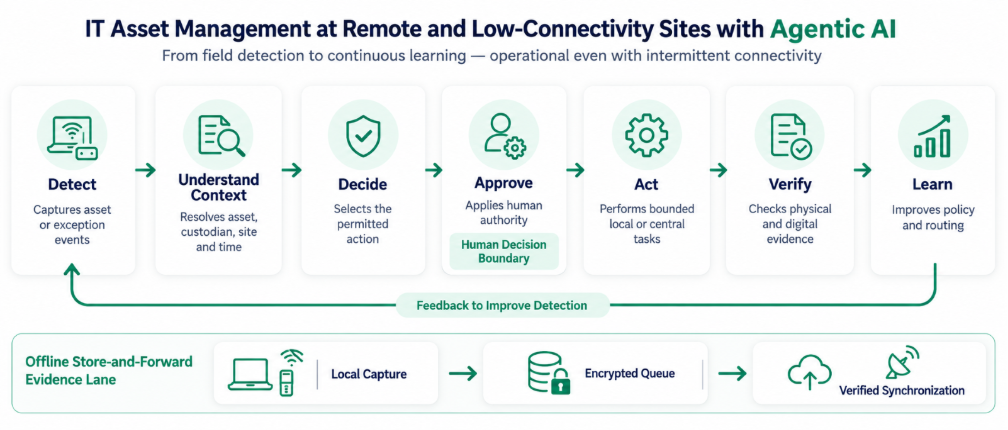
The governed operating loop continues during disruption through local capture, an encrypted queue, and verified synchronization.
Remote IT Asset Workflow for Low Connectivity Sites
The tablet replacement begins when the supervisor scans the failed device and the spare. A site agent records the device labels, local time, operator identity, work order, reason for replacement, and available endpoint posture. It resolves both devices against the cached asset graph and flags that the spare has conflicting location and custodian records.
- Validate the scanner or workstation, operator identity, site, project, and policy-pack version before accepting the event.
- Resolve the asset from barcode, serial number, endpoint ID, hostname, procurement record, and recent observations without creating a new duplicate record.
- Assess role eligibility, asset sensitivity, encryption state, repair status, software restrictions, and the age of supporting evidence.
- Select an approved local path, such as provisional issue, quarantine, return to stock, repair intake, or hold for central review.
- Capture custody evidence with timestamps, device signatures, reason codes, and required acknowledgements, then store it in an encrypted local queue.
- On reconnection, synchronize the event sequence, retrieve newer enterprise context, identify conflicts, and request human resolution where authority is unclear.
- Verify the tablet through endpoint check-in, recipient confirmation, and consistent source-system updates before promoting the provisional state to verified.
If the link fails again during synchronization, the workflow resumes from the last acknowledged event rather than replaying every action blindly. Idempotent connector operations prevent duplicate tickets and assignments. The agent keeps unresolved conflicts visible, and the central record remains unchanged until the required evidence and approvals are present.
Architecture for Offline and Remote IT Asset Management
A resilient architecture has an edge operating zone and a private enterprise control zone. The edge zone includes mobile capture, barcode or RFID readers, a local inventory cache, an encrypted event queue, current policy packs, and narrowly scoped connectors to site systems. It can continue recording and validating permitted events without a wide-area connection. It cannot grant itself new authority or silently modify central records.
The enterprise zone contains the authoritative context, skills registry, agent orchestration, human approval services, and integrations with ITSM, CMDB, identity, endpoint management, procurement, ERP, logistics, and security platforms. Synchronization moves signed event envelopes rather than replacing whole records. Each envelope carries the source, effective time, observation time, policy version, actor, and evidence references needed for reconciliation.
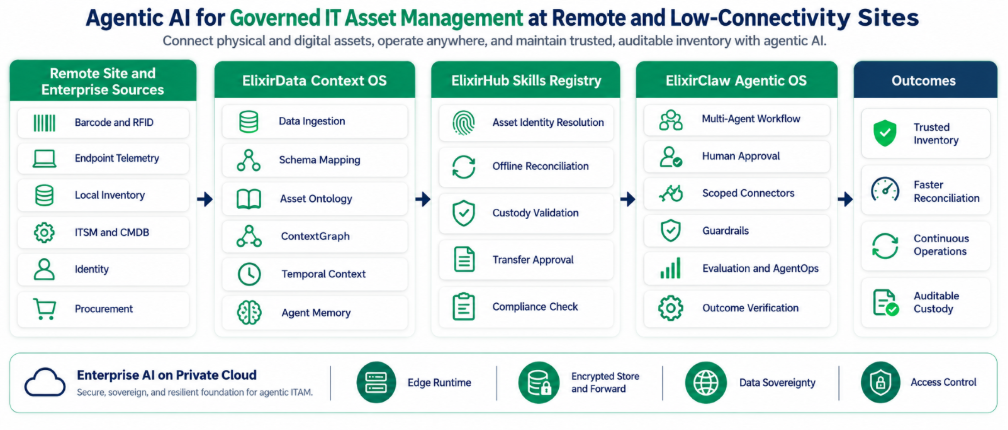
ElixirData, ElixirHub, and ElixirClaw connect edge evidence with enterprise policy, governed execution, and verified outcomes on private cloud infrastructure.
Systems of record retain their defined authority. The context layer relates identity, endpoint, procurement, financial, and asset records and exposes contradictions. The agentic layer coordinates approved changes without replacing the control model of the underlying platforms.
Trusted Remote Asset Context with ElixirData
ElixirData provides the Context OS for remote IT asset management and distributed asset operations. It ingests and synchronizes central data and remote-site events, while schema and field mapping normalize serial numbers, asset tags, endpoint IDs, people, sites, projects, custody states, policy versions, and timestamps. A remote observation can therefore be connected to the existing enterprise asset even when local labels or field names differ, improving remote asset tracking and IT asset reconciliation.
Ontology management defines the operational relationships: an asset is observed at a site, assigned to a custodian, allocated to a project, covered by a contract, configured with software, and subject to security and movement policies. ContextGraph connects these entities. Temporal context distinguishes when an event occurred, when it was recorded locally, when it synchronized, and when the enterprise verified it. That distinction is essential when events arrive late or out of order.
Knowledge ingestion makes remote-site procedures, asset standards, repair guides, security policies, and exception rules retrievable during a decision. Graph and vector intelligence combine structured asset relationships with relevant work notes and policy text. Context retrieval supplies only the evidence needed for the current decision. Agent memory retains the workflow state and outstanding evidence without converting a provisional observation into a permanent fact.
Reusable Remote Asset Skills with ElixirHub
ElixirHub provides a governed registry for the operational skills used at the edge and in the enterprise. Each skill declares required inputs, allowed execution environments, policy dependencies, output contract, evaluation criteria, and version. A site receives only the approved skill and policy versions appropriate to its geography, asset classes, and operating role.
-
Asset Identity Resolution Skill links scans and endpoint signals to the correct enterprise asset while preventing duplicate creation.
-
Offline Evidence Validation Skill checks signatures, timestamps, required fields, operator authority, and evidence completeness before an event is queued.
-
Custody State Transition Skill validates issue, return, transfer, repair, storage, quarantine, and loss states against permitted transitions.
-
Synchronization Conflict Resolution Skill orders delayed events, compares local and enterprise states, and proposes a resolution with supporting evidence.
-
Remote Site Compliance Skill checks encryption, configuration, role eligibility, local procedures, and jurisdiction constraints before an asset is placed in service.
Versioning makes offline decisions reproducible. When an event synchronizes, the enterprise can identify exactly which skill and policy pack supported the local action. Governance controls who can author, evaluate, approve, publish, and retire each skill. Reuse provides consistent controls across sites while still allowing approved local extensions.
Governed Remote Asset Execution with ElixirClaw
ElixirClaw provides the Agentic OS for coordinating local and central agents. A site agent captures and validates evidence. A context agent assembles the current enterprise view. A policy agent classifies the decision boundary. A reconciliation agent compares event histories, and an execution agent invokes permitted tools. Multi-agent workflows can evaluate identity, device posture, custody, and policy in parallel, but the final action still follows one governed case state.
Enterprise connectors and MCP interfaces expose bounded operations such as opening a service ticket, reserving a spare, updating an approved CMDB field, requesting endpoint attestation, or notifying a custodian. Site connectors expose an even smaller set of local operations. Permissions bind each agent to a site, asset class, action type, and record scope. Human approval remains mandatory for sensitive assets, destructive actions, financial changes, cross-border movement, policy exceptions, and unresolved identity conflicts.
Guardrails block actions when policy is missing, evidence is too old, or the operation exceeds the agent's authority. Evaluations and AgentOps test identity resolution, conflict handling, queue replay, and outcome verification. Agentic BI shows synchronization age, provisional assignments, unresolved conflicts, stale policy packs, and missing check-ins.
Private Cloud AI for Remote IT Asset Management
Remote asset operations combine employee identity, location, device telemetry, security posture, and financial ownership. Keeping models, context, policy evaluation, agent memory, and execution inside the enterprise boundary reduces exposure and allows existing security controls to govern the workflow.
Enterprise AI on Private Cloud supports central deployment in a private cloud or data center, with approved edge runtimes at sites that need offline continuity. Encryption, enterprise identity, key management, network segmentation, privileged access, logging, and monitoring apply across both zones. Data-sovereignty rules can restrict which event fields leave a region, while the context graph retains references and verified relationships within the permitted boundary.
The edge runtime should contain the minimum context and skills needed for its work. It should use signed policy packs, encrypted storage, bounded retention, and explicit expiration. When a policy pack expires or the requested action requires current central evidence, the agent stops and waits. This keeps low-connectivity support aligned with governance rather than turning the edge into an unmanaged copy of the enterprise platform.
Security Governance and Human Oversight
The control model should classify actions by risk, connectivity, evidence quality, and reversibility. A scan and provisional custody record may continue offline. A device wipe, ownership change, or sensitive assignment should not. The decision trace must preserve the local observation, cached context, skill and policy versions, approval identity, queued action, synchronization result, and final verified state.
|
Operating condition |
Agent response |
Required control |
|
Connected with current context |
Execute approved low-risk workflow |
Scoped permissions and outcome verification |
|
Disconnected with current policy |
Record a permitted provisional action |
Signed policy pack and complete local evidence |
|
Disconnected with high-risk request |
Hold the request for enterprise review |
Human approval and current central context |
|
Expired policy or identity cache |
Stop execution and preserve the request |
Reconnect before making the decision |
|
Synchronization conflict |
Quarantine the disputed state |
Evidence-based reconciliation or human resolution |
Operational resilience testing should include long outages, clock drift, partial uploads, duplicated messages, lost devices, compromised site credentials, and conflicting actions from two locations. The agent must fail safely, preserve evidence, and resume deterministically. Audit records should support asset inventory controls such as NIST SP 800-53 CM-8 and CIS Control 1 without claiming compliance from automation alone.
Business Outcomes and Performance Measures
The business case should start with measured baselines. Useful measures include days since last verified inventory, number of provisional assignments, time to reconcile after reconnection, unresolved asset conflicts, manual site follow-ups, and equipment shipped because local availability was uncertain. Directional outcomes can then be assessed without inventing savings percentages.
|
Outcome |
How the workflow contributes |
Evidence to monitor |
|
Higher inventory accuracy |
Late and offline events remain ordered, attributable, and reconciled |
Mismatch backlog and time to verified state |
|
Continuous site operations |
Permitted low-risk work continues under current local policy |
Work delayed by connectivity and provisional action volume |
|
Lower manual effort |
Agents assemble evidence and target only unresolved exceptions |
Analyst time, follow-up messages, and reconciliation rework |
|
Improved asset utilization |
Local stock becomes visible after verified synchronization |
Idle assets, emergency shipments, and spare availability |
|
Better security and compliance |
Stale policy and high-risk requests stop at explicit boundaries |
Expired policy events, blocked actions, and missing attestations |
|
Reduced business risk |
Custody and decision evidence survives outages and delayed sync |
Unattributed assets, disputed assignments, and audit exceptions |
A successful pilot should show that the enterprise can locate assets more reliably, operate through outages without bypassing controls, and reconcile faster when connectivity returns. It should also reveal where local procedures, labels, or systems create avoidable ambiguity.
How to Implement Remote IT Asset Management
Begin with a small set of remote sites that have recurring connectivity gaps and a manageable asset scope. Define which data source is authoritative for each field, which events may be captured offline, which actions may be provisional, how long cached policy remains valid, and what evidence promotes a local observation to an enterprise verified state. Baseline current reconciliation effort before introducing agents.
-
Run the agent in observation mode to compare local events with central records without changing either source.
-
Test identity resolution and event ordering on historical discrepancies, including duplicate tags and delayed telemetry.
-
Introduce offline evidence capture and encrypted store-and-forward before enabling any local action.
-
Enable reversible, low-risk workflows first and keep sensitive or destructive operations behind live approval.
-
Exercise extended outages and failed synchronizations, then confirm that queued work resumes without duplication.
-
Scale through approved skills, policy packs, site profiles, connector scopes, and shared AgentOps evaluations.
The pilot should leave the enterprise with a remote-site asset ontology, defined temporal states, a reconciliation policy, tested failure modes, and an auditable decision boundary. Those foundations can support project mobilization, spare management, repairs, refresh programs, returns, loss investigation, and compliant disposition across the broader estate.
From Offline Tracking to Governed Asset Operations
Low connectivity does not remove the need for accurate inventory or governed decisions. It changes how evidence must be captured, qualified, and synchronized. A resilient operating model records what happened locally, preserves the authority and timing of each fact, and promotes changes to enterprise systems only after policy and verification requirements are met.
AgenticAssetOps provides that architecture through ElixirData for trusted temporal context, ElixirHub for governed operational skills, and ElixirClaw for bounded action and reconciliation. Enterprise AI on Private Cloud keeps sensitive asset and workforce context within the enterprise boundary while supporting approved edge execution where continuous connectivity is not available.
The measurable result is remote IT asset management that remains operational during disruption, supports governed autonomous asset operations where appropriate, and returns the distributed asset estate to a trusted, auditable state after the network recovers.
Frequently Asked Questions
-
How does Agentic AI manage assets during a network outage
Agentic AI uses cached, approved policy and the latest trusted asset context to validate low-risk local events. It stores signed evidence in an encrypted queue, preserves event order and synchronizes the records when connectivity returns. Sensitive or irreversible actions remain blocked until current enterprise context or human approval is available. -
Can AI agents update a CMDB while a remote site is offline
A safe design does not treat an offline observation as an immediate authoritative CMDB update. The site records a provisional event locally. After reconnection, the workflow compares timestamps, identifiers, policies and evidence, resolves conflicts and updates the CMDB only when verification requirements are satisfied. -
Which systems should integrate with remote asset management
Typical integrations include ITAM, CMDB, ITSM, MDM, endpoint management, identity, HR, procurement, ERP, logistics and security platforms. Barcode or RFID readers, local inventory tools and endpoint telemetry provide field evidence, while governed connectors restrict each agent to approved records and actions. -
How are remote asset actions governed and secured
Controls should include authenticated users and agents, least-privilege permissions, signed policy packs, encrypted local storage, bounded retention, human approval for high-risk work, tamper-evident decision traces and outcome verification. Expired policy, stale identity data or conflicting evidence should stop execution and preserve the request for review. -
Which KPIs measure remote IT asset management success
Useful KPIs include inventory accuracy, days since last verified observation, provisional assignment volume, reconciliation time after reconnection, unresolved conflicts, missing check-ins, manual follow-up effort, emergency shipments, idle asset levels and audit exceptions. Measure these against a pre-pilot baseline before estimating ROI.