AI asset transfer automation uses governed AI agents to validate, approve, track and reconcile equipment moves between employees, offices, projects and remote sites, so every handoff keeps chain-of-custody evidence and enterprise records agree once the transfer is complete.
What Is Agentic AI Asset Transfer Automation?
Agentic AI asset transfer automation uses governed AI agents to coordinate equipment movement between employees, offices, projects, stockrooms, and remote sites. It connects each transfer request with verified asset identity, custody, approval, logistics, receipt, and reconciliation data so the physical handoff and enterprise records remain aligned.
The resulting delay creates more than an administrative problem. A new employee may wait for equipment while usable assets sit idle. Security may see a device reporting from an unexpected network. Finance may charge depreciation to the wrong cost center. The CMDB may show the original custodian even after the recipient has signed for the package. When the transfer evidence is fragmented, the enterprise cannot prove who is accountable for the asset at a given time.
Asset transfer automation addresses this operating gap by treating every handoff as a governed change in the enterprise context. As part of a broader Agentic AI asset management strategy, AI agents for IT asset management can assemble the transfer request, validate asset and recipient eligibility, assess risk, obtain approval, initiate authorized tasks, monitor the shipment, confirm receipt, and perform IT asset reconciliation across source systems. The value comes from connecting decisions and evidence, not from replacing asset, logistics, identity, or service-management platforms.
Agentic AssetOps supports this approach through ElixirData for trusted context, ElixirHub for reusable operational skills, and ElixirClaw for governed execution. The architecture enables bounded autonomous asset operations: AI agents receive enough enterprise context to make useful transfer decisions while consequential actions remain inside explicit policy, connector permissions, and human approval boundaries.
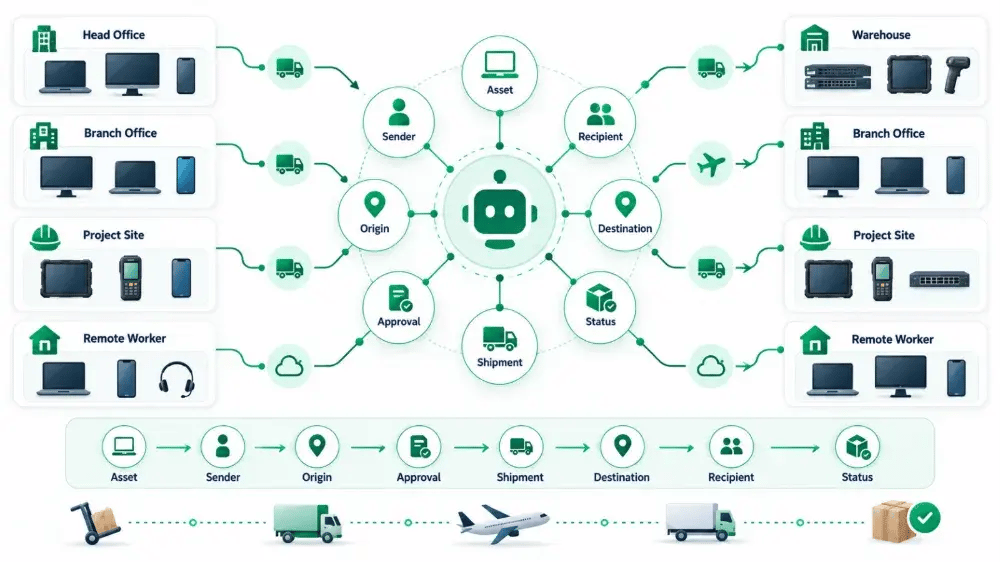
Agentic I asset transfer automation connects asset identity, custody, approval, logistics, receipt, lifecycle status, and IT asset reconciliation across distributed locations.
See how Context OS governs AI agent decisions
Context OS gives asset transfer agents trusted custody, identity and policy context before any record changes.
What Is the Asset Transfer Risk Across Distributed Locations?
Consider a global engineering company closing a six-month project at a client site. Several laptops, rugged tablets, monitors, network devices, and test instruments must move to new projects. One laptop is allocated to a remote employee in another region. The project register marks it available, but endpoint management still associates it with the departing engineer. The CMDB lists the client site as its location, procurement links it to the old project cost center, and a service ticket shows a pending memory upgrade.
The transfer cannot safely proceed on the project manager's instruction alone. The enterprise must confirm that the device is the intended asset, the old custodian has released it, the recipient is authorized, the destination is permitted, and required security controls are present. The memory upgrade must either be completed or consciously deferred. A cross-border shipment may also require logistics and compliance review. Each question has a different owner and evidence source.
If the team relies on email, spreadsheets, and disconnected tickets, the device can remain in an ambiguous state for days. A courier may collect it before the security team clears the destination. The recipient may receive it without a recorded acceptance event. Local teams may create duplicate records when the central inventory does not update. The transfer appears complete physically, while the enterprise systems still disagree.
Why Do Traditional IT Asset Transfer Processes Fail?
Most asset platforms record assignment and location, but the transfer process often sits between systems. A ticket can route tasks, yet it usually cannot resolve conflicting asset identities or determine whether a delayed endpoint signal is relevant. A spreadsheet can coordinate a local move, but it provides weak controls for authority, versioning, evidence, and enterprise-wide reconciliation.
- Transfer requests arrive through email, chat, ticket, project plan, or local inventory process with inconsistent fields.
- Asset, employee, project, site, and shipment identifiers do not align across CMDB, ITSM, identity, procurement, and logistics systems.
- Approvals become generic checkboxes even when risk depends on asset sensitivity, recipient role, destination, or cross-border movement.
- Chain-of-custody evidence breaks between release, packaging, carrier collection, local receipt, and final user acceptance.
- System updates occur at different times, allowing a completed physical transfer to remain unresolved in digital records.
Conventional automation handles predictable field updates. It struggles when the decision depends on context spread across structured records, free-text notes, policy documents, and temporal events. That is where AI agents can change the operating model, provided their access and decisions remain governed.
How Does Agentic AI Automate IT Asset Transfers?
The enterprise operating loop remains Detect, Understand Context, Decide, Approve, Act, Verify, and Learn. For an asset transfer, the request or a planned project closure provides the detection event. Understanding context means resolving the asset, current custodian, recipient, origin, destination, service state, security posture, and policy. The decision determines whether the transfer is eligible and which conditions apply. Approval enforces human authority. Action initiates tasks and integrations. Verification confirms receipt and consistent records. Learning identifies recurring delays, exceptions, and policy gaps.
This sequence prevents a common design error: allowing an agent to treat a transfer request as permission to change every connected system. The request is an input, not an authorization. The agent must establish the current state, apply policy, preserve uncertainty, and escalate when evidence is missing or contradictory.
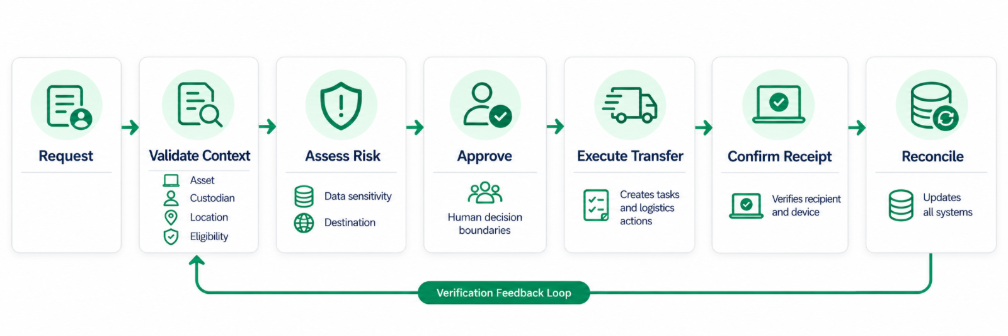
The transfer-specific workflow maps request, context, risk, approval, execution, receipt, and reconciliation to the governed Agentic AI loop.
How Does the Agentic AI Asset Transfer Workflow Run Across Offices and Remote Sites?
The workflow begins when a project manager requests the laptop transfer. The transfer agent creates a case and resolves the serial number, device ID, hostname, barcode, current assignment, service history, and procurement record. It checks whether the source custodian has released the device and whether another open transfer, repair, legal hold, or disposal workflow exists.
- Validate the recipient against identity, employment status, role, project assignment, location, and approved device profile.
- Assess asset sensitivity, encryption, endpoint compliance, software entitlements, warranty, repair status, and destination restrictions.
- Select the correct transfer path, including local handoff, stockroom staging, domestic courier, international shipment, or project-site collection.
- Request approval from the asset owner, project owner, security, finance, or compliance only when policy requires their authority.
- Create the ITSM, endpoint, stockroom, packaging, shipping, and notification tasks through scoped connectors.
- Track custody events from release through carrier collection, destination receipt, recipient authentication, and device check-in.
- Reconcile assignment, location, cost center, project, software entitlement, and transfer status after verification succeeds.
If the destination office has intermittent connectivity, the workflow can accept a signed local receipt and hold the case in a provisionally verified state. When endpoint or network evidence arrives, the agent completes reconciliation or raises a targeted exception. It does not hide missing evidence by marking the transfer complete early.
What Is the Enterprise Architecture for Governed Asset Transfers?
A reliable design separates systems of record, context, policy, and execution. ITSM remains authoritative for workflow tasks. The CMDB remains authoritative for defined configuration fields. Identity establishes people and roles. Endpoint management supplies device posture and observation events. Logistics proves movement, while procurement and ERP provide ownership and financial context. The architecture links these domains without forcing one platform to become authoritative for everything.
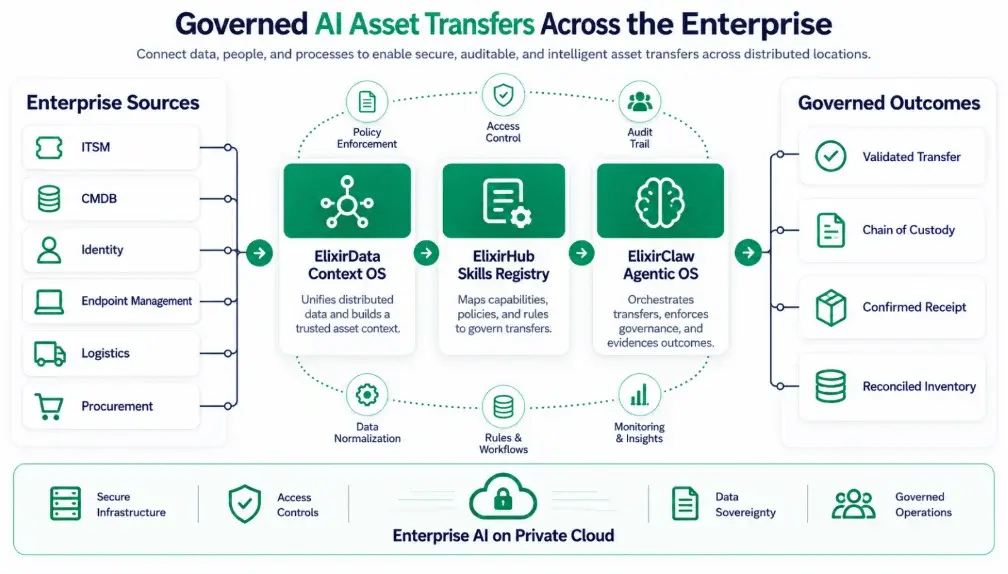
ElixirData, ElixirHub, and ElixirClaw connect enterprise sources to validated transfers, custody evidence, confirmed receipt, and reconciled inventory.
The context layer maintains the relationship between the physical asset and each operational record. The skills layer contains reusable transfer logic and policy. The agentic execution layer invokes only approved actions through scoped connectors. Identity, access control, audit, evaluation, and human approval apply across all layers. This structure allows the enterprise to improve automation without granting a general-purpose model unrestricted control over inventory, security, logistics, or financial systems.
Get the Executive Blueprint for governed enterprise AI
A practical guide for CIOs, CAIOs and risk leaders on moving AI agents from pilot to production without losing control of context or decisions.
How Does ElixirData Provide Trusted Transfer Context?
ElixirData provides the Context OS for IT asset transfer automation. It ingests and synchronizes data from ITSM, CMDB, identity, endpoint management, procurement, ERP, logistics, facilities, project systems, and local inventory tools. Schema mapping normalizes fields such as serial number, device identifier, employee ID, project code, site, cost center, transfer status, and timestamp, creating a trusted context for IT asset reconciliation and asset lifecycle management.
Ontology management defines the entities and relationships that matter: an asset is assigned to a custodian, allocated to a project, located at a site, covered by a contract, included in a shipment, and subject to a policy. ContextGraph connects those records, while temporal context shows when each assignment, observation, approval, and custody event became valid. This matters because a transfer is a sequence of changing relationships rather than one status field.
Knowledge ingestion makes transfer policies, shipping instructions, security standards, device profiles, and site procedures retrievable during the case. Graph and vector intelligence combine structured relationships with relevant notes and documents. Context retrieval gives the agent the evidence required for the current decision, and agent memory retains case progress without turning an earlier assumption into permanent truth.
How Does ElixirHub Provide Reusable Asset Transfer Skills?
ElixirHub provides a governed registry for reusable IT asset transfer skills. Each skill defines its inputs, policy dependencies, output contract, evaluation criteria, and version. Approved skills can be published once and reused across offices, projects, service desks, and regional asset teams, giving Agentic AI asset transfer automation consistent business logic without hard-coding rules into individual agents.
- Transfer Eligibility Skill validates the asset, source custodian, recipient, destination, and allowed transfer path.
- Asset Configuration Validation Skill checks device posture, required accessories, repair status, and role-specific standards.
- Custody Chain Validation Skill confirms release, collection, transit, receipt, and final acceptance events.
- Transfer Approval Routing Skill determines which owners must approve based on policy and risk.
- Receipt and Reconciliation Skill verifies recipient identity and device evidence before synchronizing enterprise records.
Versioning makes transfer decisions reproducible. The enterprise can identify which skill and policy version supported a shipment, evaluate changes before promotion, and roll back faulty logic. Governance determines who can author, approve, discover, and execute each skill. Reuse reduces regional variation without eliminating legitimate local rules.
How Does ElixirClaw Govern Asset Transfer Execution?
ElixirClaw provides the Agentic OS for coordinating AI agents for IT asset management. A context agent assembles evidence, a policy agent evaluates eligibility and risk, an orchestration agent plans the approved steps, and an execution agent invokes enterprise tools. Multi-agent workflows can run in parallel where tasks are independent, such as checking endpoint compliance while validating recipient eligibility.
Connectors and MCP interfaces expose bounded operations such as creating an ITSM task, reserving stock, generating a shipping request, updating an approved CMDB field, sending a receipt challenge, or requesting endpoint verification. Permissions restrict which agent can call each operation and which records it may affect. Human approvals remain explicit for sensitive assets, cross-border movement, financial ownership changes, policy exceptions, and security actions.
Evaluations and AgentOps test classification quality, evidence use, policy adherence, tool behavior, and verification. Agentic BI shows transfer aging, blocked approvals, missing receipts, reconciliation failures, and recurring route problems. The decision trace records the request, context, skill, and model versions, approval, connector calls, and verified outcome.
Why Use Private Cloud AI for Secure Asset Transfers?
Asset transfers combine employee identity, device telemetry, project allocation, site information, network observations, shipment details, security posture, and financial data. The assembled context can reveal where people and equipment operate, which devices hold sensitive data, and how projects are organized. That makes the execution boundary a material architecture decision.
Private cloud AI keeps models, context retrieval, agent memory, policy evaluation, and tool execution for Agentic AI asset transfer automation within the enterprise boundary. Existing identity, privileged access, encryption, key management, network segmentation, logging, and monitoring controls can govern the agent runtime. Regional context services can enforce data residency and restrict cross-border transfer of employee or device data.
On-premises or private-cloud deployment also supports plants, field sites, healthcare environments, and regulated operations with limited connectivity. A site can record custody events locally, apply approved transfer rules, and synchronize evidence when connectivity returns. Legacy inventory and logistics systems can participate without sending sensitive records outside approved networks.
How Are Security Governance and Human Oversight Handled?
Transfer automation should separate the authority to investigate, recommend, approve, and execute. Read access can be broad enough to establish context, but write access should be narrow, reversible where possible, and tied to a defined workflow. The agent must stop when required evidence is missing, the destination violates policy, or the requested action exceeds its permission.
| Transfer condition | Agent response | Required control |
| Standard internal transfer | Validate and prepare the transfer plan | Approved policy, verified identities, scoped write access, and outcome verification |
| Sensitive device or data | Escalate for security review | Security approval and confirmed destination controls |
| Cross-border movement | Check the route and jurisdiction rules | Compliance and logistics approval before shipment |
| Conflicting custody evidence | Pause execution and open an exception | Human resolution of the authoritative state |
| Receipt not confirmed | Maintain transfer-in-progress status and escalate | No final assignment change until acceptable evidence arrives |
The audit trace should preserve the records retrieved, their effective times, policy and skill versions, approval identity, tool calls, errors, and final verification. This evidence supports operational review and controls, such as the NIST SP 800-53 system component inventory requirement. It also makes failures diagnosable when an integration, policy, or agent changes.
What Are the Business Outcomes and Performance Measures?
Enterprises should measure Agentic AI asset transfer automation against a defined baseline. Useful measures include the age of open transfers, time waiting for approval, proportion of transfers with complete chain-of-custody evidence, IT asset reconciliation delay, asset redeployment cycle time, and manual effort per exception. Directional outcomes include the following.
| Outcome | How the workflow contributes | Evidence to monitor |
| Faster asset availability | Validated transfers move reusable equipment to the next approved recipient | Request-to-ready time and time spent waiting at each handoff |
| Higher utilization | Idle project assets become visible and eligible for reassignment | Available inventory, idle days, and redeployment cycle time |
| Lower manual effort | Agents assemble evidence and coordinate repeatable tasks | Analyst time, follow-up volume, and exception rework |
| Reliable chain of custody | Every release, movement, receipt, and acceptance event remains linked | Transfers with complete sender, carrier, recipient, and timestamp evidence |
| Improved inventory accuracy | Verification triggers synchronized assignment, location, and financial updates | Mismatch rate and reconciliation delay across systems |
| Reduced business risk | Policy gates stop unauthorized destinations and sensitive transfers | Blocked policy exceptions, missing receipts, and overdue escalations |
The business case should use measured baselines rather than assumed savings percentages. A pilot should prove that the workflow completes transfers with better evidence, less elapsed time, and fewer unresolved discrepancies before the organization expands autonomous actions.
How Do You Implement Agentic AI Asset Transfer Automation?
Start with one transfer route that has sufficient volume and clear pain, such as project closure to the regional stockroom or the stockroom to the remote employee. Define the authoritative source for each field, expected synchronization delay, required custody events, approval owners, and acceptable receipt evidence. Build only the context graph needed for that route.
- Run the agent in recommendation mode and compare its transfer plan with that of experienced asset analysts.
- Evaluate identity resolution, policy selection, exception classification, and evidence completeness using historical cases.
- Enable low-risk actions first, including task creation, notifications, reservations, and evidence collection.
- Retain approval for sensitive, cross-border, financial, and exception-based transfers until performance is proven.
- Require receipt verification and system reconciliation before closing every transfer.
- Scale through approved skills, reusable connectors, regional policy extensions, and workflow-level monitoring.
A successful pilot leaves the enterprise with a reusable transfer ontology, integration patterns, decision boundaries, evaluation cases, and an auditable operating process. Those foundations can later support loaners, repairs, refresh programs, returns, warranty exchanges, and compliant disposition.
From Manual Transfers to Governed Asset Operations
An IT asset transfer is a controlled change to custody, location, configuration, financial ownership, and operational responsibility. Treating it as a ticket update creates gaps whenever the physical asset and digital records move at different speeds. Agentic AI asset transfer automation closes those gaps by using AI agents to assemble context, apply policy, coordinate approved actions, preserve the chain of custody, and verify the result across systems.
Agentic AssetOps provides the operating architecture for that process. ElixirData establishes trusted transfer context and asset intelligence, ElixirHub governs reusable transfer skills, and ElixirClaw executes authorized workflows with human oversight. Private cloud AI keeps sensitive identity, asset, project, and movement data inside the enterprise boundary while supporting governed autonomous asset operations where the organization is ready for them.
The target outcome is simple to measure: assets reach the right recipient sooner, every handoff remains attributable, and enterprise records agree after the transfer is complete.
Take the next step
Download the Executive Blueprint, or talk to our team about governed asset transfer automation.
ElixirData: Frequently Asked Questions
-
How is this different from standard ITSM ticketing for asset transfers?
A ticket can route tasks, but cannot resolve conflicting asset identities across systems or judge whether a delayed endpoint signal matters. AI agents assemble context from the CMDB, identity, endpoint, and logistics systems before a transfer is approved, closing gaps that ticket-based processes leave open. -
What is chain-of-custody automation in IT asset management?
Chain-of-custody automation captures and links every event in a transfer, from release and packaging through carrier collection, destination receipt, and recipient acceptance, so the enterprise can prove who was accountable for an asset at any point in time. -
Does Agentic AI asset transfer automation replace existing ITSM and CMDB platforms?
No. It connects decisions and evidence across existing systems of record. ITSM remains authoritative for workflow tasks and the CMDB for configuration fields, while AI agents act through scoped connectors rather than replacing these platforms. -
Can Agentic AI asset transfer automation run in a private cloud for compliance reasons?
Yes. Private cloud AI keeps models, context retrieval, agent memory, and tool execution inside the enterprise boundary, which supports data residency requirements and regulated or low-connectivity environments such as plants and healthcare sites.