

Enterprise AI has moved from answering questions to doing work. Agents now draft, route, update records and trigger workflows across Salesforce, ServiceNow, SAP and the rest of the stack.
That shift changes the governance question. It used to be "who can see this document?" Now it is "who approved this action?"
Glean is one of the best answers to the first question. ElixirData was built for the second.
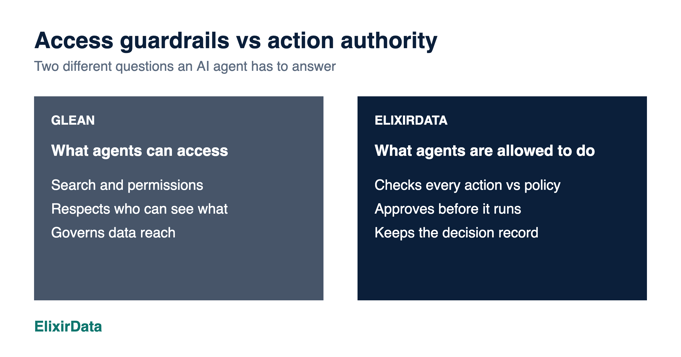
The short answer: Glean governs what your agents and employees can access. ElixirData governs what your agents are allowed to do — it checks each consequential action against policy and authority before it runs, escalates when it should, and keeps audit-grade evidence.
What Glean does well
Glean is one of the fastest-growing companies in enterprise software, passing $300M in annual recurring revenue in May 2026. Its strengths are clear:
- The Enterprise Graph — a permission-aware map of people, content and activity across 100+ SaaS applications.
- Glean Assistant — an AI assistant every employee can use, grounded in company knowledge with citations.
- Glean Agents — a no-code builder that lets teams create, share and run agents in natural language, with model choice across many LLMs.
- Glean Protect — permission enforcement, sensitive-data protection, prompt-injection defences and agent alignment controls that keep agents within their intended scope.
If your problem is "our people can't find anything, and we want every team building agents on company knowledge", Glean is a strong choice.
The gap: guardrails are not authority
Guardrails answer can this agent see this, and is it staying on task? Authority answers may this agent do this, at this value, without a human?
Take a finance agent built on company knowledge. It finds the right contract, the right vendor record and the right purchase order. Permissions are respected; nothing leaks. It then proposes to release a $1.2M payment.
Access controls have done their job. But three questions remain, and they are about the action, not the data:
- Is this within policy? Spend thresholds, vendor risk ratings, segregation of duties, month-end freezes.
- Is this within the agent's authority? Your delegation-of-authority matrix says a payment of this size needs a CFO-level approver.
- Is it provable? When internal audit samples this payment next year, can you replay exactly what the agent saw, which rule applied and who signed off?
These are the controls finance, risk and compliance teams already run for people. As agents start to act, they need the same controls — enforced in the execution path, not reviewed in a log afterwards.
That is the decision layer, and it is what ElixirData does.
Glean vs ElixirData at a glance
| Glean | ElixirData | |
|---|---|---|
| Category | Work AI platform: search, assistant, agent builder | Decision layer / Context OS for governed agent actions |
| Core question answered | "What do we know, and who can see it?" | "Is this action allowed, by whom, and can we prove it?" |
| Primary user | Every employee; IT runs the platform | Risk, compliance, operations and AI platform teams |
| Core asset | Enterprise Graph across 100+ SaaS apps | Context Graph, dual-gate policy engine, Decision Traces |
| Governance focus | Permissions, sensitive data, agent scope and alignment | Policy, authority and approvals for each consequential action |
| When it checks | At retrieval and during agent runs | Before reasoning (Gate 1) and before execution (Gate 2) |
| Outcome of a check | Restrict access; keep agent in scope | Allow, modify, escalate to a named approver, or block |
| Evidence | Audit logs | Full-lineage Decision Traces: context, policy version, authority, approver, result |
| Autonomy model | Agents run as built | Trust Graduation: shadow → supervised → bounded → full autonomy |
| Deployment | SaaS, single-tenant VPC, on-premises option | SaaS, customer VPC, on-premises, hybrid, edge |
| Pricing model | Per employee seat, plus usage credits for advanced AI | Per governed decision, published plans |
Glean scales with people. ElixirData scales with decisions that carry risk. That difference shapes where each one belongs.
Better together: Glean agents read, ElixirData approves
Glean and ElixirData fit naturally in the same agent workflow:
- An employee asks a Glean agent to process a vendor renewal.
- Glean gathers the knowledge — the contract, past correspondence, the vendor record — respecting every permission.
- The agent drafts the action — renew for three years at a 12% uplift.
- ElixirData Gate 2 evaluates it — against procurement policy, budget limits and delegation of authority.
- Within limits, it proceeds. Above them, it escalates to the right approver, with the full context attached.
- ElixirData records the Decision Trace — what the agent knew, which rule applied, who approved, what happened.
- Over time, the trust level rises — actions that are consistently approved can move to bounded autonomy, with evidence to justify it.
Glean makes agents knowledgeable and easy to build. ElixirData makes their actions controllable and auditable. Low-risk work flows freely; high-risk work gets the right oversight.
One platform: ElixirData, ElixirClaw and ElixirHub
Glean is a platform for the whole workforce. The Elixir platform is built for agents that act inside operations — security, IT, finance, risk — and it has three parts:
- ElixirData (Context OS) — compiles business context, enforces policy and authority with dual gates, and writes Decision Traces. It governs what agents know and how decisions are made.
- ElixirClaw (Agentic OS) — the operating system agents run on. Orchestration, 200+ pre-built skills, and digital workers such as Agent SOC, Agent GRC, Agent IAM and Agent FinOps, with autonomy levels set per skill and enforced by policy.
- ElixirHub (agent supply chain) — a registry of signed, attested, version-pinned skills, agents, evaluators, MCP tools, policy templates and ontologies, with Official, Verified Partner and Community trust tiers.
| Need | Glean | Elixir platform |
|---|---|---|
| Find knowledge, assist employees | Glean Assistant, Enterprise Graph | Not our focus — use Glean |
| Build and run agents | Glean Agents no-code builder, many LLMs | ElixirClaw Agentic OS, 200+ skills, operational digital workers |
| Control agent actions | Glean Protect: access, sensitive data, scope, alignment | ElixirData dual gates, authority, escalation, Decision Traces |
| Autonomy | Agents run as built | Autonomy levels per skill, raised as evidence builds |
| Share agents and skills | Shared and governed inside Glean | ElixirHub: signed, attested, version-pinned registry with trust tiers and SOX/IFRS policy templates |
| Deployment | SaaS, single-tenant VPC, on-premises option | Managed cloud, VPC/hybrid, on-premises, air-gapped |
For productivity agents, Glean is a natural home. For operational agents that touch money, access and infrastructure, ElixirClaw runs them, ElixirData governs them and ElixirHub supplies trusted building blocks.
From demo to production: where each fits across the 5 layers
Enterprise agent programmes follow the same path — prototype, pilot, production, scale — across five layers: scope, architecture, observability, operations and optimisation. The architecture layer itself has four jobs: Know (retrieval), Act (tools and actions), Remember (memory) and Coordinate (orchestration). Mapping both platforms onto that path shows where each earns its place.
| Layer | The question it asks | Glean | Elixir platform |
|---|---|---|---|
| 1. Scope & assumptions | Who is the user, what outcome improves, what stays human, how much autonomy? | Every employee; productivity outcomes | Operational workflows with a named risk owner; the agency–control trade-off is set as autonomy levels per workflow |
| 2a. Know | Does the agent retrieve the right, permitted knowledge? | Strongest here — Enterprise Graph, permission-aware search across 100+ apps | ElixirData Context Graph for decision context; works alongside Glean's knowledge |
| 2b. Act | Approved tools, least privilege, trust boundaries, prompt-injection defence? | Agent actions with Glean Protect: permissions, scope, prompt-injection defence | ElixirData dual gates check policy and authority before execution; ElixirClaw zero-trust runtime; ElixirHub signed MCP tools with scopes |
| 2c. Remember | What does the agent keep, and why? | Personal and enterprise memory to personalise answers | Decision Traces kept as audit evidence, with retention by plan |
| 2d. Coordinate | Single agent first; multi-agent only when earned? | Agent builder and orchestration for business users | ElixirClaw orchestration and digital workers for SOC, GRC, IAM, FinOps |
| 3. Observability & evals | Are inputs, tool calls, retries, costs and errors logged and scored? | Agent Development Lifecycle to build, govern and measure agents | Every gate check and tool call written to a Decision Trace; ElixirHub evaluators; human review through escalation |
| 4. Production & ops | Scale, latency, reliability, freshness, security, audit? | SaaS scale, fresh indexes, enterprise security | AgentOps, audit trails, SLAs, and VPC, on-prem or air-gapped deployment |
| 5. Advanced optimisation | Lower latency and cost, higher quality, complexity only when earned? | Model choice; seat plus usage-credit pricing | Per-decision pricing, model-agnostic routing, reusable signed assets, and autonomy raised only on evidence |
Glean is strongest at Know and at putting agents in every employee's hands. The Elixir platform is strongest at Act, at operational Coordinate, and at the evidence side of Remember and Observability — the layers that decide whether an agent that moves money or changes access ever leaves the pilot. A prototype proves an agent can work. Production proves it can be trusted.
Which do you need, Glean or ElixirData?
- Choose Glean first if your priority is employee productivity: finding knowledge, answering questions and letting every team build helpful agents.
- Choose ElixirData first if your agents act on money, access, customers or infrastructure, and a risk owner must be able to stop, approve and explain those actions.
- Run both if you want broad agent adoption across the workforce and you operate under regulators, auditors or a board that will ask how agent decisions are controlled.
A simple test: count the agent actions that would need a human signature if a person did them. If that number is above zero, you need a decision layer.
Glean vs ElixirData: Frequently asked questions
Is ElixirData a Glean alternative?
No — it solves a different problem. Glean is a work AI platform for knowledge and agent building. ElixirData is the control layer for consequential agent actions. Many enterprises will use Glean broadly and ElixirData where actions carry risk.
Doesn't Glean Protect already govern agents?
Glean Protect governs access, sensitive data and agent scope, which is essential. ElixirData adds action-level policy and authority: thresholds, approvals, segregation of duties and escalation, enforced before execution, with Decision Traces as evidence.
Can ElixirData govern agents built on other platforms?
Yes. ElixirData is model-agnostic and platform-agnostic, and connects to 50+ enterprise systems. Talk to us about placing ElixirData gates in front of agent actions from your existing platforms.
Does ElixirData run in our own environment?
Yes — as managed SaaS, in your cloud account, or on-premises and hybrid for full data sovereignty.
How is ElixirData priced?
By governed decisions executed, not by employee seats. See our pricing page.
Your agents can find anything. Who decides what they're allowed to do?
Book a Decision Readiness Assessment and we will map your highest-risk agent actions to policy gates, approval paths and Decision Traces — alongside the AI tools your teams already use.
Glean is a trademark of its respective owner. Product details are based on Glean's public materials as of October 2026.


