An AI risk management framework for enterprise agents must cover models, data, tools, deployment and business actions, not only model accuracy. This article presents a four-layer risk assessment approach, aligned with the NIST AI RMF, that separates AI capability from decision authority and keeps agentic AI governance continuous.
Enterprise AI risk assessment must cover more than model accuracy. An AI agent can retrieve customer data, invoke a tool, issue a refund or change a production setting. Each step may work technically while the final action violates a business rule. The central question is therefore: what is the system allowed to decide and execute under these specific conditions?
This article presents a practical AI risk assessment framework for enterprise teams deploying agents. It connects model evaluation, system design, decision authority and continuous evidence into one operating approach.
See how Context OS governs AI agent decisions
Context OS applies policy-aware authority checks and decision traces to every agent action your risk framework covers.
What is enterprise AI risk assessment?
Enterprise AI risk assessment is the ongoing process of identifying, measuring, controlling and monitoring risks across AI models, enterprise data, applications, agents, tools, deployment environments and business actions. It assesses both technical reliability and whether the system operates inside approved enterprise authority.
A refund agent illustrates the distinction. The model identifies a valid customer complaint and calls the correct payment API. The refund succeeds, but it exceeds the amount the agent may authorize. Monitoring shows success; governance shows a breach. Authentication confirms the agent could use the API, while a separate business control must determine whether this transaction should proceed.
The NIST AI Risk Management Framework organizes risk work around Govern, Map, Measure and Manage. For agentic applications, those functions need to extend through the entire decision and execution chain, from the original request to the business outcome.
Four layers of an enterprise AI risk management framework
An effective assessment examines four connected layers. The same model can carry very different risks when its data, permissions, deployment or business purpose changes.
-
Model capability: Evaluate accuracy, bias, robustness, unsafe outputs and performance on the actual enterprise task. A strong general benchmark score cannot establish that a model is reliable for a claim, clinical workflow or financial decision.
-
AI system: Review prompts, retrieval, memory, orchestration, agents, MCP servers, tools and APIs. Test whether the system can retrieve unauthorized material, follow malicious instructions or use a tool outside its intended scope.
-
Deployment and trust boundaries: Map inference, data residency, logs, operator access, provider dependencies, secrets and network egress. A private deployment may reduce exposure, but it does not fix excessive agent permissions.
-
Business context and harm: Identify who could be affected, the financial or safety impact, whether the action can be reversed and how many cases the system could influence.

Figure 1: The four layers to assess before approving an enterprise AI system.
This model turns broad labels such as “hallucination risk” into concrete scenarios. For example: an untrusted document enters a retrieval index; an operations agent follows its injected instruction; a privileged tool changes a production configuration; users lose service. The scenario points directly to retrieval controls, tool limits, approvals, rollback and testing. The OWASP guidance on excessive agency is useful when assessing what an application allows an agent to do.
Separate AI capability from decision authority
Access control asks which system an identity may reach. AI agent governance must also ask which business decision that identity may make with the access it has.
Consider a procurement agent with permission to create purchase orders. The organization may permit automatic purchases under $10,000, require a manager between $10,000 and $50,000, and require a competitive process above that amount. The purchasing API may accept all three requests; enterprise policy must decide which one the agent may submit.
An authority check should use the transaction amount, requestor, supplier, contract, geography, current policy and prior approvals. It should return an explicit outcome: allow, require approval, modify within a limit or deny. The agent should not be able to bypass that result by selecting a different tool.
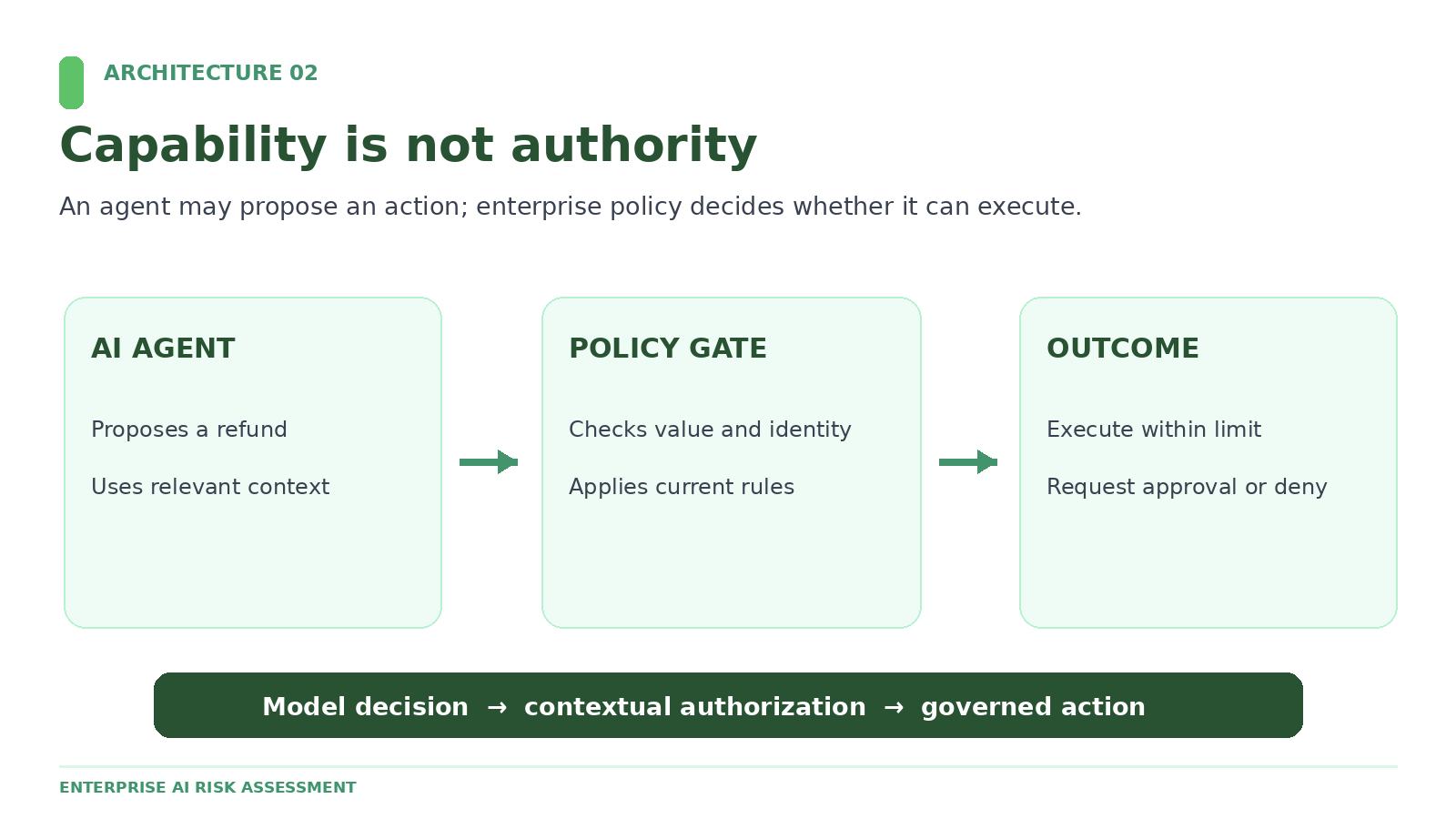
Figure 2: An independent policy gate separates an agent proposal from execution.
This distinction also applies to infrastructure changes, external messages and access to sensitive records. A model can recommend an action; the enterprise determines whether the action is permitted at that moment.
Assess agents as operational actors
Traditional model reviews often stop at accuracy and safety tests. An agentic AI risk assessment must map the permissions and effects of the complete workflow. Record the answers before approving deployment:
-
Which identities, databases, tools and APIs can the agent use?
-
Can it write records, commit funds, send messages or execute code?
-
Which actions need approval, and who can approve them?
-
Can it delegate to another agent or invoke a tool through an MCP server?
-
Can execution be interrupted, access revoked and changes rolled back?
-
What evidence links each action to the identity, context, policy and outcome?
Test both ordinary mistakes and hostile inputs. A retrieved page, email or log entry may contain instructions that the agent should treat as untrusted data. OWASP's LLM risk guidance provides a useful starting point for prompt injection and related application threats. Security testing should also cover combinations of individually permitted actions that create an unsafe result together.
Human approval is valuable for high-impact or irreversible actions, but it should be applied selectively. If reviewers receive hundreds of routine requests, approval loses meaning. Low-risk actions can run within deterministic limits; medium-risk actions can use bounded automation and exception review; high-risk actions need a named decision owner and clear escalation. A reviewer must see enough context to understand what will happen, rather than a generic “approve” button.
Example: an incident response agent
Suppose an agent detects an application outage and proposes a restart. First, assess whether its incident classification is reliable under noisy or incomplete telemetry. Next, check whether it can read untrusted log lines and whether those lines could redirect its tool choice. Then identify its service identity, the production environments it can see and the specific restart commands it can issue.
The authority check should consider the affected service, active change window, incident severity, dependency map and possible customer impact. A routine restart of an approved noncritical service may be automatic. A restart of a payment service during a live transaction spike may require an on-call owner. Record the proposed action, policy result and final outcome; provide a stop control and a tested rollback path. This assessment yields implementable boundaries instead of a generic “automation: high risk” label.
Get the Executive Blueprint for governed enterprise AI
A practical guide for CIOs, CAIOs and risk leaders on moving AI agents from pilot to production without losing control of context or decisions.
Connect context, reusable skills and runtime controls
The authorization decision depends on current enterprise facts. A refund limit may vary by customer contract, location and date. A reliable Context Graph can connect those relationships with provenance and temporal state, making the information used by an agent easier to verify and reconstruct.
ElixirData Context OS describes a context and control model for policy-aware decisions and decision traces. In this architecture it helps answer what information the AI used, whether that information was current and which rule applied. Teams still need to validate source access and the quality of the underlying data.
Reusable checks, such as contract validation or escalation logic, can be organized through ElixirHub's skills registry. Publishing a skill makes it discoverable; it does not by itself authorize every agent to run it. Versions, owners, dependencies and approved use cases should be recorded.
ElixirClaw's agentic governance addresses execution controls such as agent permissions, tool access, policy checks, human approval and action records. Together, these layers can support an operating rule: gather trustworthy context, determine authority independently, execute within bounds and preserve evidence. The exact controls should be evaluated against each organization's implementation and risk appetite.
Use risk tiers to set proportionate controls
An enterprise does not need the same approval process for a meeting summary and a production restart. Classify systems using autonomy, permission scope, data sensitivity, business impact, reversibility, volume and regulatory exposure.
-
Low risk: Informational tasks with limited data and no consequential action. Use basic evaluation, access controls and monitoring.
-
Moderate risk: Operational assistance or bounded actions. Add domain tests, transaction limits, sampled review and clear ownership.
-
High risk: Sensitive data, write access, customer impact or material financial effects. Require stronger evaluations, contextual authorization, approval thresholds and incident procedures.
-
Critical or restricted: Safety, rights, major financial commitments or critical infrastructure. Apply independent authorization, separation of duties and evidence requirements appropriate to the use case.
A risk tier is a governance decision, not a score calculated from a single model metric. Document why the tier was chosen and who accepts the remaining risk. Revisit it whenever permissions, volume or business purpose expands.
For each tier, write down the minimum evidence needed for approval: use-case tests, tool and identity inventory, policy rules, escalation owner, monitoring thresholds and recovery procedures. A high-risk application should also test failures at handoffs between retrieval, the model, the agent and the business API. This prevents a team from passing an excellent model evaluation while leaving the action boundary untested.
Make assessment continuous and evidence based
Approval at launch is only the beginning. Prompts, models, retrieval sources, policies, skills and tool permissions may change independently of a conventional application release. A drafting assistant may gradually acquire the ability to update customer records. Its name stays the same while its risk profile changes.
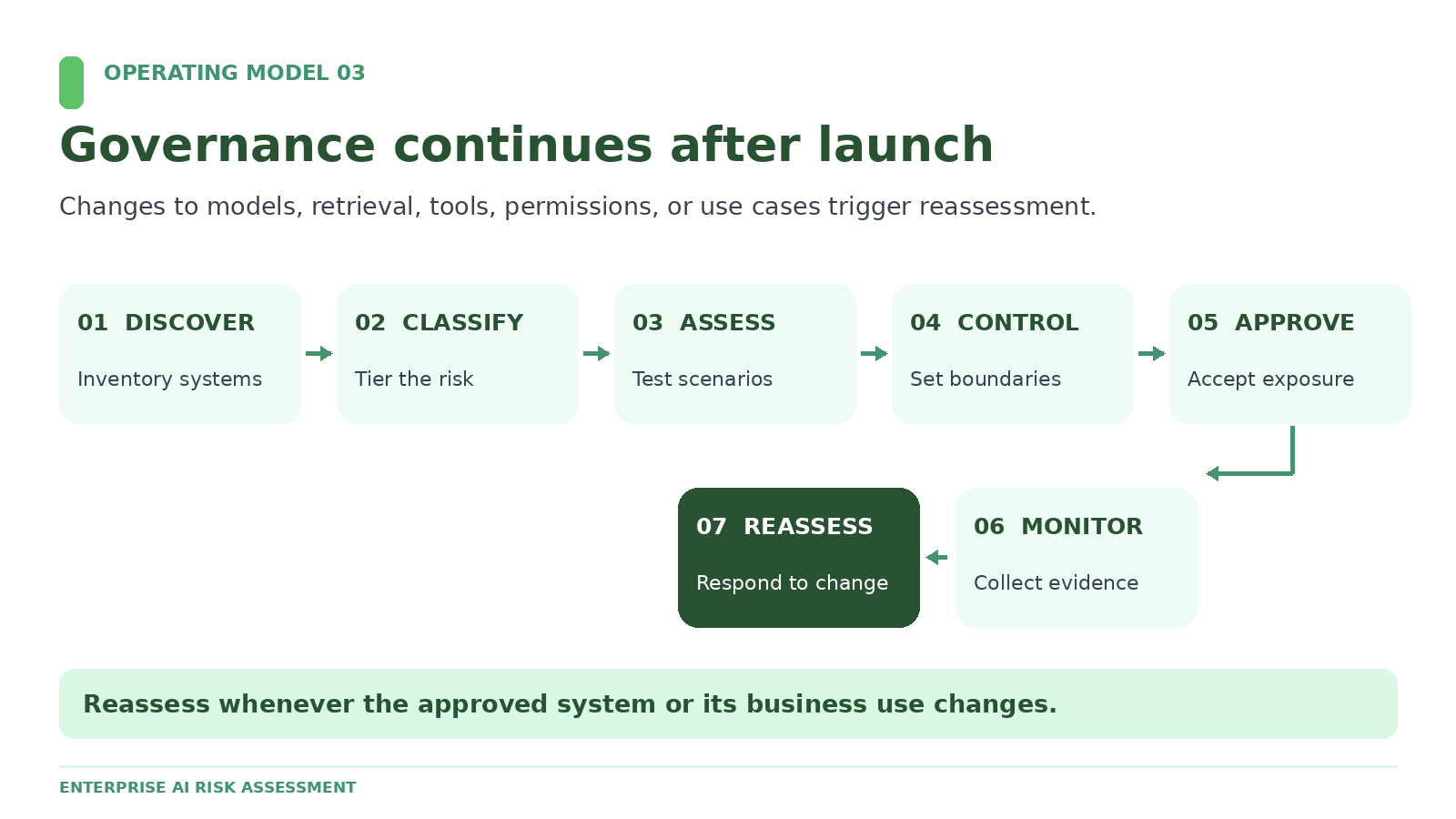
Figure 3: Changes to an approved AI system should trigger reassessment.
Maintain an inventory of AI systems and owners; map trust boundaries and plausible harms; evaluate controls; approve residual risk; monitor operation; and reopen the assessment after material change. NIST's AI RMF Playbook offers suggested actions for putting the framework's functions into practice.
Evidence should include the model and prompt version, retrieved sources, tool call, policy result, approver if any, final outcome and rollback status. Keep sensitive content subject to retention and access rules. These records allow teams to distinguish four questions: did the system function, can we reconstruct it, was the action allowed, and who owns the consequence?
Set specific review triggers and measures. Examples include blocked tool calls, approval exceptions, retrieval access violations, policy overrides, failed rollbacks and unexplained changes in action volume. Inspect a sample of permitted decisions as well as denials: a zero-denial dashboard may mean that controls are working, or that they are not being reached. Pair operational telemetry with periodic scenario tests so a change in behavior is detected before it becomes a material incident.
Watch for use-case drift when people rely on a system for decisions beyond its approval, and permission drift when agents gain broader access. Reassess after model upgrades, new tools, changed data sources, increased transaction volume, incidents or policy updates. Continuous governance means checking whether the conditions that justified approval still hold.
What should leaders ask before scaling?
Executives need a view of delegated authority and residual exposure rather than only the number of AI pilots. For each important system, ask: Who owns it? What actions can it take? Which data and tools can it access? What is the highest plausible harm? Where are approval limits enforced? Could a consequential decision be reconstructed? How quickly could the organization stop or reverse an unsafe action?
The aim is not to eliminate every risk. It is to align autonomy with authority, apply controls proportional to harm and retain evidence that those controls work. Enterprise AI risk assessment becomes useful when it changes architecture and operating behavior, not when it merely fills a register.
Take the next step
Download the Executive Blueprint, or talk to our team about risk assessment and authority controls for AI agents.
Frequently asked questions
-
What is enterprise AI risk assessment?
It evaluates risks across the complete AI system, including models, data, tools, agents, deployment and business actions. -
How is it different from model risk assessment?
It adds system permissions, decision authority, deployment boundaries and real-world harm to model evaluation. -
What are the four risk layers?
Model capability, AI system, deployment and trust boundaries, and business context and harm. -
Why do AI agents need extra controls?
They can take actions through tools and APIs, so permissions, approval limits and execution records matter. -
When should an AI assessment be repeated?
After material changes to models, data, prompts, tools, permissions, volume or business use, and after significant incidents.