In brief: Governments are moving from AI that answers citizens to AI agents that act for the state: approving permits, processing benefits and triaging cases. Gartner predicts that at least 80% of governments will deploy AI agents to automate routine decision-making by 2028. Abu Dhabi already runs more than 1,200 services through one AI-assisted platform. The constraint is no longer capability. It is governance: every action an agent takes on the state's behalf must be authorised, bounded, explainable and reversible. This guide gives public leaders the five controls to put in place first, real examples, and a 90-day plan.
Who this is for: heads of government entities, Chief AI Officers and digital-service leaders deciding where AI agents can act for the state, and how to keep them accountable.
What is agentic AI in government services?
Agentic AI in government services means AI agents that complete public-service tasks end to end, not just answer questions. A chatbot tells a citizen which form to fill in. An agent checks eligibility, gathers the evidence from other departments, drafts the decision and, within defined limits, issues it.
That shift from answering to acting changes the risk. Once an AI system can act, the questions are no longer only "is the answer accurate?" They become: what can the agent access, under whose authority is it acting, and can its actions be stopped or reversed? That framing comes from the OECD Working Group on Agentic AI in Government, whose members include Australia, Canada, Estonia, Japan, Korea, Singapore and the UK.
Why is 2026 the turning point for AI in the public sector?
Three signals arrived in the same year.
- Adoption at scale is now a plan, not a pilot. In March 2026, Gartner predicted that at least 80% of governments will deploy AI agents to automate routine decision-making by 2028.
- Explainability is becoming mandatory. In the same release, Gartner predicted that by 2029, 70% of government agencies will require explainable AI and human-in-the-loop mechanisms for automated decisions that affect citizen services.
- National targets are explicit. In April 2026 the UAE Cabinet set a target to move 50% of government sectors and services to agentic AI within two years. Singapore is building a registry of AI agents that records the ownership and activity of agents used across a public service of about 150,000 officers.
80%
of governments will use AI agents for routine decisions by 2028 (Gartner)
70%
of agencies will require explainable AI and human-in-the-loop by 2029 (Gartner)
50%
of UAE government sectors and services targeted to move to agentic AI within two years
Demand is broad, but trust has to be earned. In a Capgemini survey of 350 public-sector organisations, 90% said they plan to explore, pilot or implement agentic AI in the next two to three years.
Governments carry a higher duty than the private sector to explain, justify and correct what they do. AI agents inherit that duty.
Where is agentic AI already working in government?
The leading examples share one pattern: they redesign the service around the citizen, then let agents work across the departments behind it.
- Abu Dhabi, TAMM. One platform now brings more than 1,200 government services together. Abu Dhabi's Department of Government Enablement reports that service delivery costs fell by more than 30% over three years while satisfaction rose from 78% to 92%. In the first half of 2026, TAMM handled 55.5 million transactions, about 98% of them digitally.
- Estonia, Bürokratt. Instead of dozens of separate agency chatbots, Estonia is building an interoperable network of public-sector assistants that aims to give citizens access to about 3,000 e-services through one conversation.
- Ireland, MyWelfare. Deloitte reports that Ireland's online welfare service was auto-awarding more than 83% of illness benefit claims by late 2024, a sign of how far rules-based decisions can be automated when the data is joined up.
- Singapore, agent registry. Before scaling agents, Singapore is putting accountability first: every agent has a recorded owner and activity trail.
Common use cases now include licensing and permits, benefits eligibility, tax reconciliation, emergency and municipal triage, and internal work such as procurement checks and HR requests. Each of these is a decision, not just a task. That is why governance, not model choice, decides whether they scale. For adjacent public-sector patterns, see decision infrastructure for smart cities and decision infrastructure for emergency response.
What is the business case for AI agents in government services?
The strongest business case is not headcount. It is time from application to decision, and the cost of every day a citizen or business waits.
- Citizen outcomes: fewer touchpoints, no repeated submission of the same evidence, and decisions in days rather than weeks.
- Cost to serve: Abu Dhabi's 30% fall in delivery costs alongside higher satisfaction shows that faster and cheaper are not in conflict.
- Officer capacity: officers spend their time on the complex and contested cases, with the routine ones prepared or decided for them.
- Audit and trust: a complete record of every decision reduces the cost of appeals, audits and ombudsman reviews.
Measure it per service: the number of decisions, today's average time to decision, the share that are routine and reversible, and the cost of delay. That baseline is what turns an AI pilot into a funded programme.
Why traditional AI governance is not enough for AI agents
Most public-sector AI frameworks, including the NIST AI Risk Management Framework, were written for systems that advise a person. They focus on training data, bias testing and approval before deployment. Agents need controls that run at the moment of action, every time:
- Authority: the legal basis for the decision, and the exact service, value and risk level the agent is allowed to act on.
- Context: the current policy, the citizen's record and the precedent from similar cases, from sources that are owned, versioned and permissioned.
- Reversibility: whether the action can be undone, and an automatic stop before anything that cannot be.
- Evidence: a record of what the agent saw, which rule it applied and why, kept for the citizen, the auditor and the ombudsman.
Regulation is moving the same way. The EU AI Act lists access to essential public services and benefits among its high-risk uses, with requirements for record-keeping and human oversight. Approval queues are not a substitute: an agent that finishes in seconds and then waits days for sign-off delivers none of the benefit and still lacks real control. We explain the difference in AI guardrails vs AI governance and AI policy enforcement for enterprise agents.
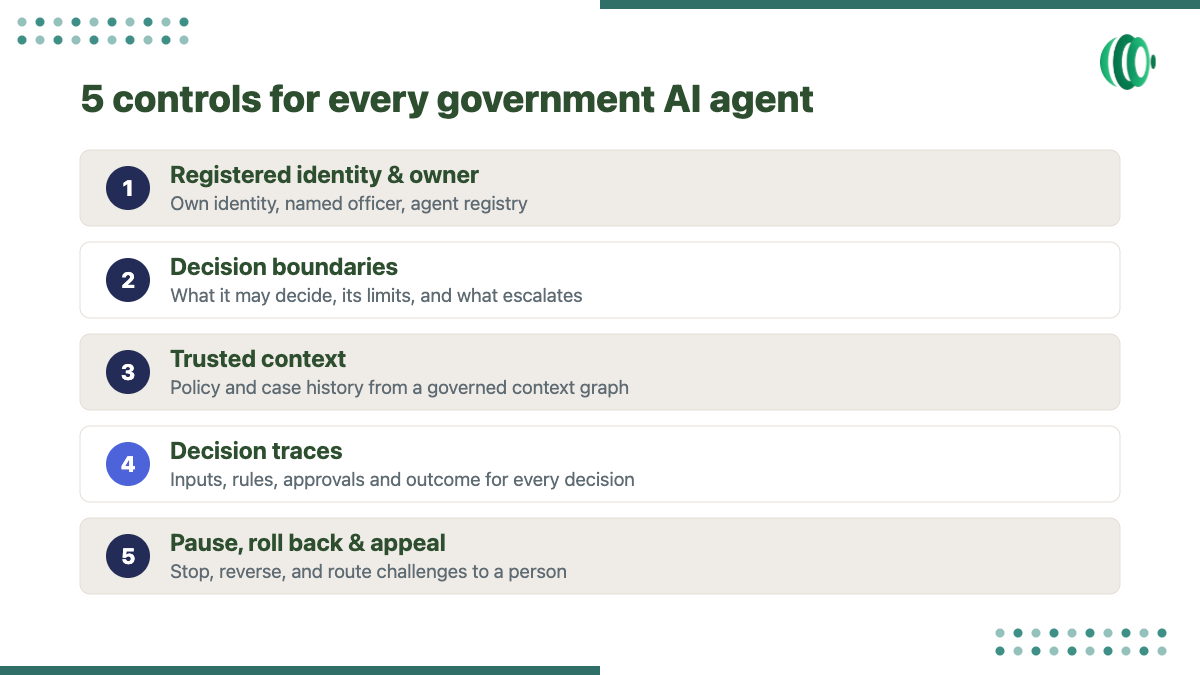
The Government AI Agent Charter: 5 controls every public leader needs
We call these five controls the Government AI Agent Charter. Put them in place before any agent acts for a public body.
- A registered identity and owner. Every agent has its own identity, a named accountable officer and an entry in an agent registry. No shared credentials, and access scoped to the task.
- Decision boundaries. Explicit limits per service and decision class: what the agent may decide, up to which value and risk level, and what always escalates to a person.
- Trusted context. Policies, eligibility rules and case history served from a governed context graph, not whatever a document search returns.
- Decision traces. An immutable record of inputs, sources, rules applied, approvals and outcome for every decision. This is what makes an agent's decision explainable to a citizen and defensible in an appeal. See how decision traces build trust in AI agents.
- Pause, roll back and appeal. The ability to stop an agent, reverse its actions where the law allows, and route any citizen challenge to a human decision-maker with the full trace attached.
Start with one service. In a one-day decision-register workshop we map one service's recurring decisions, their legal basis, owners and reversibility, and show which are ready for an agent at the "observe" stage.
How should governments roll out AI agents safely?
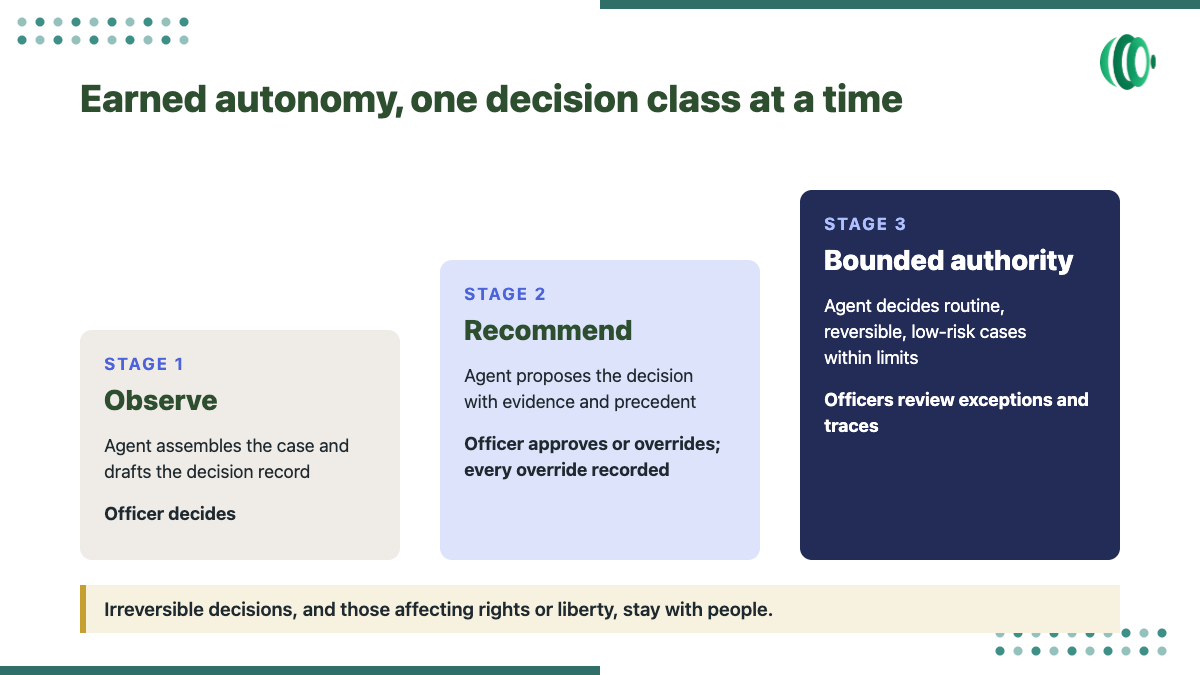
Autonomy should be earned per decision class, on evidence, in three stages:
- Observe: the agent assembles the case and drafts the decision record; an officer decides.
- Recommend: the agent proposes the decision with its evidence; the officer approves or overrides, and every override is recorded with a reason.
- Bounded authority: the agent decides routine, reversible, low-risk cases within explicit limits; officers review exceptions and traces, not every case.
Irreversible decisions, and those that affect a citizen's rights or liberty, stay with people, but they reach the officer with the context already assembled. That is how a service can move from weeks to days for most citizens without weakening accountability for any of them.
Questions for your cabinet or leadership team
- Which of our services have high volumes of routine, reversible decisions, and how long does each take today?
- For every AI agent we run, who is the accountable officer, and is it in a registry?
- Can we show a citizen, an auditor or a court exactly why an agent made a specific decision on a specific day?
- Which decisions must never be automated, and is that written down?
- If an agent makes a wrong decision at scale, how quickly can we stop it and reverse the effects?
A 90-day plan for public-sector leaders
- Days 1–30: build a decision register for one service. List its recurring decisions, the legal basis for each, an owner, a reversibility rating and today's time from application to decision.
- Days 31–60: run one decision class at the "observe" stage, with decision traces switched on from the first case. Measure completeness of context and officer agreement.
- Days 61–90: move to "recommend", publish the boundaries and escalation rules, and register every agent with an owner. Report time-to-decision and override reasons to leadership.
Common mistakes to avoid
- Automating the form instead of redesigning the decision.
- Running agents on shared service accounts with broad access.
- Treating human-in-the-loop as a rubber stamp at the end of the process.
- Keeping logs that record what an agent did but not why it did it.
- Scaling to new services before the first one has evidence that its boundaries work.
How ElixirData supports AI in government services
ElixirData's Context OS is the decision harness for enterprise and public-sector AI agents. It provides context graphs for trusted policy and case context, governed actions with decision boundaries enforced before every action, and decision traces for every decision an agent makes. It sits above existing government systems and supports sovereign and in-country deployment. ElixirClaw, our AI agents computing platform, runs the agents that act inside those boundaries. The same pattern already serves regulated sectors such as banking and public safety.
Book a one-day decision-register workshop →
Frequently asked questions
What is agentic AI in government?
It is the use of AI agents that complete public-service tasks and decisions end to end, such as eligibility checks, permit approvals and case triage, within limits set by the government body that remains accountable for them.
How is an AI agent different from a government chatbot?
A chatbot answers questions. An agent takes actions: it gathers evidence, applies rules and can issue or prepare a decision. That is why agents need controls on authority, reversibility and evidence that chatbots do not.
Can AI agents make decisions about citizens?
For routine, reversible and low-risk decisions, and within explicit boundaries, yes. Decisions that are irreversible or affect rights should stay with human officers, with the agent preparing the case. Gartner expects 70% of agencies to require explainable AI and human-in-the-loop mechanisms for such decisions by 2029.
What is an AI agent registry?
A record of every AI agent a public body runs, its owner, its permissions and its activity. Singapore is building one for its public service, and it is the starting point for accountability.
Can this run in-country, without replacing our existing systems?
Yes. Context OS supports sovereign, in-country deployment with data residency controls and tenant isolation, so citizen data stays inside the jurisdiction. It sits above existing case-management, ERP and data platforms through integrations rather than replacing them, so the first service can start without a systems migration.
How do governments keep AI agent decisions explainable?
By recording a decision trace for every action: the inputs, sources, rules applied, approvals and outcome. The trace answers a citizen's or auditor's "why", and supports appeals and corrections.
This article is general information, not legal or regulatory advice.
Related on ElixirData: Public Safety AI
Sources
- Gartner, Gartner Predicts at Least 80% of Governments Will Deploy AI Agents to Automate Routine Decision-Making by 2028, 17 March 2026.
- OECD.AI, Governing with agentic AI: when machines act on government's behalf, 25 September 2026.
- Khaleej Times, Abu Dhabi government service costs fall by 30% as satisfaction hits 92%, 6 October 2026.
- Gulf News, Abu Dhabi's TAMM handles 55.5m transactions, 15 August 2026.
- Interoperable Europe, Government virtual assistant Bürokratt.
- Deloitte Insights, Agentic AI and customized government services, 2026.
- UAE Cabinet, New UAE Government framework to deploy agentic AI across 50% of government sectors and operations within two years, 23 April 2026.
- Malay Mail, Singapore rolls out AI agent registry, 2 June 2026.
- Capgemini, Where should governments start with agentic AI?, 2026.
- NIST, AI Risk Management Framework.
- EU AI Act, Annex III: High-risk AI systems.
- World Economic Forum, Making Agentic AI Work for Government: A Readiness Framework.