Agentic AI for workplace safety uses AI detections — such as missing PPE, restricted-zone entry or forklift-pedestrian proximity — as inputs, checks each event against zone, shift, permit and policy context, then routes a governed response to the right person, with human review and measured follow-through.
Agentic AI for workplace safety needs more than another camera feed
A forklift approaches a pedestrian near a loading bay. The camera detects proximity, but the safety team still needs to know the zone, vehicle route, operating state, shift and correct supervisor. Plants often hold that information across CCTV, access control, permits, maintenance systems and incident records. Connecting it quickly is the operational problem.
Conventional monitoring can leave teams reviewing footage after an incident or relying on periodic walkthroughs. OSHA distinguishes lagging measures, such as injuries already recorded, from leading indicators that show how preventive activities are working. AI should help teams identify risks early and close corrective actions, with results checked against a baseline.
A vision model may flag missing PPE, restricted zone entry or forklift and pedestrian proximity. An agentic workflow can combine that detection with permitted zone, equipment, shift and policy context, rank the event, assemble evidence and route it to a responsible person. XenonStack discusses why detection only video analytics often leaves investigation work unresolved.
See how Context OS governs AI agent decisions
Context OS links each hazard detection to zone, shift, permit and policy context so safety responses are governed and traceable.
From AI surveillance to agentic safety intelligence
The first generation of video analytics classified what appeared on camera: PPE, intrusion, smoke or a fall. An isolated alert cannot establish whether a worker was authorized, whether a permit was active or whether a machine was in maintenance mode. That uncertainty should be resolved before escalating a consequential event.
For a forklift proximity event, context can include the route, zone classification, vehicle operating state, shift and applicable procedure. The system can then send an evidence package for review, escalate an urgent event or open a corrective task according to site policy. The same pattern appears in ElixirData’s guide to agentic video intelligence.
NIOSH describes computer vision as a promising aid for ergonomic risk assessment, including posture and motion observation over longer periods. Its research supports using visual evidence to prioritize professional assessment; a deployment still needs site testing and human interpretation.
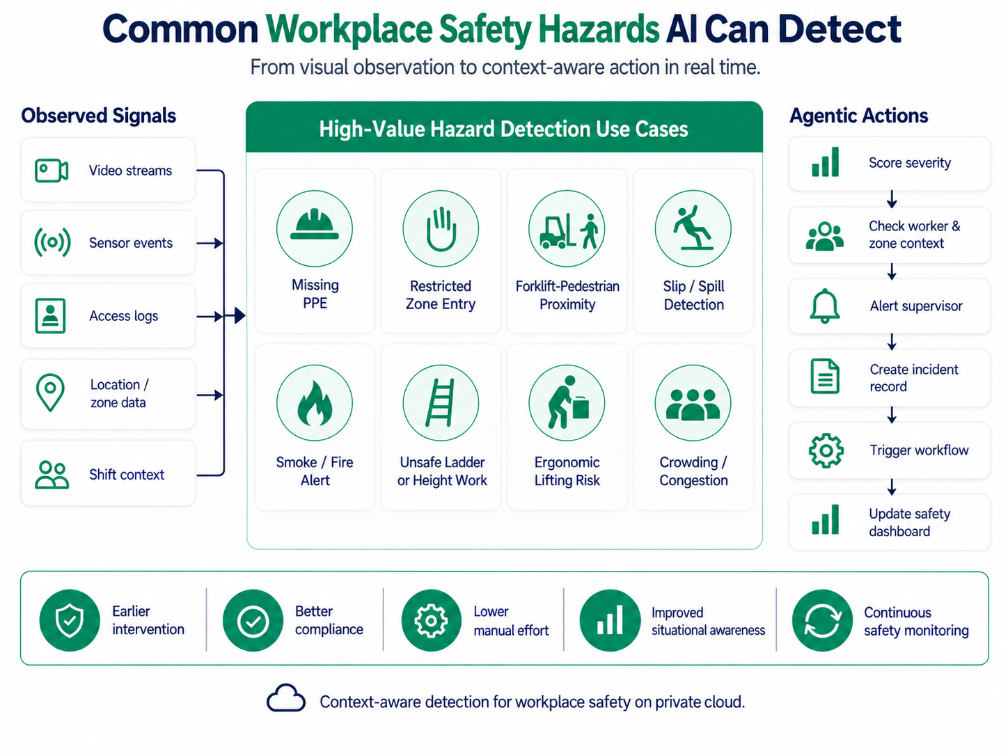
High-value hazard detection scenarios can feed a common agentic workflow: assess context, prioritize risk, alert the right person, create a record, trigger follow-up, and update analytics.
High-value workplace hazards that can be monitored in real time
The most useful starting points are hazards that are visually observable, frequent enough to justify automation, and connected to a clear response process. The exact detection model depends on the environment, camera placement, operating conditions, workforce policies, and validation data, but common scenarios include:
- PPE compliance: detect missing hard hats, high-visibility clothing, eye protection, gloves, or other site-specific protective equipment where visual detection is appropriate.
- Restricted-zone entry: identify people entering hazardous, machine-only, maintenance-only, or permit-controlled areas and correlate the event with access permissions.
- Forklift-pedestrian proximity: detect unsafe proximity or route conflicts between moving industrial vehicles and people, then apply zone and speed context.
- Slip, spill, and obstruction detection: flag visible floor hazards for rapid containment and inspection.
- Smoke or visible fire indicators: use visual signals as an additional early-warning source alongside certified fire and environmental systems, not as a replacement for them.
- Unsafe work at height or ladder use: identify patterns that merit supervisor review, subject to site rules and model validation.
- Ergonomic risk: identify repeated awkward postures or lifting patterns to help safety and ergonomics teams prioritize assessment.
- Crowding or congestion: detect abnormal density around workcells, loading areas, evacuation paths, or high-risk operations.
The objective is a faster, more consistent safety response. Ambiguous detections and actions that affect workers or plant operations require a human review point and a record of why the event was escalated.
The context layer for AI agents
A shared context layer makes a visual event interpretable. ElixirData can connect camera events to zones, shifts, work orders, permits, equipment and approved policy. A ContextGraph records which relationships were valid when the event occurred. See the broader explanation of a context layer for AI.
A safety ContextGraph may connect a worker or contractor role, training, shift, permitted zone, supervisor, machine, PPE rule, work permit and incident event. Time matters: a permit can expire, an asset can switch to maintenance, and a zone can carry a different risk during a shutdown.
With shared definitions and traceable evidence, safety teams can investigate repeated near misses by zone, unresolved hazards by response time and alerts concentrated on one shift. XenonStack’s discussion of the gap between security and safety systems illustrates the need to connect adjacent operational records.
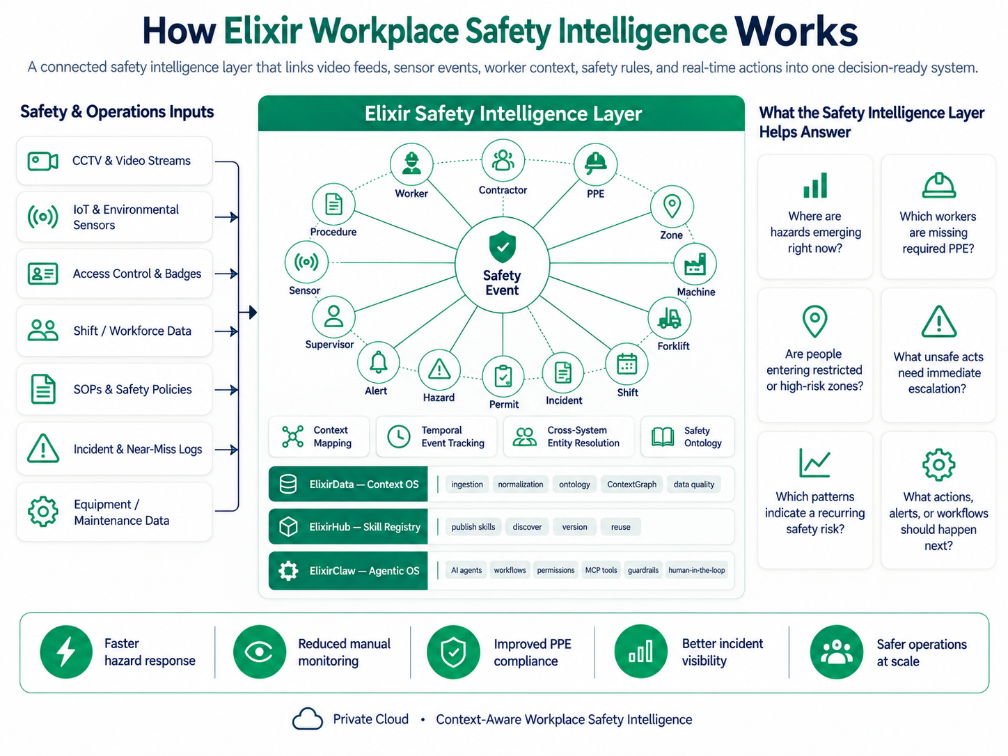
Elixir workplace safety intelligence connects video, sensor, access, workforce, policy, incident, and maintenance data into a context-rich safety event model.
How the Elixir platform supports a governed safety workflow
ElixirData - Context OS
ElixirData owns the data and context foundation. It can ingest camera metadata, sensor events, access data, shift context, safety policies, incident records, and maintenance information; normalize those sources; map them to a shared ontology; maintain lineage and data quality; and build the ContextGraph used by agents and analytics.
ElixirHub - Skill Registry
ElixirHub remains a reusable skill registry. Safety teams can publish, discover, version, install, reuse, and compose skills such as 'check PPE compliance context,' 'summarize incident evidence,' 'prepare supervisor escalation,' or 'generate shift safety summary.' The registry manages the skill package and lifecycle; it does not own external connectors, runtime permissions, or workflow execution.
ElixirClaw - Agentic OS
ElixirClaw owns the runtime agentic layer: AI agents, authentication and authorization, data and agent permissions, agentic workflows, connectors, MCP integration, tool execution, guardrails, decision boundaries, human-in-the-loop steps, prompt and LLM gateways, secure execution, and AgentOps. Advanced AI capabilities such as computer vision, anomaly detection, risk classification, prediction, or recommendation are custom models exposed to ElixirClaw through MCP.
Agentic AI - Analytics Layer
Agentic AI provides natural-language analytics, context-aware dashboards, and operational insights. It can consume enterprise context from ElixirData and AI outputs generated through ElixirClaw, while prediction, anomaly detection, root-cause analysis, and recommendation models remain custom AI capabilities exposed through MCP.
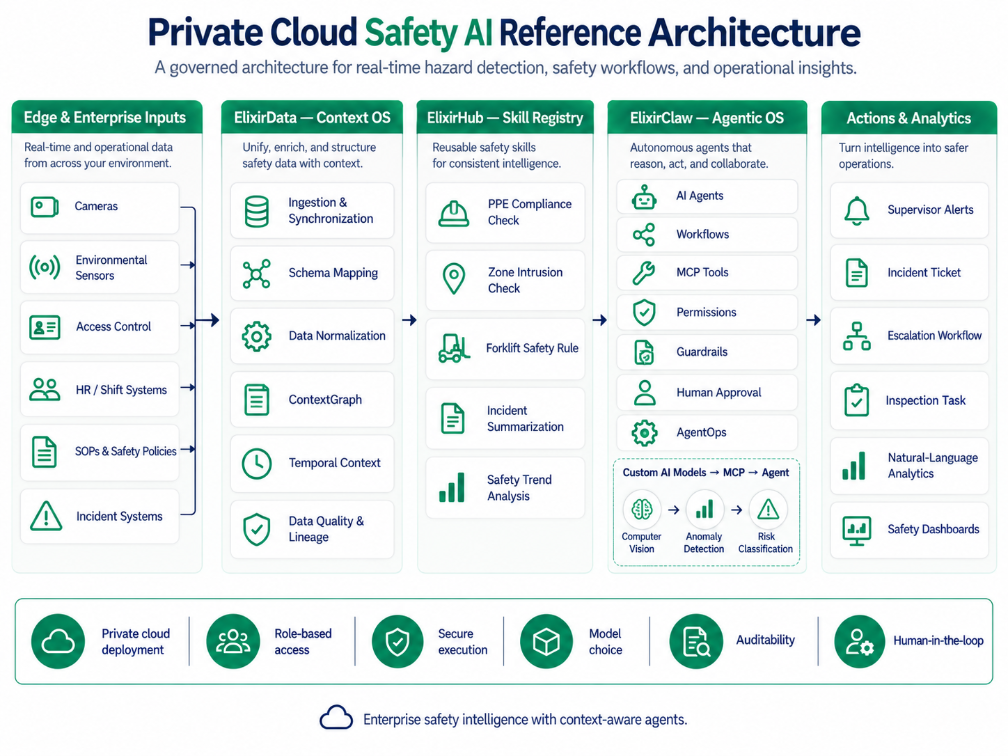
Private-cloud reference architecture: edge and enterprise inputs feed the Context OS, reusable skills, governed agentic execution, and safety actions and analytics.
Get the Executive Blueprint for governed enterprise AI
A practical guide for CIOs, CAIOs and risk leaders on moving AI agents from pilot to production without losing control of context or decisions.
What happens when a hazard is detected
Consider a forklift-pedestrian proximity event in a manufacturing facility. A computer-vision model detects that a person and a moving forklift have entered an unsafe proximity envelope. Instead of producing a generic red box on a monitoring screen, the event can flow through a context-aware agentic process:
- Detect: the vision model identifies the event and sends structured evidence, confidence, location, and timestamp.
- Enrich: ElixirData retrieves the zone, shift, worker or role context where permitted, vehicle, operating state, nearby work order, and applicable safety policy.
- Evaluate: an ElixirClaw agent invokes the required rules or custom risk-classification capability through MCP and applies decision boundaries.
- Act: based on severity, the workflow can alert a supervisor, create an incident or near-miss record, request confirmation, or create a corrective inspection task.
- Observe: AgentOps captures the execution path, model output, tool calls, approvals, and outcome for traceability.
- Learn: Agentic AI aggregates events into trends so safety teams can see recurring risk by zone, shift, asset type, contractor, or process.
Use a human review step when detection confidence is low, video is ambiguous or a proposed action could affect a person or operating equipment. Capture the evidence, approver and outcome so missed events and false alarms can improve the process.
Why private cloud matters for workplace safety AI
Workplace safety AI can involve sensitive video, operational layouts, access events, worker information, machine states, and incident records. For many industrial and regulated organizations, the question is not only whether AI can detect hazards, but where the data is processed, who can access it, which models are approved, and how actions are governed.
Private cloud can keep video, context stores, model endpoints and agent execution within an approved environment. It can support chosen retention rules and enterprise identity controls, but it still requires access control, encryption, logging, network segmentation, patching and model oversight.
NIST’s AI Risk Management Framework offers a voluntary way to govern, map, measure and manage AI risks across the lifecycle. For workplace safety systems, apply that discipline to model performance, privacy, security, human oversight and the consequences of wrong alerts.
Agentic analytics: moving from incident counts to leading indicators
Count completed preventive actions as well as alerts. OSHA’s leading indicator resources encourage organizations to evaluate whether safety activities are helping identify and control hazards before harm occurs. Analytics should connect a detection to acknowledgment, investigation, corrective action and verification.
Useful measures can include hazard detection-to-acknowledgment time, percentage of high-risk events reviewed within target, time to close corrective actions, repeat hazard rate by zone, PPE compliance trend, percentage of near misses with root-cause review, overdue inspection actions, false-positive rate by detection model, model confidence drift, and the proportion of safety actions requiring human override.
This creates a stronger loop between detection and prevention. A safety team can ask a natural-language question such as 'Which production areas had the fastest increase in forklift-pedestrian proximity alerts over the last four weeks, and which corrective actions are still open?' The answer can combine ContextGraph relationships, event history, workflow state, and dashboards rather than forcing analysts to manually join multiple systems.
Governance, privacy, and worker trust are design requirements
AI-enabled safety monitoring can become counterproductive if workers perceive it as opaque surveillance rather than a clearly bounded safety system. Organizations should define the purpose of monitoring, the hazards being addressed, the data being collected, retention rules, access controls, how model outputs are used, and which decisions require human review. Where worker identity is not required to resolve a safety event, designs should minimize unnecessary identification and collection.
Validate each model in the deployed environment. Lighting, angle, occlusion, dust, uniforms, PPE colors and layout affect performance. Review precision and recall for each hazard category, including false positives that overload teams and false negatives that miss real risk. Recheck after camera or process changes.
A notification for missing PPE and a machine stop have very different consequences. Any stop or emergency response must follow approved engineering controls, certified safety systems and explicit authority. An AI agent should not bypass established interlocks or emergency procedures.
Business outcomes: what to measure
Assess detection, response, prevention, model quality and governance together. Set a baseline before rollout, then use the following measures to determine whether hazards are handled faster and whether corrective actions reduce recurring risk.
Outcome area |
Example measures |
Why it matters |
Response |
Detection-to-acknowledgment time; escalation time; corrective-action closure time |
Faster intervention and more consistent escalation |
Prevention |
Repeat hazard rate; near-miss trend; leading-indicator completion |
Better visibility into recurring risk and preventive action |
Operations |
Manual monitoring hours; investigation preparation time; inspection follow-up |
Lower administrative burden and better focus for safety teams |
AI quality |
Precision/recall where appropriate; false-positive rate; drift; human override rate |
Evidence that automation remains reliable in the deployed environment |
Governance |
Audit coverage; approval adherence; access-policy exceptions |
Stronger traceability and controlled use of sensitive safety data |
Alert volume alone is not a safety outcome. Review whether confirmed hazards receive timely attention, corrective actions close, repeat events fall and model errors remain within the site’s agreed thresholds.
A practical adoption roadmap
Start with one or two observable hazards in a controlled area where response ownership and ground truth are clear. Run the new workflow alongside existing safety procedures until performance and escalation rules are validated.
Phase 1 - Observe and validate
Deploy one or two detection use cases in a controlled area. Measure model quality, camera coverage, latency, false positives, and operator feedback. Keep decisions human-reviewed while the team establishes baseline performance.
Phase 2 - Add enterprise context
Connect zone definitions, shift data, equipment, permits, incident systems, and safety policies through ElixirData. Build the minimum ContextGraph required to explain why an event matters, not just what was detected.
Phase 3 - Orchestrate governed actions
Use ElixirClaw to introduce severity-based workflows, supervisor alerts, ticket creation, inspection tasks, guardrails, permissions, and human-in-the-loop approvals. Publish reusable safety skills through ElixirHub so the same logic can be versioned and reused.
Phase 4 - Scale with agentic analytics
Expand across additional zones, sites, and hazard types. Use Agentic AI to monitor leading indicators, response performance, recurring risk patterns, model quality, and workflow outcomes. Treat each new facility as a validation exercise rather than assuming identical conditions.
Conclusion: safety intelligence that can see, understand, and act
The strongest workplace safety application connects visual detection to current site context, a governed response and measured follow through. Operators should be able to see why an event was prioritized and whether the corrective action was completed.
The Elixir architecture separates those responsibilities clearly. ElixirData builds the context layer for AI agents. Custom computer-vision and risk models are exposed through MCP. ElixirClaw runs agents and governed workflows. ElixirHub manages reusable skills. Agentic AI turns events and context into operational insight. Deployed on private cloud, the same architecture can keep sensitive safety and operational data within customer-defined control boundaries while supporting model choice, auditability, and secure execution.
The goal is earlier intervention and fewer repeated hazards, backed by evidence, a responsible decision owner and a workflow that can be tested at each facility.
Take the next step
Download the Executive Blueprint, or talk to our team about agentic AI for workplace safety.
Frequently Asked Questions
-
What is agentic AI for workplace safety?
It is a workflow that uses AI detections as inputs, checks each event against site context and policy, then routes a governed response to the right person or system. An alert remains subject to the facility’s safety process. -
Which hazards are suitable for an initial pilot?
Choose a visible, frequent hazard with a clear owner and response rule, such as restricted zone entry, site specific PPE use or forklift and pedestrian proximity. Validate camera coverage and false alarms in the actual operating area. -
Does video AI replace safety staff or certified alarms?
No. Safety staff interpret ambiguous events, approve consequential actions and manage corrective work. Fire alarms, machine interlocks and emergency procedures retain their approved roles. -
How should worker privacy be protected?
Limit collection to the stated safety purpose. Use role or zone context where identity is unnecessary, restrict access to clips and worker records, set retention periods, and document human review and appeal paths under applicable policy. -
Why use private cloud for safety video and agents?
It can keep video, model processing, context and execution inside an approved customer environment. The organization still needs encryption, scoped access, audit logs, patching and regular validation.