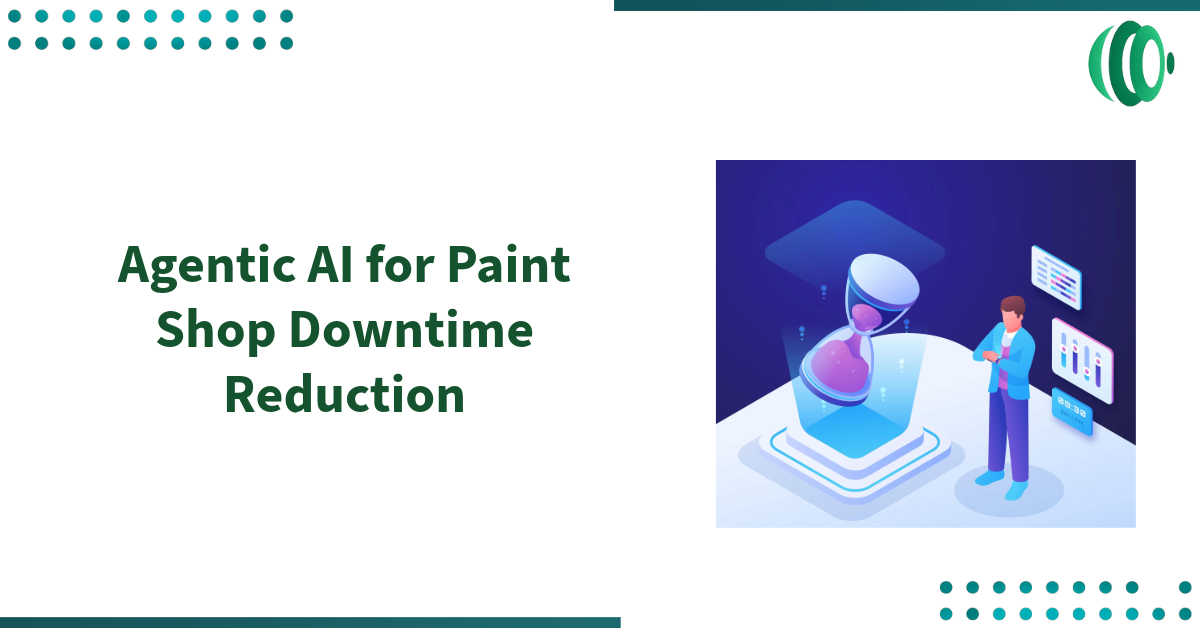
Paint shops are among the most interconnected areas of a manufacturing plant. A fault in a circulation pump, exhaust fan, spray robot, conveyor, curing oven, filtration unit, compressed-air system, or booth controller can interrupt throughput, affect coating quality, increase rework, consume material, and disrupt downstream assembly.
The cost of failure therefore depends on operational context, not only the equipment alarm.
Modern plants already collect much of the required information. PLC and SCADA systems expose operating conditions. Historians retain sensor trends. CMMS and EAM platforms contain maintenance history. MES tracks production sequences. ERP and inventory systems record spare availability. Quality platforms identify process deviations.
The problem is that these records are often evaluated separately. Traditional predictive maintenance can identify early signs of failure, but maintenance teams still need to understand production impact, previous failures, spare availability, intervention timing, approval requirements, and whether the intervention restored normal operation. This is where Agentic AI for manufacturing becomes valuable: connecting equipment intelligence with maintenance, production, quality, and governed action.
McKinsey's work on Agentic AI for operations also reflects this shift from systems that generate insights toward systems capable of coordinating operational work.
Why Paint Shop Downtime Is a Context Problem
Consider an automotive paint shop during a high-volume production day. A basecoat circulation pump begins showing increasing vibration and motor current. The equipment is still operating and has not crossed a hard alarm threshold.
SCADA records the deviation. The CMMS contains a previous bearing replacement and a technician note describing early wear. MES shows a heavily loaded production window approaching. Inventory records show one compatible bearing locally, while a replacement pump would need transfer from another plant.
At the same time, quality inspection begins recording small coating-consistency deviations associated with the booth. No single system contains the complete decision.
SCADA knows equipment condition but not production impact. CMMS knows maintenance history but not the production schedule. MES understands production priorities but not equipment degradation. Quality systems identify process variation but may not connect it to the pump.
If coordination begins only after failure, the plant may face:
-
Emergency maintenance
-
Unplanned booth stoppage
-
Work-in-progress accumulation
-
Rework and material waste
-
Technician overtime
-
Expedited spare transfers
-
Production disruption
The problem is not missing data. It is the absence of a decision-ready Context Graph that connects evidence while there is still time to act.
Why Predictive Maintenance Alone Is Not Enough
Manufacturing systems usually optimize one part of the operating model. They can detect conditions, create work orders, schedule production, track inventory, or record quality events. But they rarely determine whether those records represent the same developing operational risk.
Common gaps include:
-
Asset IDs differ across PLC, historian, CMMS, MES, and ERP.
-
Equipment health is evaluated without production dependencies.
-
Maintenance priorities may ignore redundancy and spare availability.
-
Quality changes may appear before hard equipment alarms.
-
Predictive models create alerts without connecting them to approved actions.
-
A closed work order does not prove that the process returned to normal.
Predictive maintenance asks:
What might fail?
Agentic AI extends the question:
What should happen next, given the context, risk, production dependency, and plant policy?
AWS also positions AI in manufacturing around connecting operational data with faster maintenance and quality decisions.
How Agentic AI Changes Paint Shop Maintenance
The AgenticAssetOps operating model follows:
Detect → Understand Context → Decide → Approve → Act → Verify → Learn
Detect
The workflow can begin with:
-
SCADA deviation
-
Condition-monitoring alert
-
Operator observation
-
Maintenance inspection
-
Repeated failure code
-
Quality anomaly
Understand Context
Agentic AI connects the event with equipment hierarchy, maintenance history, production dependencies, quality information, redundancy, spare availability, and plant policy.
Decide
The system evaluates approved options such as:
-
Continue enhanced monitoring
-
Schedule inspection
-
Perform maintenance during the next production gap
-
Switch to redundant equipment
-
Escalate for a controlled shutdown
Approve and Act
Decision authority depends on operational impact. Low-risk actions may proceed within predefined boundaries, while production changes, equipment stops, or safety and quality impacts require named approval.
Approved actions can include creating work orders, reserving parts, notifying teams, and coordinating maintenance windows.
Verify and Learn
The workflow verifies whether vibration, motor current, process flow, production, and quality returned to acceptable ranges. The reviewed event then becomes evidence for future reliability decisions.
Forbes has similarly discussed how Agentic AI in factories can move manufacturing systems toward more proactive operational coordination.
Target Agentic AI Workflow
For the circulation-pump example, the workflow can:
-
Resolve the correct pump, booth, line, component hierarchy, and event time.
-
Correlate SCADA and historian trends with operating conditions.
-
Retrieve CMMS work orders, inspections, notes, and failure history.
-
Check MES production sequence and intervention windows.
-
Check spare parts, technician availability, and transfer lead times.
-
Relate quality deviations to the same time window without assuming causation.
-
Evaluate monitoring, inspection, planned maintenance, redundancy, or escalation.
-
Create approved maintenance work and reserve parts.
-
Verify equipment condition, production recovery, and quality results.
If evidence remains incomplete, the Agentic AI system should not fabricate certainty. It can request inspection, continue monitoring, or escalate to a reliability engineer. The objective is to make maintenance decisions contextual, evidence-based, policy-bounded, and connected to operational outcomes.
Architecture for Agentic AI Paint Shop Operations
Existing systems remain authoritative. PLC and SCADA control operational state. Historians retain time-series evidence. CMMS manages maintenance history. MES owns production execution. ERP and inventory systems manage spare records. Quality systems retain inspection evidence. Agentic AI connects these systems without replacing them.
ElixirData: Context OS
ElixirData Context OS provides trusted manufacturing context for Agentic AI.
It can connect:
Equipment → Component → Sensor Signal → Failure Event → Maintenance Action → Spare Part → Production Order → Quality Event
The Context Graph for manufacturing adds relationships, temporal state, operational constraints, and decision traceability. For example, the system can show that a vibration deviation followed a bearing repair, occurred during a particular production run, coincided with a quality shift, and improved after an intervention. This transforms fragmented records into decision-ready manufacturing context.
ElixirHub: Reusable Agentic AI Skills
Operational logic should not be rebuilt for every agent or plant.
Reusable skills can include:
-
Equipment Health Assessment: combines condition signals and maintenance history.
-
Maintenance Prioritization: evaluates criticality, production impact, quality risk, and intervention windows.
-
Production Impact Assessment: identifies affected orders, booths, shifts, and downstream processes.
-
Spare Availability: checks inventory, reservations, transfers, and feasibility.
-
Maintenance Verification: confirms that equipment and processes returned to the required baseline.
Version-controlled skills improve consistency and help show which rules, thresholds, and evidence influenced each decision.
ElixirClaw: Governed Agentic AI Execution
ElixirClaw Agentic OS provides the governed execution layer for Agentic AI workflows.
Specialized agents may include:
-
Equipment Agent
-
Maintenance Agent
-
Production Agent
-
Inventory Agent
-
Decision Agent
-
Verification Agent
Connectors can expose approved operations such as creating CMMS work orders, reserving spares, reading MES schedules, retrieving quality results, and sending notifications. Permissions restrict actions by plant, equipment class, operating condition, role, and system.
The architecture becomes:
ElixirData → Understand Context
ElixirHub → Reuse Operational Skills
ElixirClaw → Governed Agentic AI Execution
Human Oversight and Governance
Agentic AI should not receive unlimited authority in paint-shop operations.
| Operational Situation | Agentic AI Role | Required Control |
|---|---|---|
| Emerging condition within limits | Gather evidence and recommend inspection | Maintenance policy |
| Maintenance fits production gap | Prepare work and schedule proposal | Planner/maintenance approval |
| Production stop may be required | Escalate with evidence | Production authority |
| PLC or safety logic involved | Do not modify automatically | Engineering authority |
| Quality/environmental limit affected | Escalate and keep case open | Quality/EHS approval |
The audit trail should preserve triggering signals, equipment identity, supporting evidence, policies, approvals, system actions, production effects, and final verified operating state.
Enterprise Private Agentic AI
Paint-shop context can include sensitive manufacturing information such as PLC tags, equipment configurations, plant topology, production schedules, quality results, and maintenance procedures. Enterprise Private Agentic AI can keep context retrieval, agent memory, policy evaluation, and execution within controlled enterprise infrastructure. On-premises, private-cloud, or hybrid deployments can maintain governed connections with SCADA, historians, CMMS, MES, ERP, inventory, and quality platforms. This supports operational intelligence without giving agents unrestricted access to critical manufacturing systems.
Measuring Business Outcomes
Agentic AI should be measured against plant performance.
Useful KPIs include:
-
Unplanned downtime
-
Condition-to-maintenance decision time
-
Mean time to repair
-
Emergency work orders
-
Repeat failures
-
Spare-related delays
-
Production minutes protected
-
Quality deviations
-
Rework
-
Manual investigation effort
-
Verified recovery rate
McKinsey's recent analysis of AI-enabled maintenance in asset-heavy operations also emphasizes embedding maintenance intelligence into operational workflows rather than treating analytics as an isolated capability. The first proof point should be whether the workflow consistently finds the correct context, routes decisions to the appropriate authority, executes only permitted actions, and verifies recovery.
Practical Adoption Approach
Start with one equipment category such as circulation pumps, conveyors, spray robots, curing-oven systems, exhaust fans, or compressed-air equipment.
Then:
-
Define authoritative systems and equipment identities.
-
Establish maintenance and downtime baselines.
-
Model production and quality dependencies.
-
Define decision and approval boundaries.
-
Run Agentic AI in recommendation mode first.
-
Compare recommendations with engineers and planners.
-
Enable evidence gathering and work-order preparation.
-
Introduce low-risk, reversible actions.
-
Require verification before case closure.
-
Scale through reusable skills, policies, connectors, and evaluations.
A successful pilot should create reusable equipment context, decision policies, evaluation cases, connector boundaries, and a clear definition of a resolved reliability event.
Conclusion
Paint shop downtime is not simply an equipment-monitoring problem. The decision to intervene depends on equipment condition, maintenance history, production dependency, quality behavior, spare availability, time, and plant authority.
Predictive maintenance identifies emerging risk. Agentic AI connects that risk with context, governed decisions, approved actions, and verification. AgenticAssetOps supports this closed loop through ElixirData for trusted manufacturing context, ElixirHub for reusable operational skills, and ElixirClaw for governed Agentic AI execution. The goal is practical: detect risks earlier, understand production impact, coordinate maintenance effectively, keep high-impact decisions under human authority, and verify that equipment and production return to an acceptable state.
That is how Agentic AI can reduce paint shop downtime—by turning fragmented operational signals into governed, context-aware, and verified maintenance action.
Frequently Asked Questions
-
How can Agentic AI reduce paint shop downtime?
Agentic AI connects equipment condition, maintenance history, production schedules, quality data, and spare availability so teams can respond to emerging risks earlier. -
How is Agentic AI different from predictive maintenance?
Predictive maintenance identifies equipment risk. Agentic AI connects that prediction to context, decisions, approvals, actions, and verification. -
Which systems can Agentic AI connect?
It can work with governed data from PLCs, SCADA, historians, CMMS/EAM, MES, ERP, inventory, and quality systems. -
Should Agentic AI automatically stop equipment?
High-impact actions such as production stops, control changes, and safety overrides should remain subject to explicit plant authority. -
Which KPIs should manufacturers track?
Track unplanned downtime, maintenance decision time, MTTR, emergency work, repeat failures, spare delays, production impact, quality deviations, and verified recovery.