Agentic AI in healthcare needs decision-grade context: task-relevant evidence enriched with source, time, provenance, relationships, and applicable policy. The Elixir Platform provides it (ElixirData for context, ElixirHub for reusable skills, ElixirClaw for governed agents) inside a customer-controlled Private AI environment.
Why does healthcare have a context problem, not a data problem?
A single patient may generate thousands of data points across EHRs, laboratory systems, imaging, pharmacy, claims, clinical notes, wearables, payer systems and patient-engagement platforms. Every individual data point may be correct and an AI agent can still make the wrong decision.
As healthcare moves from copilots that answer questions toward agents that coordinate workflows and initiate actions, the architecture must do more than retrieve information. It must provide the right context, reusable expertise, governed execution and a controlled operating boundary.
The core architectural idea
ElixirData builds and maintains enterprise context. ElixirHub manages reusable skills. ElixirClaw runs and governs agents. Enterprise Private AI provides the customer-controlled operating environment around data, models, agents, tools and infrastructure.
Key takeaways for healthcare AI leaders
- Healthcare AI needs decision-grade context, not simply more retrieved data.
- Agentic AI changes the risk model because agents can coordinate workflows and initiate governed actions.
- ContextGraph, provenance, temporal state and policy applicability help turn fragmented records into decision-ready evidence.
- Autonomy should expand by decision type, with human confirmation or escalation for higher-risk actions.
- Private AI, observability and auditable execution are core architectural controls for sensitive healthcare workflows.
See how Context OS governs AI agent decisions
Context OS gives healthcare agents decision-grade context with provenance, temporal state and policy before they act.
How is AI moving from answering to acting?
The first generation of generative AI in healthcare was largely assistive: summarize a chart, draft a clinical note, explain laboratory results, or generate a discharge summary. Useful, but a human still moved the workflow forward.
Agentic AI changes that model. An agent can detect a care gap, assemble patient context, interpret clinical criteria, retrieve policies, use specialized models, determine a proposed next action, coordinate across systems, request approval, execute an authorized workflow and monitor the outcome.
Did the agent understand the right patient, at the right moment, using the right evidence, under the right policy, with the right permissions and within the right authority before it acted?
The Healthcare Context Layer
A healthcare AI agent cannot simply retrieve every record containing a relevant keyword. It needs to understand which information is current, which source is authoritative, which records represent the same patient or concept, what changed over time, which policy applies, and which information is relevant to the specific task.
- Which information is current and clinically relevant?
- Which source is authoritative, and where did the information originate?
- Which records refer to the same patient, event or clinical concept?
- What changed, and what is true now?
- Which policies, guidelines and operating constraints apply?
- What context should the agent retrieve for this specific purpose?
This is why RAG alone is not a healthcare context architecture. RAG can retrieve information. A context layer for AI must determine what information matters, how it relates, how current it is, where it came from and what it means for the decision being made.
From Patient 360 to Decision 360
Healthcare has spent years pursuing Patient 360: “What do we know about this patient?” Agentic healthcare requires a more precise question: “What context is required to make this particular decision safely and effectively right now?”
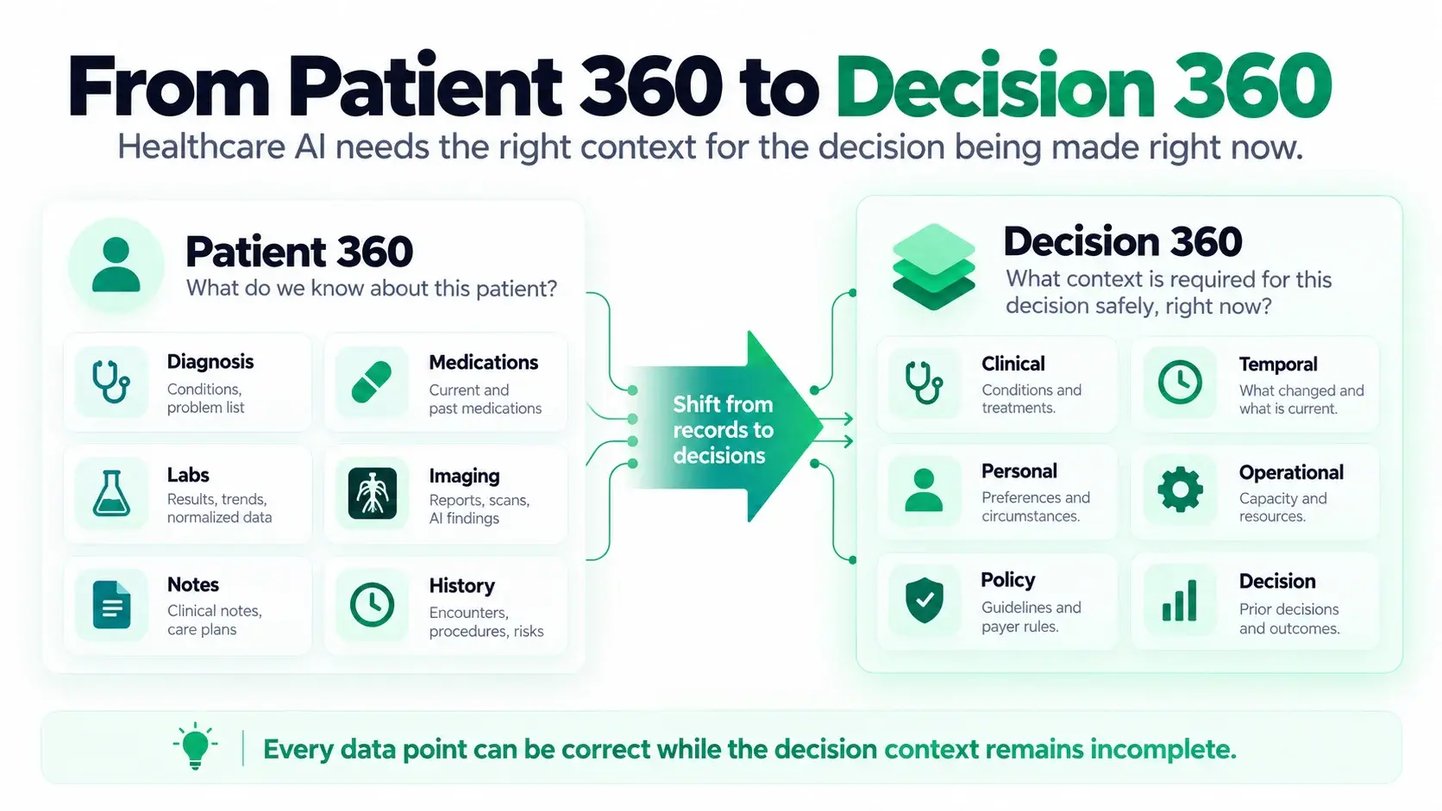
Decision 360 focuses the AI system on the context needed for the decision at hand, not simply the full patient record.
Six dimensions of decision context
- Clinical context: Conditions, medications, allergies, laboratory results, imaging, procedures, terminology, contraindications and guidelines.
- Temporal context: What was true previously, what changed, what is true now, and what immediately preceded the current decision.
- Personal context: Preferences, consent, history, social circumstances, affordability and practical constraints.
- Operational context: Appointments, bed availability, clinician capacity, diagnostics, pharmacy stock, transportation and home-care services.
- Policy context: Clinical protocols, payer requirements, formularies, organizational policies, consent requirements and regulatory constraints.
- Decision context: What was decided previously, which evidence informed it, which policy applied, what action followed and what happened afterward.
What is decision-grade context?
Not every retrieved fact should carry equal weight. If an agent retrieves “Penicillin allergy,” a conventional retrieval pipeline may simply place that statement into the prompt. Decision-grade context asks additional questions about source, clinical status, timestamp, state, version, provenance, relationship and quality.
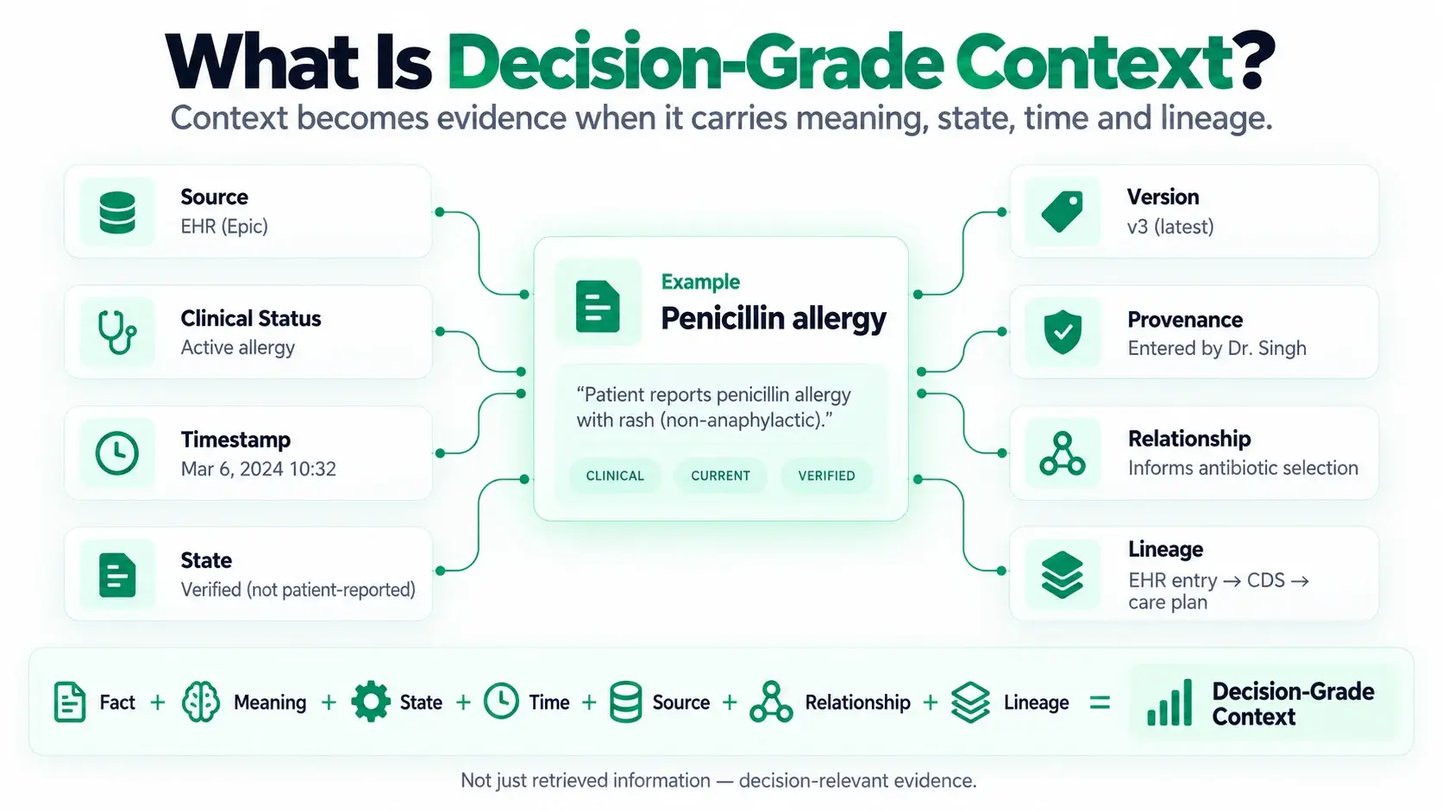
Decision-grade context treats retrieved information as evidence with meaning, state, time, relationship and lineage.
ElixirData: Context OS
ElixirData builds and maintains the enterprise context that healthcare agents and analytics consume. It connects and organizes information across EHR, FHIR, HL7, labs, PACS, pharmacy, claims, CRM, policies, knowledge and operational systems. Its ContextGraph helps preserve the relationships, time, provenance and policy context required for decision-grade AI.
- Data ingestion and synchronization
- Schema and field mapping
- Data normalization
- Ontology management
- ContextGraph and temporal context
- Graph + vector intelligence
- Knowledge ingestion
- Data quality and lineage
- Context retrieval
- Agent memory and contextual state where applicable
Context tells the agent what it needs to know. ElixirClaw controls how it acts.
Once AI begins interacting with healthcare workflows, another boundary appears. A model can reason, recommend, classify, predict and propose. But the model should not independently determine the limits of its own authority.
ElixirClaw: Agentic OS provides the runtime environment for AI agents, private assistants, multi-step workflows, connectors, MCP-based tools and custom AI capabilities. It also provides the control plane around those agents.
- Agent Gateway
- Authentication and authorization
- Data and agent access permissions
- Decision boundaries and human-in-the-loop controls
- Guardrails
- LLM Gateway and prompt management
- Secure tool execution
- AgentOps and observability
- Online and offline evaluation
|
Architectural separation ElixirData determines the context available to intelligence. ElixirClaw governs the agents that reason and act using that context. |
Healthcare agents in practice
- Clinical Decision Support Agent: Assembles patient state, medications, allergies, labs, clinical knowledge and contraindications. It may propose an intervention, but execution should remain within explicit runtime authority.
- Medication Reconciliation Agent: Reconciles prescriptions, pharmacy records, medication orders, discharge medications, allergies and interactions. Conflicting evidence should be surfaced rather than silently resolved.
- Care Coordination Agent: Brings together clinical state, discharge plan, appointments, transportation, home care, insurance and pending results so the plan is actually executable.
- Revenue Cycle & Coding Agent: Connects documentation, diagnosis, procedures, coding rules, payer policy and claim history; unsupported recommendations can be blocked or escalated.
ElixirHub: reusable healthcare expertise as skills
Not every healthcare agent should rebuild the same logic. Hospitals repeatedly need policy retrieval, medication validation, document classification, eligibility checks, evidence extraction, coding validation and workflow-specific checks. These capabilities can be packaged as reusable skills.
- Skill publishing
- Skill discovery
- Skill registry
- Skill versioning
- Skill installation and configuration
- Skill metadata
- Skill reuse and composition
- Skill lifecycle
|
ElixirData provides context. ElixirHub provides reusable expertise. ElixirClaw provides governed agents and execution. |
Get the Executive Blueprint for governed enterprise AI
A practical guide for CIOs, CAIOs and risk leaders on moving AI agents from pilot to production without losing control of context or decisions.
Why do specialized AI models belong in the agentic runtime?
Not every healthcare problem should be solved by an LLM. Healthcare workflows may require readmission-risk prediction, deterioration prediction, wait-time forecasting, anomaly detection, classification, recommendations, optimization, root-cause analysis or other domain-specific models.
The specialized model contributes intelligence; the agent orchestrates when and how that capability is used; enterprise context remains managed by ElixirData. This allows generative AI, traditional ML and healthcare-specific models to coexist behind governed interfaces.
How does the Elixir Platform support agentic AI in healthcare?
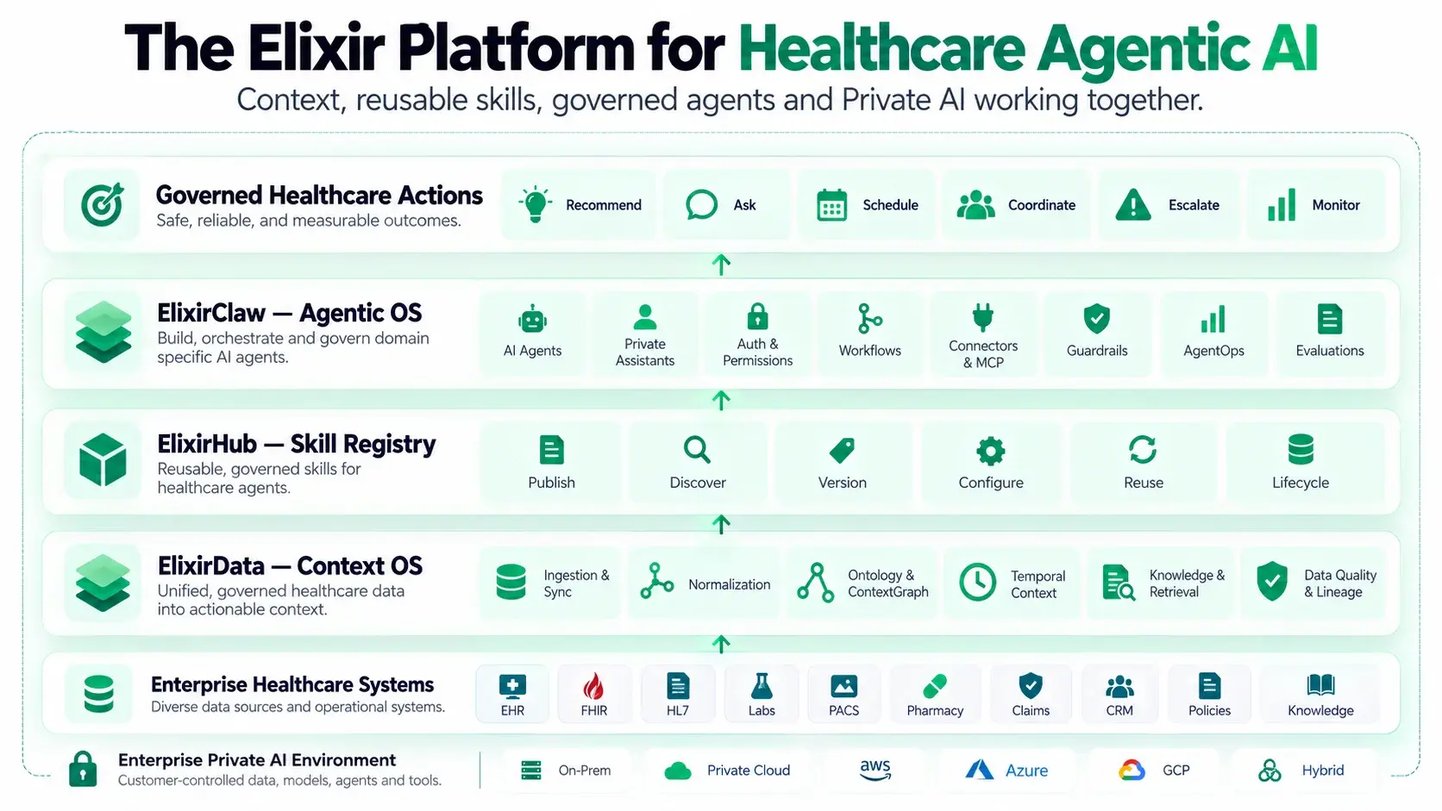
Elixir Platform architecture: enterprise systems feed context and skills into governed agents, operating within a customer-controlled Private AI environment.
The platform separates responsibilities cleanly: ElixirData connects, normalizes and contextualizes enterprise information; ElixirHub packages reusable skills; ElixirClaw reasons, orchestrates, governs, executes and observes; Enterprise Private AI establishes the deployment and control boundary.
A prior authorization example
Consider an MRI request for a patient with chronic lower-back pain. The workflow demonstrates how context, skills and governed agent execution come together without collapsing all responsibilities into the model.
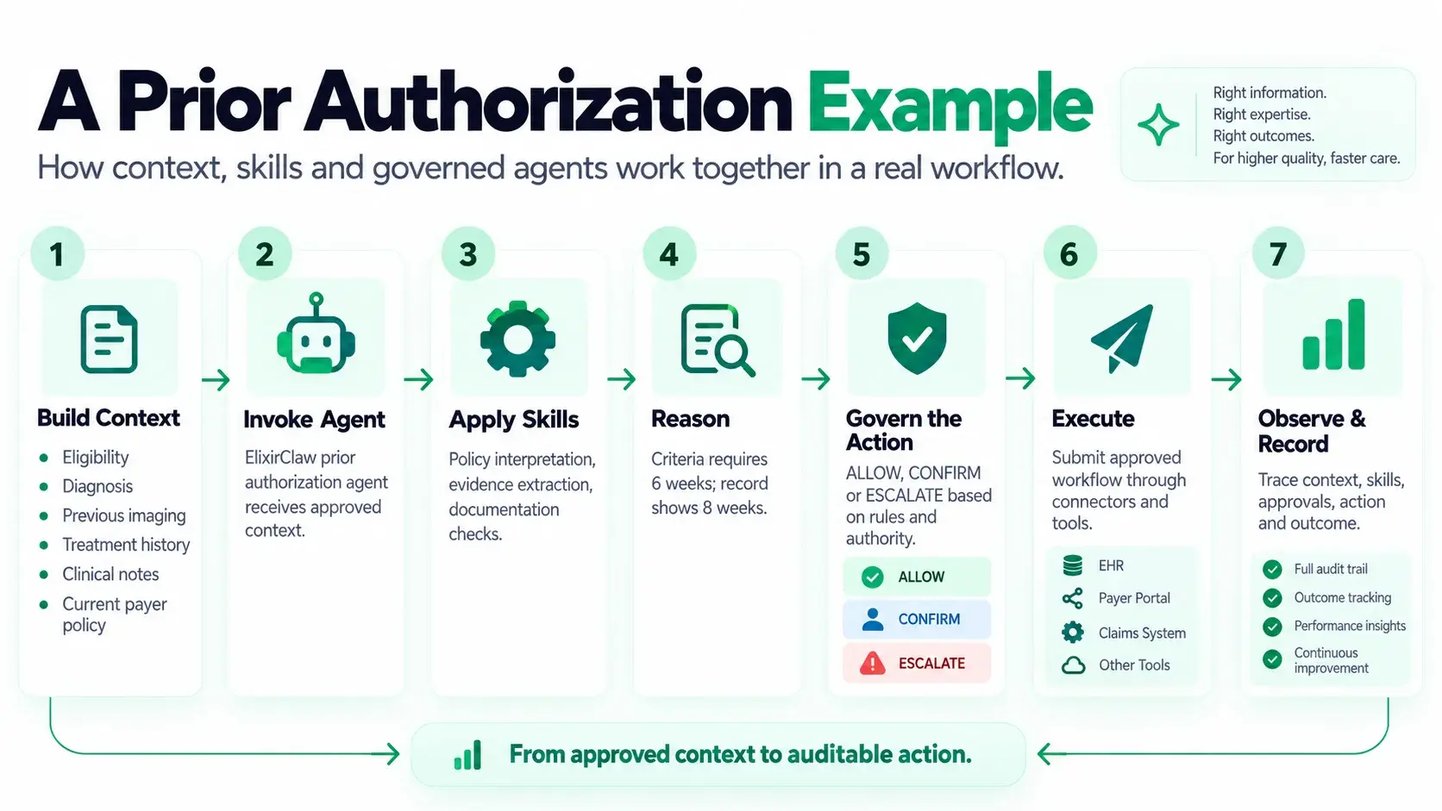
A practical flow from approved context to auditable action.
Step-by-step
- Build context: ElixirData assembles current eligibility, diagnosis, previous imaging, treatment history, relevant notes and the current payer policy.
- Invoke the agent: An ElixirClaw Prior Authorization Agent receives approved, task-relevant context under authenticated permissions.
- Apply reusable skills: The agent can use ElixirHub skills for policy interpretation, evidence extraction and documentation completeness.
- Reason: If policy requires six weeks of conservative therapy and the record shows eight, the agent can determine that this criterion appears satisfied.
- Govern the action: ElixirClaw applies the agent’s operating boundary: ALLOW, CONFIRM or ESCALATE based on the approved workflow.
- Execute: Approved connectors or MCP tools can submit the workflow into enterprise systems.
- Observe and record: AgentOps captures the execution path, approvals, tools, outcome and evaluation signals; relevant context and temporal relationships can be retained for future workflows.
Agents should earn autonomy
Healthcare should not jump from copilots directly to unrestricted autonomous agents. A more controlled progression is Shadow → Supervised → Bounded → Autonomous. The important principle is that autonomy should be granted per decision type, not simply per agent. This progression is consistent with continuous, lifecycle-based AI risk management described in the NIST AI Risk Management Framework.
The same agent may operate autonomously for low-risk scheduling while requiring human confirmation or escalation for clinically sensitive changes. ElixirClaw’s runtime controls, AgentOps and evaluations provide the mechanism for progressively expanding those boundaries.
Why healthcare AI also needs to be private
Context and governance solve only part of the problem. Healthcare AI operates on highly sensitive patient information, clinical knowledge, internal workflows, model interactions, agent traces and operational actions. For U.S. regulated entities, the HIPAA Security Rule requires administrative, physical and technical safeguards for electronic protected health information. For many organizations, the question becomes: can we build agentic AI without losing control of our data, models, infrastructure and operating boundaries?
Enterprise Private AI keeps sensitive data, models, agents, tools and operational control inside the organization’s approved boundary.
Why is private AI more than hosting an LLM privately?
- Private context: Enterprise knowledge, ContextGraph, retrieval, memory and operational state remain within approved boundaries.
- Private models: Approved LLMs, embedding models, vision models and specialized AI/ML capabilities can run in customer-controlled environments.
- Governed agents: Agents operate through authenticated identities, permissions, decision boundaries and approved workflows.
- Governed tools: Enterprise systems are exposed through approved APIs, connectors and MCP tools rather than unrestricted access.
Depending on enterprise requirements, the Elixir Platform can operate on-premises, in private cloud, in customer-controlled AWS/Azure/GCP environments, or in hybrid deployments.
How does decision history become institutional context?
One of the most valuable long-term assets may be the accumulation of decision history. A meaningful healthcare decision can be represented as Patient → State → Evidence → Policy → Decision → Authority → Action → Outcome.
ElixirData can maintain contextual and temporal relationships around those entities, while ElixirClaw captures runtime traces such as agent execution, tools invoked, approvals, escalations, actions and evaluation results. Together, this creates the foundation for institutional decision memory.
|
Future agents should understand not only what happened, but the context, evidence, authority and outcome surrounding consequential decisions. |
How does healthcare data infrastructure become healthcare decision infrastructure?
Healthcare technology has progressed through systems of record and systems of intelligence. Agentic AI adds systems of action. Between intelligence and action, organizations need systems of context and control.
- What is true?
- What changed?
- Which evidence should be trusted?
- What context does this task require?
- Which expertise should the agent use?
- What data may the agent access?
- Which tools may it invoke?
- What actions are inside its authority?
- When must a human take control?
- Can the entire execution path be reconstructed later?
Why may the healthcare AI moat not be the model?
Models will continue improving. Clinical reasoning will improve. Healthcare-specific models will proliferate. Agents will become more capable. And organizations will increasingly have access to similar underlying model intelligence.
The durable differentiation may instead come from who can build the best decision context; connect clinical evidence with operational reality; reuse institutional expertise safely; govern what agents can see and do; combine generative AI with specialized models; preserve decisions and outcomes; learn from exceptions; and run all of this inside enterprise-controlled boundaries.
Context → Skills → Agents → Governed Action → Memory
|
ElixirData |
ElixirHub |
ElixirClaw |
Governed |
Memory & |
ElixirData determines what the AI needs to know. ElixirHub provides reusable enterprise expertise. ElixirClaw enables agents to reason, orchestrate, invoke capabilities, apply decision boundaries and execute approved actions. AgentOps, context history and evaluation signals preserve what happened and improve the next decision.
The question healthcare leaders should be asking
The question is no longer only “Which LLM should we use?” and soon it will not simply be “Which AI agents should we deploy?” The more consequential question is what infrastructure provides the context, reusable expertise, authority, execution controls and memory behind every decision those agents make.
When AI moves from generating answers to taking actions, context becomes part of the safety boundary, governance becomes part of execution, and Private AI becomes part of enterprise control. The WHO guidance on ethics and governance of AI for health reinforces the need to put ethics and human rights at the center of AI design, deployment and use in healthcare.
ElixirData: Frequently Asked Questions
-
What is decision-grade context in healthcare AI?
Decision-grade context is task-relevant healthcare information enriched with meaning, state, time, source, relationships, lineage and applicable policy. Instead of sending an agent every available record, it provides the current, trusted evidence needed for a specific decision. See Decision-Grade Context for AI Agents for the broader enterprise architecture. -
Why is RAG alone not enough for healthcare AI agents?
RAG can retrieve semantically relevant information, but healthcare decisions also depend on freshness, authority, patient identity, provenance, temporal change, policy applicability and task-specific relevance. A governed context layer for AI adds those decision-critical properties before an agent reasons or acts. -
How do Context Graphs support healthcare AI?
Context Graphs connect clinical, operational, temporal, policy and decision relationships so an agent can understand not only what is known, but what is relevant now and why. This supports traceability, evidence quality and governed execution across fragmented healthcare systems. Read more about Context Graphs as decision infrastructure. -
How should healthcare organizations govern AI agent autonomy?
Autonomy should be bounded by decision type, identity, permissions, policy and risk. Low-risk actions may become automated after evaluation, while clinically sensitive or ambiguous actions should require confirmation or escalation. The NIST AI Risk Management Framework provides a widely used framework for managing AI risks throughout the lifecycle. -
What role do FHIR and HL7 play in a healthcare context architecture?
FHIR and HL7 standards help structure and exchange healthcare information across systems. They are important interoperability foundations, but decision-grade context also needs provenance, temporal state, policy, relationships and decision history. The official HL7 FHIR overview explains FHIR’s role in electronic healthcare information exchange.
The future of healthcare AI is not simply better intelligence
Healthcare spent decades digitizing records. The next chapter will be about connecting those records into decision-grade context and enabling AI agents to operate safely on top of it.
|
It is intelligence operating with the right context, using the right expertise, inside the right boundaries, with every important action observable and every decision able to improve the next one. |
The Elixir Platform brings that architecture together: ElixirData for context, ElixirHub for reusable skills, ElixirClaw for governed agents and execution, all deployable within an Enterprise Private AI environment where organizations retain control of their data, models, agents, tools and infrastructure.
Take the next step
Download the Executive Blueprint, or talk to our team about governed, private agentic AI for healthcare.
Which platform is responsible for what?
|
Platform |
Role |
Canonical capabilities |
|
ElixirData |
Context OS |
Ingestion, mapping, normalization, ontology, ContextGraph, temporal context, graph/vector intelligence, knowledge, quality, lineage, retrieval and context/memory. |
|
ElixirHub |
Skill Registry |
Publishing, discovery, registry, versioning, installation/configuration, metadata, reuse/composition and lifecycle. |
|
ElixirClaw |
Agentic OS |
Agents, gateway, authN/Z, permissions, workflows, connectors, MCP, tool execution, decision boundaries, HITL, guardrails, LLM gateway, prompts, AgentOps, evaluation and secure execution. |
|
Private AI |
Operating boundary |
Customer-controlled data, models, agents, tools, logs and infrastructure across on-prem, private cloud, customer cloud or hybrid environments. |