Private AI on private cloud gives enterprises more control over where models and data processing run, but hosting alone does not make agents safe. This post covers the full architecture: a context layer for evidence, scoped identities, policy checks, human approvals and traced actions, plus how to pilot and measure it.
Why enterprise AI needs context and control
Consider an agent asked to resolve a supplier exception. It may need to join a purchase order, contract amendment, quality event and approval policy before it recommends a change. If it can also update a system, the architecture must answer four questions: which facts are current, what may it see, who may approve the action and how will the result be traced?
Private cloud can give an organization more control over where models and data processing run. A context layer for AI agents joins people, assets, policies, events, documents and decisions so the agent can use the right evidence for a task. Neither hosting nor context alone determines whether a proposed action is allowed.
NIST treats AI risk management across design, deployment and evaluation. Microsoft’s AI workload architecture describes the components and boundaries of a governed system. These references support an operational design in which retrieval, identity, tool access, monitoring and approvals are specified together.
See how Context OS governs AI agent decisions
Context OS adds governed context, scoped access and traced actions to private AI deployments.
What private cloud changes for enterprise AI
Private cloud is a deployment choice with concrete design work behind it: placement of models and context stores, approved network routes, tenant isolation, identity, secrets, logging and recovery. The application still needs a complete path from evidence retrieval through policy checks, human review when required and a recorded outcome.
An organization may use on-premises infrastructure, a dedicated hosted environment, a sovereign cloud or a governed hybrid design. The right choice depends on data residency, latency, operational ownership and the systems the agent must reach. Specify exactly which data can leave each boundary and where tool calls are executed; a private deployment label does not establish those controls by itself.
This is valuable when agents interact with ERP, ITSM, CRM, industrial systems or regulated documents. XenonStack’s guide to agentic AI on private cloud discusses the infrastructure and deployment questions that teams should resolve before production use.
The private cloud architecture from data to action
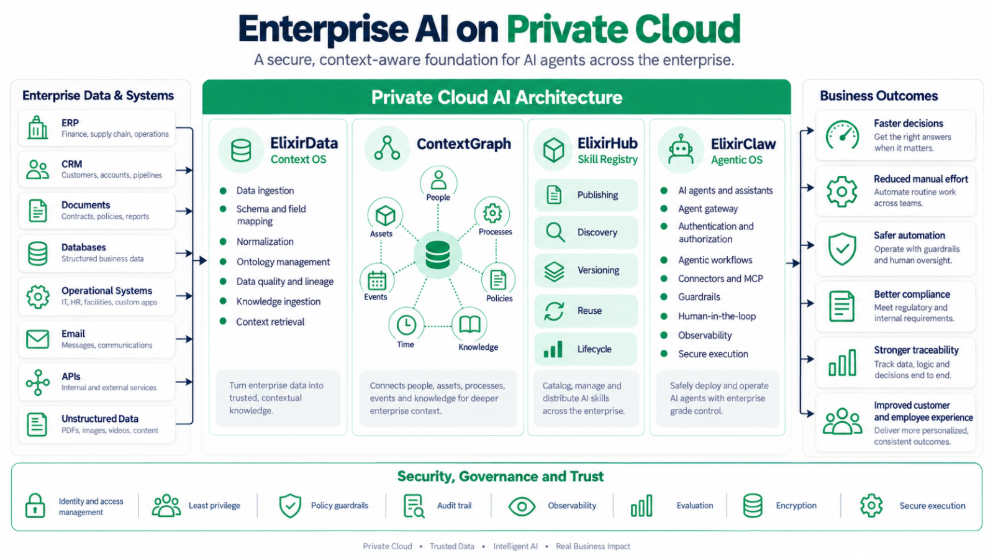
A practical architecture has five responsibilities. They can be implemented in different products, but each needs an owner and a testable boundary:
- Trusted data: synchronize permitted sources, resolve identifiers and check quality and freshness.
- Decision context: join entities, events, time, policies and source evidence for the current task.
- Agent runtime: route requests, invoke approved models and tools, and retain the task state.
- Governance: authenticate the actor, restrict retrieval and actions, and require approval at defined thresholds.
- Execution and trace: perform an authorized step and record the evidence, decision, tool call and outcome.
The workflow must do more than produce an answer. A user may need a policy check, incident update or transaction recommendation. Keeping retrieval, reasoning, authorization and execution visible as separate steps makes errors easier to diagnose and actions easier to review.
How the context layer grounds AI agents
Enterprise records are distributed across applications and document stores. A service agent may find a relevant contract clause but miss a later amendment or a customer-specific exception. The context layer connects those records and returns the pieces relevant to the current question, with source and time information. ElixirData explains the wider design in its guide to the context layer for AI.
A context model links entities such as accounts, assets, suppliers, cases, policies and events. It should distinguish what was true at the time of an event from what is true now, and identify which source supports each fact. IBM’s knowledge graph overview explains the entity-and-relationship foundation; the enterprise context layer adds decision-specific state, authority and evidence.
Agentic data intelligence is useful when software can identify data quality gaps, align related records and retrieve context across sources for a bounded task. The result should be checked for completeness and access scope before the agent relies on it. ElixirData’s article on context as infrastructure expands on the value of maintained business and decision context.
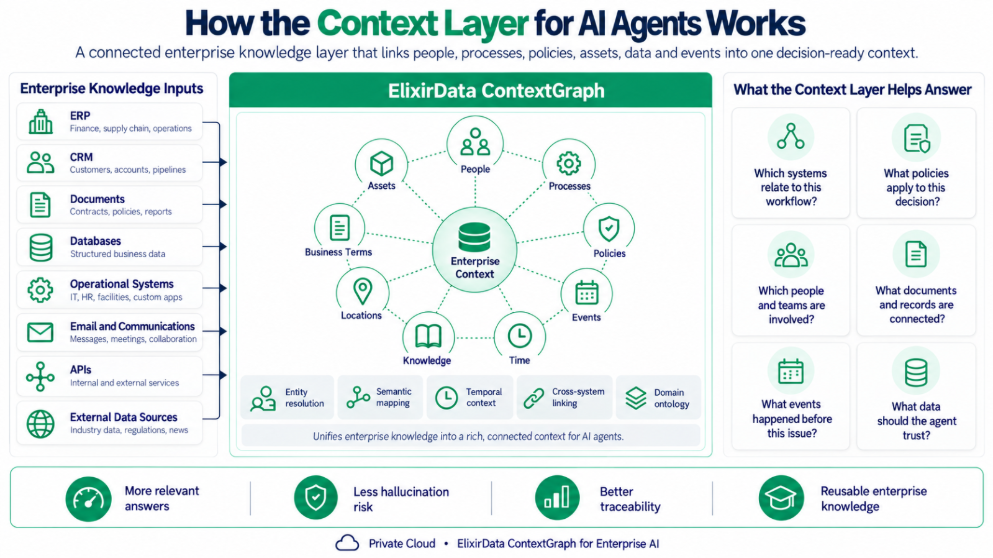
Figure 2: The context layer connects enterprise knowledge inputs, semantic relationships and decision-ready questions for AI agents.
How ElixirData ElixirHub and ElixirClaw fit
ElixirData maintains the governed context: ingestion, entity and field mapping, ontology, ContextGraph, quality, lineage and task-specific retrieval. Its output is a context package with links to underlying evidence rather than unrestricted access to all enterprise records.
ElixirHub registers versioned skills that agents can discover and reuse. A skill may package an investigation or approval preparation method. Publishing a skill does not grant the agent access to a connector or bypass the execution policy.
ElixirClaw runs agents and applies identities, permissions, tool controls, workflow checks, human approval and observability. Models for forecasting, anomaly detection or root-cause analysis can be exposed to agents as governed tools when the task requires them. The runtime records the proposed action and its result so business and security owners can review it.
Agentic BI presents natural-language analysis and operational views based on the same governed context. It supports exploration and explanation; the authorized runtime owns consequential tool calls and system writes.
Get the Executive Blueprint for governed enterprise AI
A practical guide for CIOs, CAIOs and risk leaders on moving AI agents from pilot to production without losing control of context or decisions.
The controlled path from request to action
A request enters through an identity-aware gateway. The workflow retrieves only the data allowed for that user and task, checks freshness and source evidence, then proposes an answer or action. Before a tool changes a record, a separate policy decision checks the actor, target system, action type and threshold. Sensitive steps are held for a named approver. The final trace records context, policy result, approval, tool call and observed outcome.
Autonomy can expand only after owners examine failed cases, policy exceptions and outcomes. A reversible low-impact action may be approved for bounded automation; a financial transfer, access change or safety-sensitive step may continue to require a person.
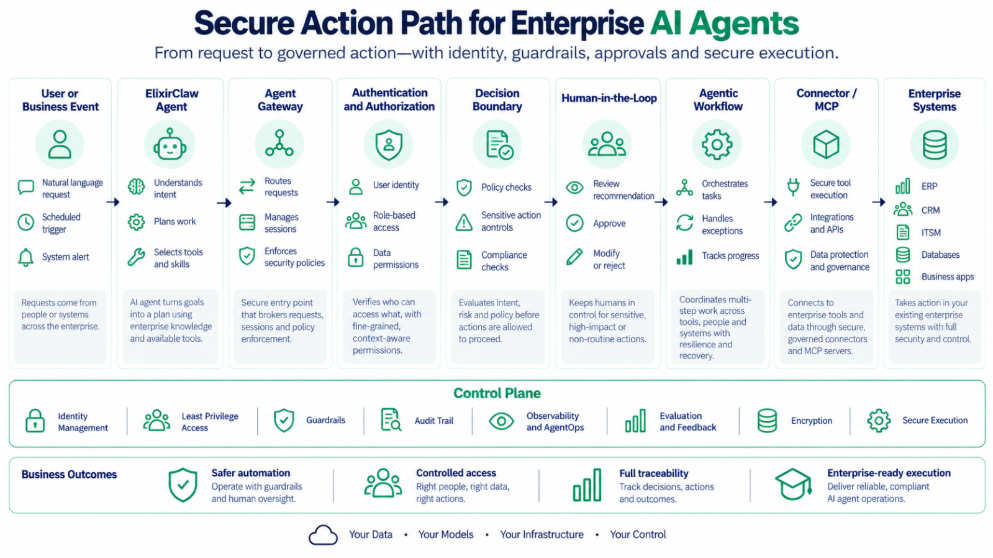
Figure 3: The secure action path adds identity, policy, approvals and observability between a request and any consequential system action.
Security and governance beyond private hosting
Private infrastructure may narrow exposure, but it does not eliminate prompt injection, overshared retrieval, excessive tool privileges or poor source quality. NIST’s AI Risk Management Framework and its generative AI profile call for risk management throughout the lifecycle. Microsoft’s AI architecture likewise treats identity, network and observability as workload design decisions.
Implement distinct identities for people, services and agents; least-privilege retrieval and tool scopes; protected model endpoints; approval gates for material actions; logs that connect input, context, decision and execution; and regular evaluation of accuracy, leakage and policy adherence. Review logs with process owners so controls can be adjusted when the workflow changes.
How the architecture applies across industries
The deployment boundary, context model and governed workflow are reusable patterns. Each industry still needs its own source mappings, policy definitions, approval roles and measures of success.
In manufacturing, an investigation can join plant events, maintenance records and operating procedures before an engineer acts. In banking, a service agent can connect an account, policy and approval history while protecting restricted data. In healthcare, administrative workflows can retrieve permitted documentation and route sensitive decisions to authorized staff. These are design examples; the access and safety rules must be validated for each setting.
Legal teams may link matters, clauses and obligations; retail teams may connect inventory, product and service context; IT teams may relate alerts, changes and incidents. The common architecture does not imply identical permissions or autonomy across those domains.
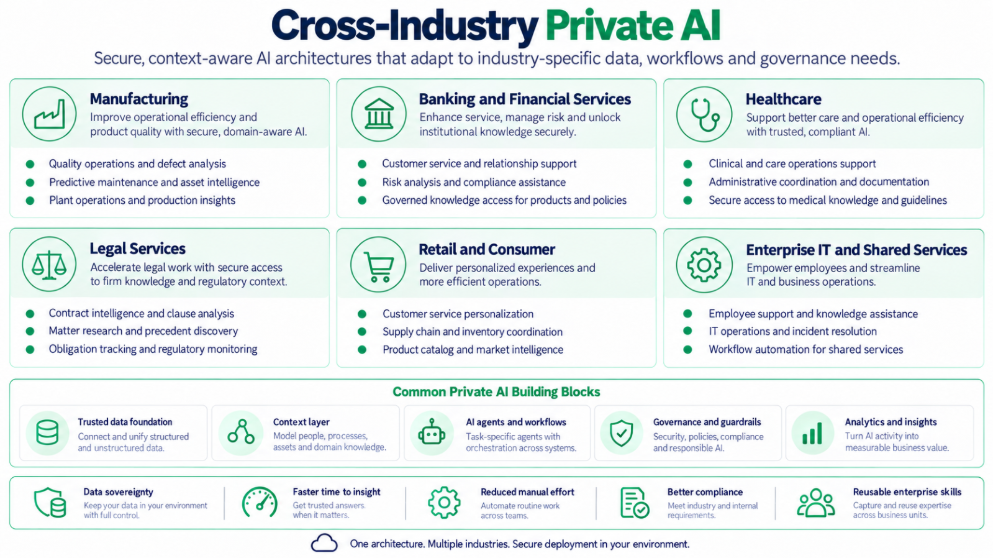
Figure 4: A common private AI architecture can support manufacturing, banking, healthcare, legal, retail and enterprise IT use cases.
Which outcomes should a private AI pilot measure?
Set a baseline for one workflow before the pilot. Track investigation or handling time, decision accuracy, workflow completion, first-time resolution and the effort needed for human review. For sensitive actions, measure policy exceptions, unauthorized attempts blocked and completeness of the decision trace. Select the business outcome that the workflow can realistically influence.
Operating measures should include context retrieval precision, freshness, source coverage, tool-call success, latency, cost per completed workflow and the share of answers requiring correction. Review the failed cases with business, data and security owners so changes address the right layer.
A practical rollout for governed AI agents
Start with one bounded process, such as supplier exception review or an IT incident investigation. List the required entities, documents, events and policies, then identify the owner of each source. Define the agent identity, permitted retrieval, approved tools, action threshold and escalation path. Test read-only recommendations before enabling a system write, and record each step for review.
Expand after the team has measured answer quality, control performance and operator experience against the baseline. Reuse validated context mappings and skills for adjacent workflows, while testing new source connections and permissions separately.
Build context and controls around the model
Private cloud gives teams a controlled place to run models, context services and agent workflows. Reliable use also depends on current evidence, scoped identities, policy checks and recorded outcomes. Connect those elements in one bounded process before expanding the agent’s authority.
The first goal is a reviewable decision: an answer grounded in known sources, an action within a clear boundary and a trace that shows what happened. Measure that result with the process owner, then refine the context and controls.
Take the next step
Download the Executive Blueprint, or talk to our team about private AI for governed agents.
Frequently Asked Questions
-
Why do AI agents need a context layer?
A context layer connects relevant entities, documents, events, policies and source history so an agent can answer a specific business question using current, traceable evidence. -
Does private cloud deployment make an AI agent secure?
No. The application also needs scoped access to data and tools, protected model endpoints, policy checks, monitoring and approvals for consequential actions. -
When should an agent ask for human approval?
Require approval when a proposed action crosses a defined risk threshold, changes a sensitive record, affects finances or safety, or falls outside the agent’s authorized scope. -
Can one private AI architecture work across industries?
The core pattern can be reused, but each industry needs its own context model, source permissions, policies, approval roles and outcome measures. -
What should a first private AI pilot measure?
Choose a bounded workflow and compare it with a baseline for handling time, answer accuracy, evidence coverage, completion rate, policy adherence and the effort required for human review.