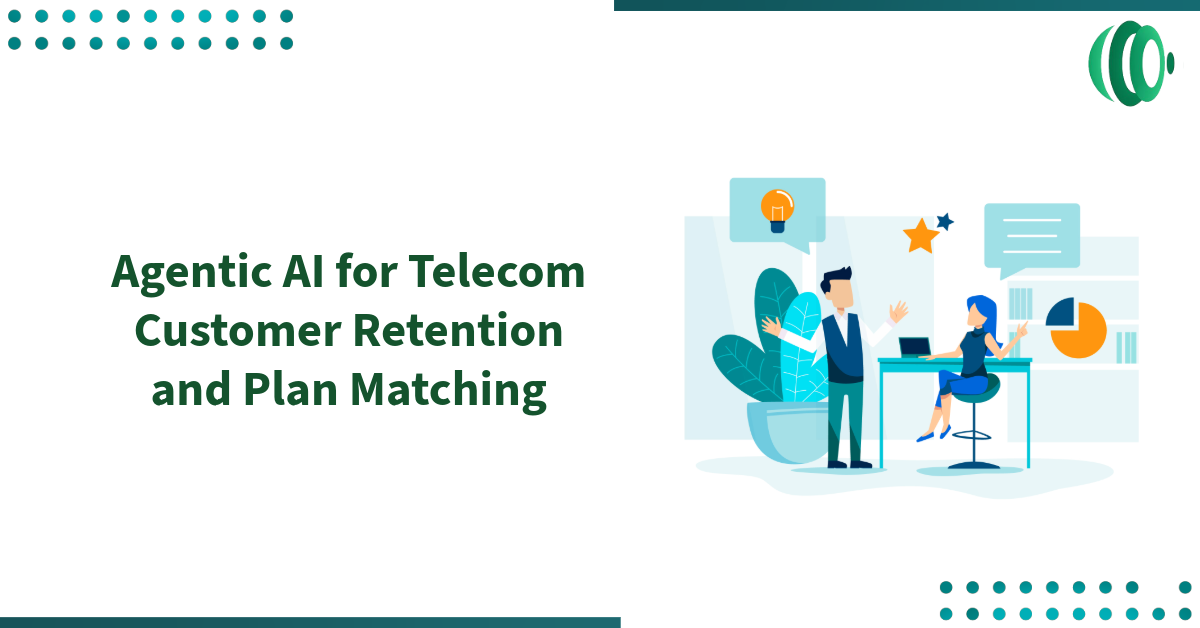
Telecom customer retention with agentic AI is a governed workflow that connects churn signals with customer context, evaluates suitable interventions such as plan changes or service fixes, checks permissions and policies, and coordinates follow-through across CRM, billing, and network systems.
A telecom operator may know which subscribers are likely to leave and still fail to retain them. A churn model produces a score, a customer relationship management (CRM) system creates a task, and a campaign sends a discount. Meanwhile, the customer may be dealing with poor coverage, an unresolved billing dispute, and a plan that no longer suits their household.
The customer experiences these issues as one relationship, even when the operator handles them in separate systems. Agentic AI for telecom customer retention can connect the signals, determine why the relationship is weakening, compare suitable plans, check commercial and customer permissions, and coordinate the next action. The aim is to improve the value the customer actually receives, rather than rely on a last-minute save offer. TM Forum's customer experience work similarly connects churn prediction with timely, personalized intervention.
See how Context OS governs AI agent decisions
Context OS links churn signals, plans, bills and network issues so retention agents act on current, governed context.
Why churn prediction is only the starting point
Consider a family mobile account approaching renewal. Its data usage has fallen because household members use home Wi-Fi. One line has experienced coverage problems, and a roaming charge led to an unresolved support case. The family is still paying for a premium unlimited plan, while a competing provider is advertising a lower-cost bundle.
A churn score can flag the account, but it cannot by itself determine whether the operator should repair a service problem, correct a bill, recommend a smaller plan, add a useful roaming benefit, or escalate the case. A generic discount might reduce the monthly bill while leaving the underlying frustration untouched.
The retention decision needs several kinds of evidence:
-
Customer needs: household lines, current and expected usage, roaming, device financing, and valued benefits.
-
Experience: coverage and call quality, open support cases, complaints, and prior promises.
-
Commercial context: contract dates, current price, plan catalog, eligibility, margin, and customer lifetime value.
-
Authority: marketing preferences, consent where required, approval limits, and rules for changing a contract or bill.
The right response can even be a lower-priced plan. That may reduce immediate revenue but improve plan fit and strengthen the relationship over time. TM Forum's price-planning case describes the industry goal of aligning plan offerings with the subscriber lifecycle and retention outcomes.
Where traditional retention workflows break down
Most operators have the data needed to make better decisions, but it is spread across charging, network operations, billing, CRM, product catalogs, campaign platforms, and customer-care channels. The problems show up in four familiar ways:
-
Static segments hide individual needs. Two subscribers on the same premium plan may have different reasons for leaving. One needs a service fix; another needs a less expensive plan; a third depends on roaming.
-
Signals arrive too late. A monthly churn score may appear after repeated complaints and declining use have already shaped the customer's decision.
-
Discounts substitute for diagnosis. An incentive is easy to send, but it may not solve a coverage issue, billing error, or unsuitable plan.
-
Execution requires manual handoffs. A useful recommendation can stall while staff check eligibility, confirm the product catalog, calculate the offer, seek approval, contact the customer, and update billing.
The improvement is a connected operating loop: Detect → Understand Context → Decide → Approve → Act → Verify → Learn. Detection identifies a change. Context explains it. Decision compares interventions. Approval checks authority. Action reaches the customer or fixes the service. Verification confirms the outcome, and learning improves the next decision.
How agentic AI can improve telecom customer retention
1. Build a current customer context
The workflow needs to connect identity, household relationships, subscriptions, device status, plan features, usage, bills, complaints, network incidents, contract dates, and prior retention actions. Time matters: a complaint after a service degradation during a renewal window is different from a resolved complaint six months earlier.
The picture can also include payment history, campaign responses, past plan changes, application engagement, and earlier retention actions. A plan recommendation should account for which signals are current, which source is authoritative, and whether household relationships or customer preferences have changed.
ElixirData's Context OS provides a way to assemble decision-relevant information from these systems. A Context Graph can represent relationships such as customer → household → subscription → device → plan → usage → bill → complaint → network incident. Provenance and temporal state help an agent distinguish a recent verified signal from an outdated record. ElixirData's telecom decision traceability article also connects network conditions with customer impact and service decisions.
This context should include data quality checks. If the customer has recently changed plans, the system should not recommend another migration based on stale usage or an old catalog entry.
2. Detect risk and explain contributing signals
A churn model can estimate risk using usage changes, service quality, billing disputes, care contacts, renewal timing, payment behavior, and other permitted data. Its output is an input to the decision, not an instruction to send an offer. The agent should examine the contributing signals and their freshness before choosing a response.
Additional signals may include device replacement cycles, reduced application engagement, sentiment in customer conversations, and port-out activity where legally available. A specialist model can be trained on historical outcomes and exposed to an agent through a controlled tool interface such as the Model Context Protocol (MCP). In that design, customer context is supplied to the model, the model estimates churn risk, and the retention agent decides what investigation or action is warranted. The model does not independently control the customer journey.
For example, an account may show elevated risk alongside an unresolved roaming dispute, reduced mobile data use, and repeated poor call quality. A service case may need attention before any plan recommendation. Predictions should be tested for accuracy and monitored for drift across customer groups and regions.
A useful decision record would include the risk level, contributing signals, contract position, plan utilization, customer value, and the next analysis needed. A standalone prediction such as “82% churn probability” is far less actionable than an explanation of why the risk rose and which evidence still needs verification. Any percentage in such a record would be an account-level model output, not a claim about typical telecom customers.
3. Match the plan to the customer's needs
Plan matching compares actual and expected usage with available products. It should consider household lines, roaming, device commitments, data headroom, broadband bundles, benefits, contract terms, and total cost. It should also explain what the customer gains and gives up.
Other relevant factors can include international calling, entertainment preferences, network entitlements, family sharing, and the operator's long-term economics. A customer approaching a data limit may benefit from an upgrade, while someone paying for unused capacity may benefit from a downgrade. The objective is a plan that remains suitable over the coming months, rather than one that matches only the latest bill.
Suppose a family uses under 15 GB a month while paying for an unlimited plan. An eligible mid-tier plan with adequate headroom may offer better value than a discount on the current one. The recommendation must still check for features the family uses, such as shared lines or roaming. A lower price is not a better match if it removes a benefit that matters.
4. Validate offers against policy and customer permissions
Before outreach or a plan change, the workflow should verify product eligibility, current catalog terms, margin limits, retention budget, contract restrictions, channel permissions, and any required consent. Larger concessions, disputes, or unusual household configurations can be routed to a human advisor.
For illustration, a family paying $145 a month might qualify for a $112 plan with enough shared data and a relevant streaming benefit. The agent could recommend it if the expected margin and contract terms meet policy. If a proposed 30% concession crosses a margin threshold, the workflow would instead seek human approval. These figures illustrate how decision boundaries operate; they are not observed campaign results or an actual product offer.
This control matters because an agent should not invent a discount or silently change a customer's contract. NIST's AI Risk Management Framework offers a useful general structure for governing, measuring, and managing AI risks; each operator must translate it into its own commercial and customer policies.
5. Coordinate the journey and confirm the result
Once an action is approved, the workflow can prepare a clear offer, select a permitted channel, and record what the customer was told. If the customer accepts, authorized integrations can update CRM, subscription, and billing records. A confirmation should state the new price, benefits, effective date, and any changed terms.
ElixirClaw's telecom retention workflow describes predictive intervention and relevant offers. In the architecture described here, ElixirClaw coordinates agent actions through defined permissions, approvals, connectors, and audit records. Reusable tasks such as eligibility validation, plan comparison, and offer explanation can be managed as ElixirHub skills, using the same skills-layer pattern described for another regulated customer workflow. XenonStack's telecom overview provides wider context for customer retention and network experience in telecom operations.
Those reusable skills can also cover customer lifetime value checks, consent capture, renewal confirmation, billing validation, communication drafts, and offer summaries. Versioning a skill lets teams reuse approved logic for prepaid upgrades, broadband migrations, family packages, and enterprise mobility renewals. ElixirHub manages the reusable capability; execution, system access, and action permissions are governed in the agent workflow.
The workflow should verify that the accepted offer was applied correctly, that an open service issue has an owner, and that the customer can see the agreed terms. An offer sent is not the same as a problem solved.
How the three platform roles connect
For a production retention journey, CRM, billing, charging, network, care, campaign, and catalog systems provide the source data. ElixirData assembles linked customer context and temporal history. Specialist churn prediction, plan recommendation, and offer optimization models provide estimates through controlled interfaces, including MCP where appropriate. ElixirClaw uses that evidence to coordinate governed decisions and actions across CRM, billing, messaging, and customer applications. ElixirHub supplies approved reusable skills when the journey needs a repeatable capability.
Keeping these roles distinct makes a decision easier to inspect. An operator can ask which source established the current plan, which model raised the risk, which skill checked eligibility, which rule constrained the offer, who approved an exception, and whether the billing update succeeded. It also prevents a prediction score from being treated as authority to change a customer's subscription.
Get the Executive Blueprint for governed enterprise AI
A practical guide for CIOs, CAIOs and risk leaders on moving AI agents from pilot to production without losing control of context or decisions.
Illustrative scenario: a family plan before renewal
The following example shows how the steps connect. Its figures are illustrative, not measured customer results.
Sara has four mobile lines and a contract that expires in 90 days. Over four months, household mobile data use has fallen by 45%, two lines now rely mainly on home Wi-Fi, a roaming charge is in dispute, and one line has recorded repeated call-quality problems.
Engagement with the operator's app has also declined. The retention agent therefore needs to consider several connected causes, including plan mismatch, service quality, and an unresolved billing experience, instead of interpreting one usage signal in isolation.
-
Detect: A risk model flags the account using recent, permitted signals.
-
Understand context: The agent checks the disputed charge, network issue, household plan, past contacts, and renewal date. It sees that a discount alone would not address the service concerns.
-
Decide: A plan comparison identifies a less expensive family tier with enough data headroom, suitable roaming terms, and the benefits Sara still uses. It also evaluates whether an entertainment benefit offers more value than a larger discount. The service team receives the coverage issue.
-
Approve: Eligibility, pricing, margin, contact permissions, and contract terms are checked. An exception goes to an authorized employee.
-
Act: Sara receives a transparent comparison through an allowed channel: her recent usage suggests a smaller plan may reduce her monthly bill while preserving the family benefits she uses. She chooses whether to accept. Only then do authorized business support system (BSS) integrations process the change.
-
Verify and learn: The operator confirms the subscription and contract state in billing and CRM, tracks the service case, and later measures acceptance, satisfaction, usage, margin, support contacts, and renewal outcome.
The agent's value is its ability to carry the same customer context across prediction, recommendation, engagement, and fulfillment.
Human judgment, privacy, and commercial control
Routine plan comparisons and draft explanations may be suitable for bounded automation. Contract disputes, significant billing corrections, high-value concessions, vulnerable-customer situations, and enterprise accounts may need specialist review. The threshold should be based on the action's customer impact and reversibility, not just the model's confidence score.
The same judgment applies to complex multi-product households, unusual contract terms, and offers beyond profitability thresholds. Well-understood and reversible actions can be considered for more automation as their quality is measured; ambiguous or sensitive cases should remain with a qualified employee.
Retention workflows can process identity, communications, usage, billing, pricing, and campaign data. Access controls, retention periods, purpose limits, customer preferences, and audit trails therefore belong in the design. A private deployment may help an operator meet its security and data residency requirements, but deployment location alone does not establish compliant data use or a correct recommendation.
The controls should cover prompts, model interactions, agent memory, customer-facing messages, and tool actions as well as the underlying CRM and billing records. This becomes particularly relevant when an agent moves from summarizing information to making changes in production systems.
Measure customer value, not just fewer cancellations
A retention program can reduce churn by giving away too much margin. Evaluate the full outcome by customer group and intervention type:
-
Retention rate: Did the customer remain after the intervention and renewal window?
-
Plan fit: Does the new allowance and benefit mix suit actual use without creating avoidable overage or waste?
-
Offer acceptance and completion: Was the offer relevant, and was the promised change applied correctly?
-
Customer experience: Did complaints, repeat contacts, and unresolved service issues decline?
-
Customer lifetime value and margin: Did the intervention preserve a sustainable relationship without excessive discounts?
-
Cost per retained customer: How much did the outreach, incentive, and manual work cost?
-
Digital completion and human escalation: How many accepted changes completed without a call-center handoff, and which cases still needed review?
-
Decision quality: Were model signals current, eligibility checks correct, approvals recorded, and exceptions escalated? Did online and offline evaluations identify inaccurate recommendations?
Use a baseline and a comparison group where feasible. An accepted offer is an immediate signal; longer-term retention, satisfaction, and economics show whether it truly helped. The range of useful interventions is wider than plan changes. It can include correcting a bill, repairing network service, removing an unused add-on, adding a roaming benefit, bundling broadband and mobile, or arranging a human conversation. The best action depends on the reason the customer relationship is deteriorating.
Frequently asked questions
-
What is agentic AI for telecom customer retention?
It is a governed workflow that connects churn signals with customer context, evaluates suitable interventions, checks permissions and policies, and coordinates follow-through across telecom systems.
-
How is plan matching different from churn prediction?
Churn prediction estimates the likelihood that a customer will leave. Plan matching evaluates which eligible product and benefits better fit the customer's needs and commercial constraints.
-
Should every at-risk subscriber receive a discount?
No. A service fix, billing correction, plan change, or human conversation may address the underlying problem better than a discount.
-
Can an AI agent change a telecom plan automatically?
Only within defined authority and after the required customer acceptance and eligibility checks. Sensitive exceptions should go to an authorized employee.
-
Which metrics show whether retention is working?
Track retention alongside plan fit, customer satisfaction, margin, completion accuracy, intervention cost, and the quality of agent decisions.
From churn scores to better customer relationships
Predicting churn helps an operator see risk. Improving retention requires understanding the cause, making a relevant recommendation, resolving any service issue, and delivering the agreed change accurately. When those steps share current context and clear decision boundaries, the operator can act before a cancellation request becomes the first meaningful conversation.
Take the next step
Download the Executive Blueprint, or talk to our team about governed agentic AI for telecom retention.