
An IAM tool for AI agents should give every agent its own identity, limit what that identity can reach, and record which agent did what on whose behalf. Workforce IAM was built for people who sign in and act one at a time. Agents call tools, call each other and run unattended, so identities multiply, permissions need to be scoped to a task, and the chain of delegation has to be traceable.
Disclosure: ElixirData sells an agent identity and access product, listed below. Vendor details come from each vendor's own pages, read on 13 November 2026. We have not tested them.
What should an IAM tool for AI agents do?
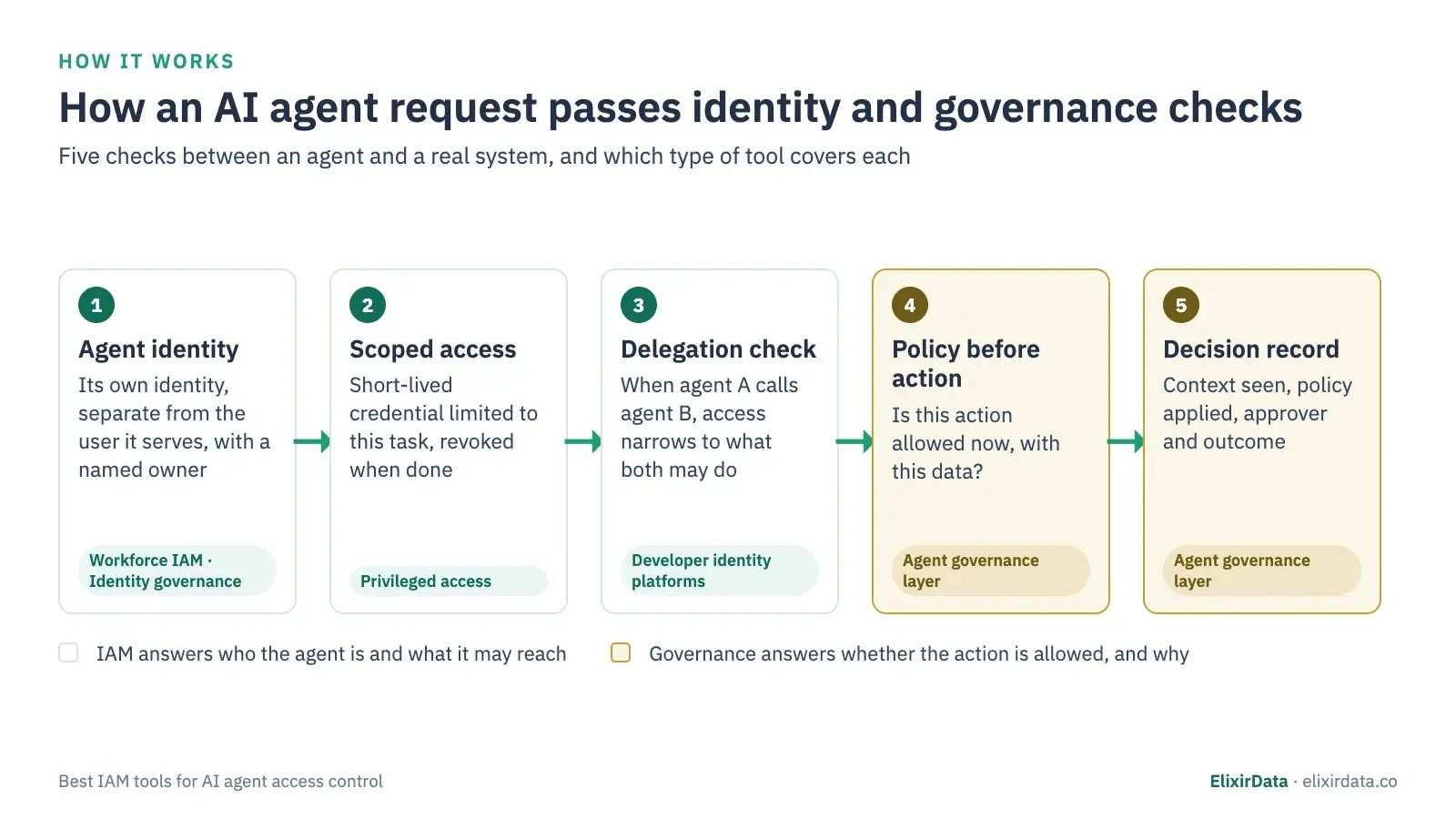
Four jobs matter most: give each agent an identity separate from the user it serves, scope access to the task, track delegation from one agent to another, and keep a log an auditor can read.
How is agent access different from human access?
- Agents often use shared API keys or service accounts, so one credential grants broad access.
- Agents hold more permissions than a task needs, because nobody scoped them.
- When one agent calls another, access can pass along unchecked.
- Actions run at machine speed, so review after the fact comes too late.
Which types of tool fit which need?
| Tool type | Best at | Gap for agents |
|---|---|---|
| Workforce and customer IAM | Sign-in, single sign-on, user lifecycle | Built around people; agent identity needs extra constructs |
| Identity governance | Inventory, ownership, access review | Review cycles are slower than agent actions |
| Privileged access | Task-scoped, short-lived credentials | Does not record why a decision was made |
| Developer identity platforms | Tokens, MCP authorisation, delegated access for agent apps | Fits apps you build; less for agents already running |
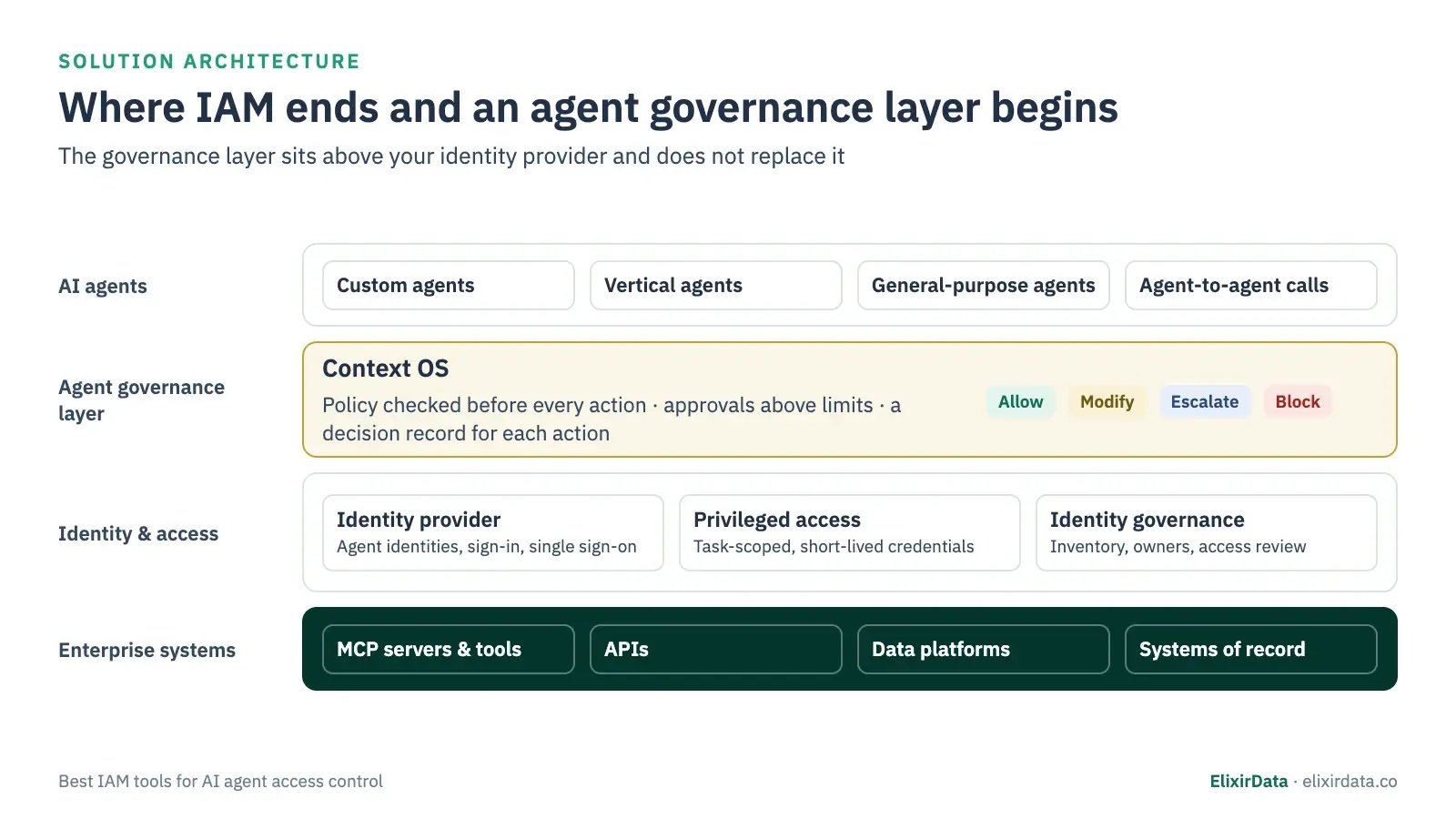
| Agent governance layer | Policy before action, decision record | Sits above IAM; does not replace your identity provider |
How do four vendors describe their approach?
Each row is according to the vendor's own page, read on 13 November 2026. Availability can change, so check each page before you buy.
| Vendor | How it describes agent access | Check before buying |
|---|---|---|
| Microsoft Entra Agent ID | Extends Entra to agents: agent identities, blueprints, OAuth 2.0, MCP and A2A, sign-in and audit logs. Source | Which Entra security features for agents need Microsoft Agent 365 licensing; preview or general availability status |
| CyberArk Secure AI Agents | Discovery, a gateway between agents and tools, task-scoped permissions revoked automatically, threat response. Source | Which tools the gateway supports; availability |
| SailPoint Agent Identity Security | Inventory, a human owner per agent, access review, shadow AI visibility. Its page says it has evolved into SailPoint Agentic Fabric. Source | Current product name and scope |
| Okta Auth0 for AI Agents | Auth for MCP and On-Behalf-Of Token Exchange, generally available when announced on 21 May 2026; Agent as Principal planned for developer preview. Source | Whether Agent as Principal is generally available yet |
Where does ElixirData fit?
According to its own page, ElixirData Agent Identity & Access gives each agent a cryptographic identity with a role, department, owner and purpose, integrates with existing IAM such as Okta and Azure AD, enforces access at the infrastructure layer, and scopes delegation to the intersection of both agents' permissions. It is not a replacement for your identity provider. For the deeper argument, read AI Agent Identity and RBAC.
What does IAM still miss?
IAM answers who the agent is and what it may reach. It does not record why an agent took one action and not another. For that you need a record of each decision: the context the agent saw, the policy that applied and who approved it. That is the layer Context OS covers; see what a governed AI stack is.
How do you choose? A four-step pilot
- List your agents and what each can reach today. Count the shared keys.
- Pick one agent that writes to a real system and put it behind each candidate.
- Test one delegation: agent A calls agent B. Does access narrow or widen?
- Ask for one action, start to finish, in a form an auditor can read.
What eight questions should you put to any vendor?
- Does each agent get its own identity, separate from the user it serves?
- Can permissions be scoped to a task and revoked automatically?
- What happens when one agent delegates to another?
- Does it work with your current identity provider?
- Which agent frameworks and MCP servers does it cover?
- What is logged, and can an auditor read it?
- Which capabilities are generally available today, and which are in preview?
- How are shared keys found and retired?
Want to map one agent decision end to end? Book a Context Workshop.
FAQ
What is IAM for AI agents?
Identity and access management applied to non-human agent identities: identity, scoped permissions, delegation and audit.
Can my existing identity provider manage agents?
Often in part. Check how each vendor handles agent identity, delegation and task-scoped access.
Is IAM enough to govern AI agents?
No. IAM controls access. It does not record why an action was taken.
What is least privilege for an agent?
Only the access a task needs, for only as long as it needs it.
Do agents need their own identity?
Yes, so their actions can be permissioned and audited separately from the user they serve.