A manufacturing context layer connects IT and OT data, asset semantics, temporal and spatial context, and operational guardrails so AI agents can reason over the current state of the plant and take governed action in maintenance, production scheduling, quality and supply chain.
Manufacturing has spent decades becoming more connected. Machines generate telemetry, production lines report performance, Manufacturing Execution Systems track work in progress, ERP platforms manage orders and inventory, quality systems record defects, maintenance teams capture work orders, and engineering teams maintain equipment manuals, drawings, and operating procedures.
Yet greater connectivity has not necessarily created greater operational understanding. The information required to make a single manufacturing decision is often distributed across many systems, formats, locations, and time horizons.
A maintenance engineer investigating an abnormal vibration reading may need information from a sensor historian, an asset hierarchy, past work orders, an equipment manual, spare-parts inventory, operating conditions, and production schedules.
A production planner reacting to a supplier delay may need material availability, customer priorities, machine capacity, workforce availability, changeover constraints, quality requirements, and expected shipment dates.
Humans understand how these pieces relate because they carry years of operational knowledge; AI systems do not automatically have that understanding.
This becomes particularly important as manufacturers move from conversational AI toward Agentic AI—AI systems capable of reasoning across multiple steps, invoking tools, coordinating workflows, and taking actions.
For an AI agent to operate safely inside a manufacturing environment, access to data is not enough; it needs context. The agent must understand what a machine is, where it sits in the production process, what material it is processing, what happened minutes ago, what maintenance was performed previously, which operating limits must never be crossed, and what downstream operations will be affected by a decision.
This is why the context layer is emerging as an important architectural foundation for industrial AI: it connects the physical and digital worlds of manufacturing and turns fragmented operational information into a continuously evolving representation of how the enterprise actually works.
Key Takeaways
- A manufacturing context layer connects IT, OT, engineering knowledge, asset semantics, and operating rules so AI agents can reason over the current state of the plant.
- ContextGraph relationships resolve how assets, sensors, orders, batches, suppliers, maintenance history, and quality events connect across systems.
- Temporal and spatial context helps agents distinguish a single event from an evolving operational pattern and understand upstream and downstream impact.
- Agentic AI can coordinate predictive models, enterprise tools, and workflows, while deterministic guardrails and human approvals define what actions are allowed.
- Manufacturers can start with one high-value decision domain, model the minimum trusted context required for that decision, and expand the pattern across adjacent workflows.
For the broader enterprise pattern, see ElixirData’s Context Layer for AI, which explains how governed context sits between enterprise data systems and AI agents.
See how Context OS governs AI agent decisions
Context OS is the context layer that connects plant, asset and enterprise data so manufacturing agents act on trusted context.
Manufacturing Has a Data Problem—but More Importantly, a Context Problem
Most manufacturers already possess enormous amounts of operational data, but that data is fragmented across technology generations and organizational boundaries.
A typical factory may contain:
- PLC and SCADA systems generating machine telemetry
- IoT platforms collecting vibration, temperature, pressure, and energy data
- MES platforms managing production execution
- ERP systems managing orders, inventory, procurement, and finance
- CMMS or EAM platforms managing maintenance
- Quality Management Systems tracking inspections and defects
- Engineering repositories containing CAD files, manuals, and specifications
- Supplier systems providing shipment and material information
- Documents containing SOPs, safety procedures, and maintenance knowledge
Each system understands one part of the factory, but very few understand how all those parts relate. Consider something as simple as a motor temperature reading of 86°C. By itself, the number says very little; the operational meaning appears only when the system can connect that reading to the asset, production line, machine, batch, and customer order.
Context chain: 86°C → Motor M-402 → Packaging Line 4 → Cartoning Machine → Product Batch B8732 → Customer Order 48291
Then additional context may reveal:
- Normal operating range: 60–78°C
- Similar temperature pattern appeared before a bearing failure six months ago
- The motor was serviced 43 days ago
- A replacement bearing is available in warehouse location A-17
- The machine is scheduled for another 11 hours of production
- The current batch supplies a priority customer order
- Maintenance requires the machine to be isolated before inspection
Now the AI system has something much more useful than a sensor value: it has operational context. That context is what allows AI to move from answering questions to supporting manufacturing decisions.
Why Traditional AI Architectures Are Not Enough
Large language models are effective at interpreting language, reasoning over information, and interacting with users, but an LLM does not inherently understand the current state of a factory.
It does not automatically know:
- whether a machine is currently operating
- which production order is running
- whether a component belongs to a critical asset
- which supplier lot is associated with a defect
- whether a maintenance procedure applies to a particular equipment version
- whether an action violates an engineering constraint
- whether information changed ten seconds ago
Retrieval-Augmented Generation can provide documents, databases can provide records, and streaming systems can provide events. An autonomous manufacturing agent, however, needs these sources connected into a coherent operational model. The manufacturing context layer provides that shared model between enterprise and industrial systems and the AI systems that consume their information.
- Operational sources: Machines, OT systems, enterprise applications, and engineering knowledge
- Context foundation: Manufacturing Context Layer
- Intelligence layer: AI models, AI agents, and analytics
- Operational outcomes: Decisions, recommendations, and governed actions
Instead of asking every agent to independently understand hundreds of systems, the context layer creates a shared representation of the manufacturing environment. A useful reference model for this IT/OT boundary is ISA-95, which defines models and information exchange between enterprise and manufacturing-control functions.
Four Foundations of a Manufacturing Context Layer
A useful manufacturing context architecture can be understood through four capabilities.
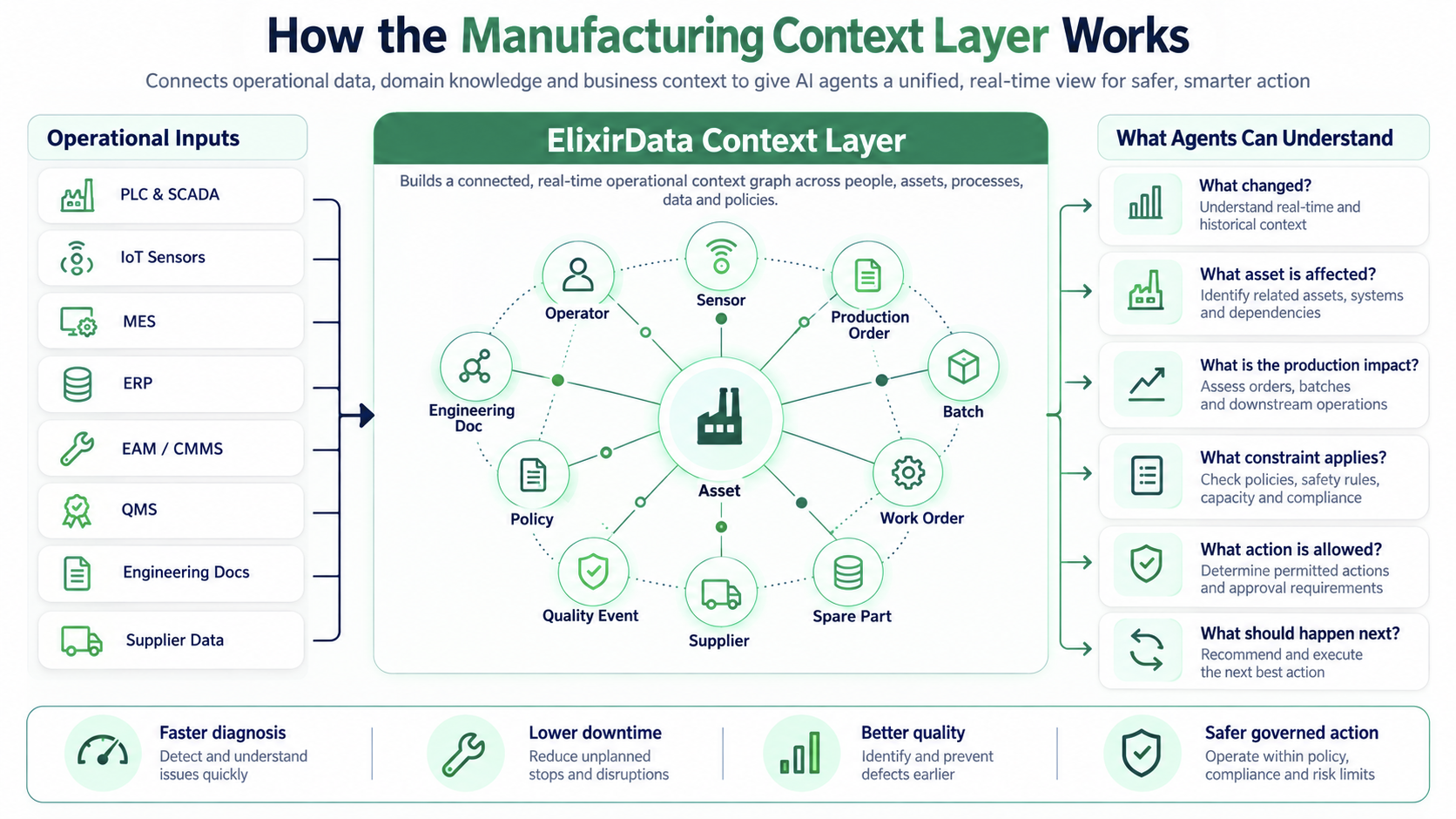
Figure 1: Manufacturing context layer: operational inputs become connected, decision-ready context for AI agents.
1. Multimodal IT and OT Context
Manufacturing produces unusually diverse data. Structured enterprise records describe production orders and inventory; time-series systems capture high-frequency telemetry; engineering repositories contain PDFs, schematics, CAD files, and manuals; quality systems hold inspection results and defect images; and operators create notes and shift reports. The context layer must bring these sources together without pretending they are all the same type of data.
- Sensor telemetry: Motor temperature = 86°C
- Asset context: Motor M-402 → Cartoning Machine 12 → Packaging Line 4
- Production context: Batch B8732 → SKU 2834 → Order 48291
- Maintenance context: Bearing replaced 43 days ago; previous anomaly = vibration spike
- Engineering knowledge: Operating temperature limit, inspection procedure, and required replacement part
The value is not simply integration; it comes from understanding the relationships between these pieces of information. For interoperable industrial information exchange, OPC UA provides a standardized communication and information-modeling framework that can span devices, manufacturing systems, and enterprise applications.
2. Semantic Asset Context
Industrial systems often represent the same physical equipment differently. A PLC may call it “PLC04_VIB_008,” the historian may use “AREA2_LINE3_MTR08,” the maintenance application may identify it as “Asset MTR-3482,” and an engineer may simply call it the “Packaging Line 3 Conveyor Motor.”
AI systems need a way to understand that these identifiers describe the same physical asset, and a semantic context layer provides that translation.
- Asset hierarchy: Factory → Production Area → Line → Machine → Component → Sensor
- Cross-domain relationships: Machine → Maintenance History → Spare Parts → Supplier → Production Batch → Quality Events → Operating Procedures
The result resembles an operational knowledge graph or ContextGraph representing how manufacturing entities relate to one another. For a manufacturing-specific view of these relationships, read The Missing Layer in Manufacturing AI: Context Graph, which focuses on decision infrastructure across SCADA, MES, ERP, equipment state, and operational constraints. This semantic representation becomes particularly valuable when agents must reason across multiple systems.
3. Temporal and Spatial Context
Manufacturing decisions are highly dependent on time. A machine being hot is different from one that has been gradually heating for six hours, just as a one-off defect differs from defects increasing across 20 production cycles. A context layer therefore needs to preserve both the current state and the sequence of events that produced it.
- 09:00 — Production batch begins
- 09:18 — Motor vibration increases
- 09:24 — Temperature begins rising
- 09:30 — Conveyor speed is adjusted
- 09:34 — Defect rate increases
- 09:37 — Quality system raises an alert
An AI agent examining only the quality alert may conclude that something happened; an agent with temporal context can begin reasoning about why it happened. Spatial context matters as well because manufacturing decisions often depend on physical relationships and access constraints.
An industrial agent may need to understand:
- which machines belong to the same production line
- where materials are physically stored
- whether maintenance teams can safely access an asset
- which upstream equipment feeds a process
- which downstream processes will be affected by shutdown
Together, temporal and spatial information allow AI to reason about manufacturing as a physical operating system rather than merely a collection of databases.
4. Decision Boundaries and Operational Guardrails
The most important distinction between enterprise AI and manufacturing AI may be the consequences of action. An incorrect recommendation in an office workflow may create inconvenience, while an incorrect action on industrial equipment can damage machinery, disrupt production, or create safety risks. For this reason, autonomous manufacturing systems cannot depend on probabilistic reasoning alone; deterministic operational boundaries must exist.
An optimization agent may recommend increasing machine speed to recover lost production, but execution should remain constrained by approved operating parameters. The architecture therefore needs a clear distinction between intelligence and authority:
- AI reasoning: “What action would improve the objective?”
- Operational policy: “What actions are actually permitted?”
- Agent recommendation: Increase line speed from 420 to 450 units/hour
- Constraint validation: Equipment maximum = 440; quality envelope = 425–440; current temperature = elevated
- Allowed action: Increase to 435 units/hour
- Execution and monitoring: Apply the approved change and monitor the resulting operating state
This separation between intelligence and authority becomes essential as AI agents receive increasing operational responsibility.
Get the Executive Blueprint for governed enterprise AI
A practical guide for CIOs, CAIOs and risk leaders on moving AI agents from pilot to production without losing control of context or decisions.
From Predictive AI to Agentic Manufacturing
Manufacturing AI has historically focused on individual models: predictive-maintenance models predict failure, vision models identify defects, forecasting models estimate demand, and optimization models recommend production schedules. These systems remain valuable; Agentic AI does not replace them, but can coordinate them as part of a broader operational workflow.
Consider predictive maintenance. A conventional model might report an 82% probability of bearing failure within seven days. That prediction is useful, but someone still needs to investigate the asset, check parts, review maintenance procedures, schedule downtime, create the work order, and coordinate with production. An agentic workflow can connect those steps.
- Detect the anomaly
- Retrieve asset context
- Review maintenance history
- Perform root-cause analysis
- Check spare-part availability
- Assess production impact
- Prepare a maintenance recommendation
- Route for human approval
- Create the work order
The AI model produces intelligence, the agent coordinates the operational workflow, and the context layer provides the trusted information required for both.
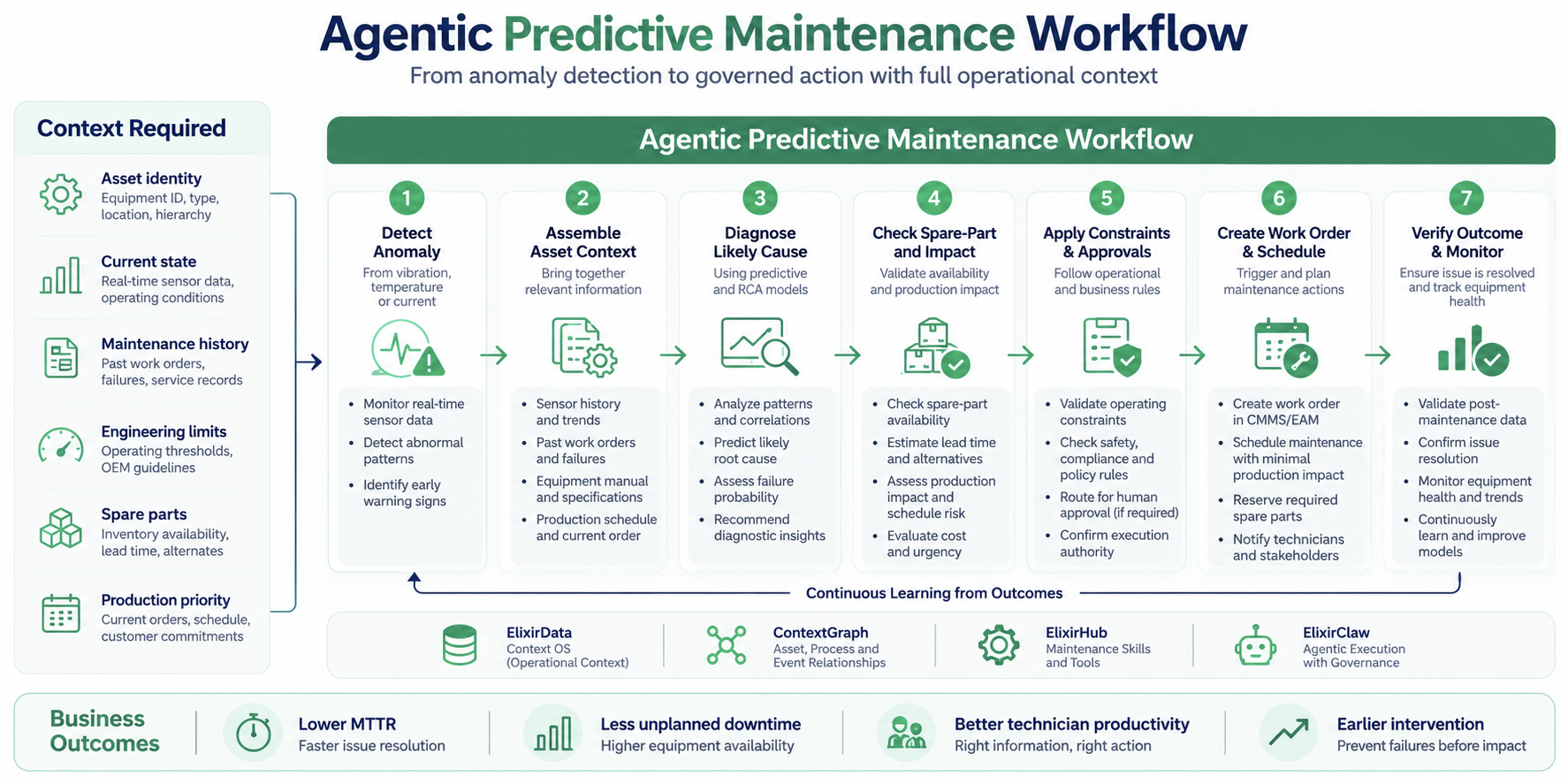
Figure 2 : Agentic predictive-maintenance workflow from anomaly detection to governed work-order execution and verification.
Use Case 1: Autonomous Maintenance and Predictive Service
Unplanned downtime remains one of manufacturing's most expensive operational problems. Factories increasingly use predictive models to identify anomalies in vibration, temperature, current, pressure, or other signals, but identifying the anomaly is only one part of the maintenance process.
An agent receiving a vibration anomaly could retrieve:
- asset identity
- current operating state
- recent sensor trends
- historical failures
- maintenance work orders
- equipment manuals
- recommended inspection procedures
- replacement parts
- inventory availability
- production schedule
A specialized Root Cause Analysis model might then be invoked to determine whether the vibration pattern resembles bearing degradation. If the evidence supports that diagnosis, the agent can check replacement-bearing availability and prepare a work order for technician review.
Instead of stopping at “Alert → Human investigation,” the workflow can become “Alert → Context → Diagnosis → Parts → Production Impact → Work Order → Approval.”
The potential business impact includes lower Mean Time to Repair, reduced unplanned downtime, better technician productivity, and earlier intervention before secondary equipment damage occurs.
Use Case 2: Dynamic Production Scheduling
Production planning is increasingly affected by variables that static schedules cannot fully anticipate.
- A supplier shipment is delayed
- A machine becomes unavailable
- A high-priority customer order arrives
- A labor constraint appears
- A quality issue blocks a material batch
Traditional planning systems may require human planners to manually rebalance the schedule.
An agentic system could continuously evaluate:
Orders + Machine Capacity + Material Availability + Workforce + Quality Status + Logistics
Suppose a critical raw material is delayed by eight hours. The agent can identify production orders that can run using available materials, calculate changeover impact, review machine capacity, and propose a revised sequence. An optimization model can generate candidate schedules, and the agent can coordinate approved updates across MES and ERP systems. The objective is not a fully autonomous factory making unconstrained decisions; it is a factory capable of responding intelligently to changing conditions while respecting operational rules.
Use Case 3: Closed-Loop Quality and Root-Cause Analysis
Quality problems frequently require information from multiple domains. Imagine, for example, that a vision system detects an unexpected rise in surface defects.
A quality engineer may investigate:
- affected production batches
- raw-material suppliers
- machine settings
- environmental conditions
- equipment calibration
- operator shifts
- previous quality events
Today this investigation can take hours. With a context layer, the required traceability relationships can already exist before the investigation begins.
Traceability path: Defect → Product Batch → Production Order → Machine → Machine Parameters → Operator Shift → Raw Material Lot → Supplier → Environmental Conditions
An agent can retrieve the relevant context and invoke an RCA model to identify likely contributors. If the organization permits automated parameter adjustments, the agent can recommend or execute a change within a predefined engineering envelope.
- Detect the defect
- Retrieve traceability context
- Perform root-cause analysis
- Prepare a corrective recommendation
- Validate engineering and policy constraints
- Route for human approval or a controlled adjustment
- Monitor quality after the intervention
This moves quality management from detecting defects after production toward continuously protecting process quality.
Use Case 4: Supply Chain and Inventory Coordination
Manufacturing supply chains contain thousands of dependencies. A relatively inexpensive component can stop a production line if it is unavailable, while carrying excessive safety stock increases working capital. Agents can help balance these competing priorities when they have sufficient context.
An inventory agent could continuously evaluate:
- current stock
- production consumption
- open production orders
- purchase orders
- supplier lead times
- shipment status
- approved suppliers
- contractual terms
- expected demand
A forecasting model may identify a likely shortage. The agent can then determine which production orders would be affected, identify approved suppliers, evaluate existing purchase agreements, and prepare procurement actions. Within predefined financial limits, selected actions may be automated, while higher-value or unusual purchases can require approval. The architectural principle remains the same: the agent should act on enterprise context, not isolated application data.
Use Case 5: The Connected Operations Copilot
Not every valuable manufacturing AI use case requires autonomy. A context layer can also enable highly capable operational assistants. A plant manager could ask, “Why did Line 3’s OEE decline during the night shift?”
Answering this question may require information from:
- MES
- machine historian
- maintenance records
- quality events
- operator logs
- downtime classifications
The system could identify that availability fell because of three micro-stoppages associated with an upstream conveyor, correlate those stoppages with increasing motor vibration, and surface the related maintenance history.
This represents a significant evolution from dashboards. Traditional BI tells operators what happened; context-aware analytics can help explain what happened in relation to everything else happening around it.
Agentic BI therefore becomes particularly powerful when it consumes trusted operational context instead of querying disconnected tables.
A related implementation pattern is covered in Agentic Data Intelligence for Manufacturing, where plant analytics evolves from dashboard reporting toward context-aware investigation and governed action.
A Practical Architecture for Manufacturing AI
A modern industrial AI architecture can be understood as several cooperating layers. At the bottom sits the operational environment—factory equipment and enterprise systems such as PLC, SCADA, IoT, MES, ERP, EAM, QMS, supply-chain platforms, and engineering documents. Above these systems sits the context foundation.
Within the Elixir architecture, this responsibility belongs naturally to ElixirData as the Context OS.
ElixirData also describes how industrial OT data becomes context-aware enterprise intelligence by connecting SCADA, MES, enterprise systems, semantic relationships, and governed agent workflows.
Its role is to ingest and synchronize information, normalize schemas, maintain ontology, construct ContextGraph relationships, preserve temporal context, manage knowledge ingestion, and expose relevant context to analytics and agents.
The next layer contains AI capabilities.
In this architecture, ElixirData maintains operational context, ElixirClaw governs agent execution, and reusable capabilities are organized through ElixirHub.
Prediction, anomaly detection, forecasting, optimization, classification, recommendation, and Root Cause Analysis are domain-specific capabilities.
Within the Elixir architecture, these models belong with ElixirClaw, where they can be exposed to agents through MCP.
For example, a custom predictive-maintenance model can be exposed through an MCP server, invoked by an ElixirClaw maintenance agent, and coordinated as part of a governed maintenance workflow.
Reusable operational capabilities can then be packaged as skills, for example:
- Retrieve Asset History
- Analyze Equipment Manual
- Validate Maintenance Procedure
- Create Work Order
- Check Spare-Part Availability
These reusable capabilities can be published and managed through ElixirHub as the Skill Registry.
ElixirHub does not become the integration or workflow layer; its role is to make skills discoverable, versioned, reusable, and composable. ElixirClaw remains responsible for the agent runtime: connectors, access controls, agentic workflows, tool execution, decision boundaries, human approvals, observability, evaluation, and secure execution.
- Industrial and enterprise systems: PLC, SCADA, IoT, MES, ERP, EAM, QMS, supply chain, and engineering knowledge
- ElixirData — Context OS: Enterprise context, asset relationships, knowledge, temporal context, data quality, and lineage
- ElixirHub — Skill Registry: Reusable manufacturing skills that can be discovered, versioned, and composed
- ElixirClaw — Agentic OS: AI agents, custom AI models through MCP, workflows, tools, guardrails, human approval, and AgentOps
- Manufacturing outcomes: Maintenance, quality, production, supply chain, and operational intelligence
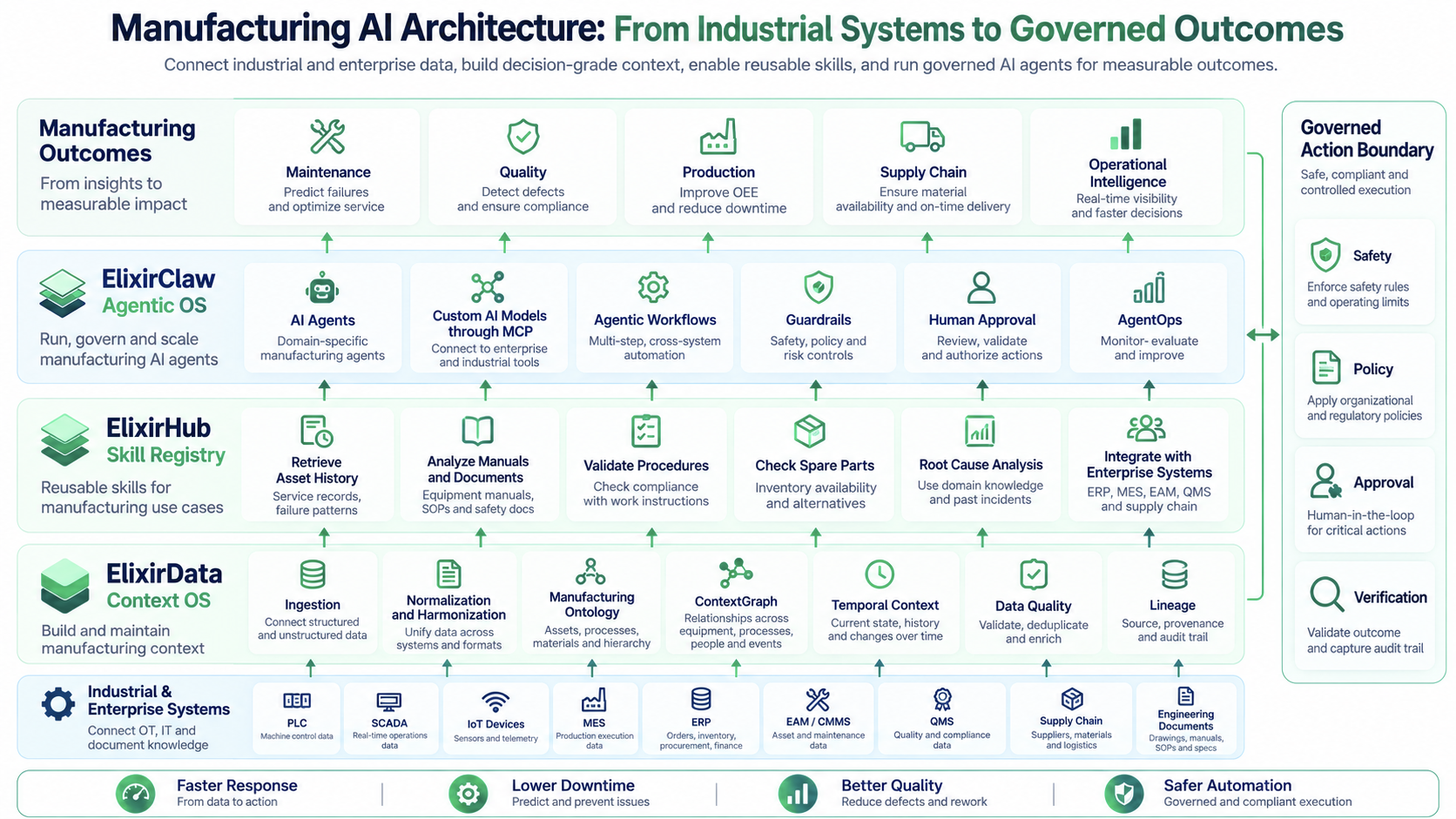
Figure 3 : Manufacturing AI architecture from industrial systems through Context OS, reusable skills, governed agents, and operational outcomes.
Why Enterprise Private AI Matters More on the Factory Floor
Manufacturing AI often interacts with information that companies consider strategically sensitive:
- production recipes
- machine configurations
- process parameters
- engineering documents
- quality data
- supplier contracts
- product designs
- proprietary operating procedures
In many industrial environments, cloud connectivity may also be constrained by latency, reliability, plant-network segmentation, or security requirements, making Enterprise Private AI particularly relevant.
Manufacturers may want the flexibility to run parts of the AI architecture:
- in a private cloud
- inside their own data center
- within a factory edge environment
- across hybrid infrastructure
The architectural goal is not simply keeping models private; it is maintaining governance over the entire interaction between data, context, models, agents, tools, and operational systems. For OT and manufacturing cybersecurity planning, the NIST Cybersecurity Framework Manufacturing Profile provides a risk-based manufacturing profile aligned to Cybersecurity Framework 2.0.
The Context Layer Becomes the Digital Nervous System
The manufacturing industry has spent years creating digital representations of individual systems: ERP represents the business, MES represents production, SCADA represents process control, EAM represents assets, digital twins represent equipment, and data platforms represent information. Agentic AI introduces a new requirement: these representations must be connected so AI can reason across the operating environment. Machines must increasingly be understood not as isolated assets but as participants in a constantly changing operational network.
An order depends on a production line; the production line depends on machines; machines depend on components and maintenance; production depends on materials; materials depend on suppliers; and quality depends on all of them. The context layer connects these relationships into one operational model.
In that sense, it becomes less like another data platform and more like the digital nervous system of the industrial enterprise.
It allows AI to understand not just data points, but the operational reality those data points represent.
The Future Factory Will Be Context-Driven
The next stage of manufacturing transformation will not come from adding another dashboard or placing a chatbot on top of existing systems. The larger shift will happen when AI systems can understand the factory as a connected operating environment. When a maintenance anomaly occurs, the AI should understand the equipment, production impact, available parts, procedures, and historical patterns. When supply is disrupted, it should understand which orders, machines, customers, and materials are affected.
When quality deteriorates, it should be able to reconstruct the operational chain that produced the defect. And when an agent proposes an action, the enterprise must know what information informed the decision, which rules governed it, which tools were invoked, and where human approval was required. That future depends less on making individual models larger and more on making enterprise context richer, more connected, more current, and more trustworthy. The manufacturers that succeed with Agentic AI will therefore not simply be those with the most AI models. They will be those that create an operational foundation where machines, processes, people, enterprise systems, engineering knowledge, and AI agents share the same trusted context.
Once that foundation exists, autonomous maintenance, adaptive production, closed-loop quality, intelligent supply chains, and self-optimizing operations become parts of the same architecture rather than isolated AI projects. The future factory will still be powered by machines, but increasingly it will be coordinated by context.
Take the next step
Download the Executive Blueprint, or talk to our team about a context layer for your plants.
Frequently Asked Questions
How is a manufacturing context layer different from RAG or a data lake?
A data lake stores information, while RAG retrieves relevant documents or chunks for a model. A context layer adds operational meaning across sources: asset identity, relationships, current state, event sequence, source authority, constraints, and decision boundaries. It can use data-lake and RAG outputs, but it organizes them into decision-ready context for a specific manufacturing task.
What is a ContextGraph in manufacturing?
A manufacturing ContextGraph represents how operational entities relate across the plant. It can connect factories, lines, machines, components, sensors, batches, work orders, suppliers, quality events, documents, and policies while preserving temporal relationships. This gives AI agents a connected view of the operational environment for investigation, planning, and governed action.
How does a context layer support predictive maintenance?
Predictive maintenance becomes more actionable when an anomaly is connected to asset identity, current operating conditions, maintenance history, engineering limits, spare-parts availability, production schedules, and past failures. An agent can use this context to investigate likely causes, assess production impact, prepare a work order, route approvals, and verify whether the intervention resolved the issue.
Can manufacturing AI agents act autonomously on industrial equipment?
Autonomy should be bounded by the risk and decision type. The AI agent can reason about a recommended action, but deterministic operating limits, safety rules, permissions, approval policies, and human-in-the-loop controls should define what can actually be executed. Higher-risk actions should remain supervised or require explicit confirmation before changes reach industrial systems.