What Happens When AI Agents Replace Clicks?
For three decades, enterprise IT followed the same architecture: humans operated software, software processed data, and data sat in servers. The value chain was linear — SaaS companies sold seats, GSIs customized implementations, and data centers stored files.
That model is breaking.
At NVIDIA GTC in March 2026, Jensen Huang told the audience that every SaaS company will become an agent-as-a-service company. The claim names a shift many enterprise architects already feel: software that people operate is giving way to agents that operate software on their behalf.
This is not a feature upgrade. It is a platform shift. The enterprise is no longer buying software that humans operate. It is deploying agents that operate software on behalf of humans.
The Platform Shift in One Sentence: In the SaaS era, enterprises bought software for humans to use. In the Agent era, enterprises deploy agents that use software, call APIs, make decisions, and take actions — autonomously, continuously, and across systems.
But this shift surfaces a hard question the industry has not yet answered:
If an agent touches five enterprise systems in one task — who governs the decisions it makes between those systems?
Not just the actions. Not just the access. The decisions.
This is the gap that separates agent frameworks from agent platforms, and developer experiments from enterprise deployment. As ElixirData's analysis of why agent frameworks aren't enough documents, frameworks solve how agents decide what to do — but nothing governs what happens when those decisions touch production systems. The answer is a new category of infrastructure: the governed agent runtime.
TL;DR
- Enterprise IT is migrating from SaaS to Agent-as-a-Service. The $700B enterprise software market is restructuring around autonomous agents that consume tokens, not seats.
- Agent frameworks optimize for execution speed but lack governance infrastructure. Enterprises must run two clocks simultaneously — execution and governance — and most frameworks only serve one.
- Ungoverned agents fail in four predictable ways: context rot, context pollution, context confusion, and decision amnesia. All stem from the absence of a governed context layer — patterns documented across the five failure modes of ungoverned agent execution.
- A governed agent runtime enforces policy, authority, and evidence before any agent action commits. This is the missing infrastructure layer between agent reasoning and enterprise execution.
- ElixirData (Context OS) and ElixirClaw (Agent Computing Platform) form the enterprise stack that closes the loop between decision infrastructure and agent execution — with both clocks running together.
Why Do Agent Frameworks Fail in Enterprise Production? The Two Clocks Problem
Most autonomous agent frameworks — including the recently prominent OpenClaw — were built for a world with one clock: the speed of execution. The agent receives a prompt, plans a sequence, calls tools, and completes the task. Fast. Impressive. Useful.
But enterprises operate on two clocks simultaneously:
| Dimension | Clock 1: Execution Speed | Clock 2: Governance Speed |
|---|---|---|
| What it measures | How fast the agent acts | How fast the org can verify, audit, and course-correct those actions |
| Optimized by | LLM inference, tool orchestration, parallel execution | Policy engines, decision traces, human-in-the-loop workflows |
| Failure mode | Slow responses, task timeouts | Unaudited decisions, compliance violations, trust erosion |
| Who cares | Developers, product teams | CISOs, compliance officers, regulators, boards |
Every enterprise deploying autonomous agents must run both clocks. Agent frameworks optimize for Clock 1. Enterprise reality demands Clock 2.
OpenClaw is optimized for Clock 1 — and it does it well. It plans tasks, calls tools, manages memory, and orchestrates sub-agents. But recent security investigations have revealed what happens when Clock 2 is absent:
- Remote code execution via malicious links (CVE-2026-25253)
- 1.5 million API keys exposed through misconfigured databases
- 341 malicious skills discovered in the marketplace
- Prompt injection attacks that poisoned agent memory and triggered unauthorized actions
These are not bugs. They are architectural gaps. OpenClaw was not designed to solve the governance clock — it is a developer framework, not an enterprise platform. As ElixirData's governed agent runtime category definition establishes, frameworks solve reasoning and orchestration; a governed agent runtime solves governance and execution control. Enterprises need both.
The real question is: what does an enterprise platform look like when both clocks run together?
FAQ:
What is the Two Clocks Problem? It is the fundamental tension between execution speed (how fast an agent acts) and governance speed (how fast the organization can verify, audit, and course-correct those actions). Enterprise AI systems must optimize for both simultaneously.
What Are the Failure Modes of Ungoverned Agents?
When autonomous agents operate without decision infrastructure, four specific failure modes emerge. These have been observed across every industry vertical — from banking to defense to healthcare. (For a deeper taxonomy including systemic risk, cost blowups, and accountability gaps, see the five ways agents fail in production.)
1. Context Rot
Agent memory degrades over time. Stale context from previous sessions contaminates current decisions. An agent planning a Q1 campaign with Q3 data does not know its context has rotted — it executes confidently on outdated information.
Enterprise impact: Compliance violations in regulated industries where decisions must reflect current state. Misaligned strategies based on expired market conditions.
2. Context Pollution
Malicious or low-quality inputs corrupt the agent's context. The 341 malicious skills found in the ClawHub marketplace are a textbook example — trojan capabilities that inject adversarial context into an agent's reasoning loop. ElixirData defines context pollution as the corruption of an agent's decision-grade context through adversarial, stale, or low-authority inputs.
Enterprise impact: Data exfiltration through poisoned memory. Adversarial manipulation of agent behavior in supply chain or financial workflows.
3. Context Confusion
When agents operate across systems, they encounter conflicting data representations. A "customer" in the CRM is not the same entity as a "customer" in the billing system. Without a shared ontology, agents make decisions based on semantic mismatches.
Enterprise impact: Incorrect financial reconciliation. Wrong patient data in healthcare. Duplicate records in master data management.
4. Decision Amnesia
The agent acts, but no one can reconstruct why. Without immutable decision traces, the organization loses accountability. When a regulator asks "why did your system approve this transaction?" the answer cannot be "the LLM thought it was appropriate." (For a field-by-field breakdown of what a decision trace captures, see Anatomy of a Decision Trace.)
Enterprise impact: Regulatory non-compliance. Legal liability. Inability to reproduce or audit decisions post-facto.
The Common Thread: All four failure modes share a single root cause — the absence of a governed context layer between the agent's reasoning engine and the enterprise's operational reality. Agent frameworks provide execution. Decision infrastructure provides the truth.
FAQ:
What causes enterprise AI agent failures in production? The four primary failure modes are context rot (stale data), context pollution (adversarial inputs), context confusion (semantic mismatches across systems), and decision amnesia (no audit trail). All result from missing decision infrastructure — the gap a governed agent runtime is designed to close.
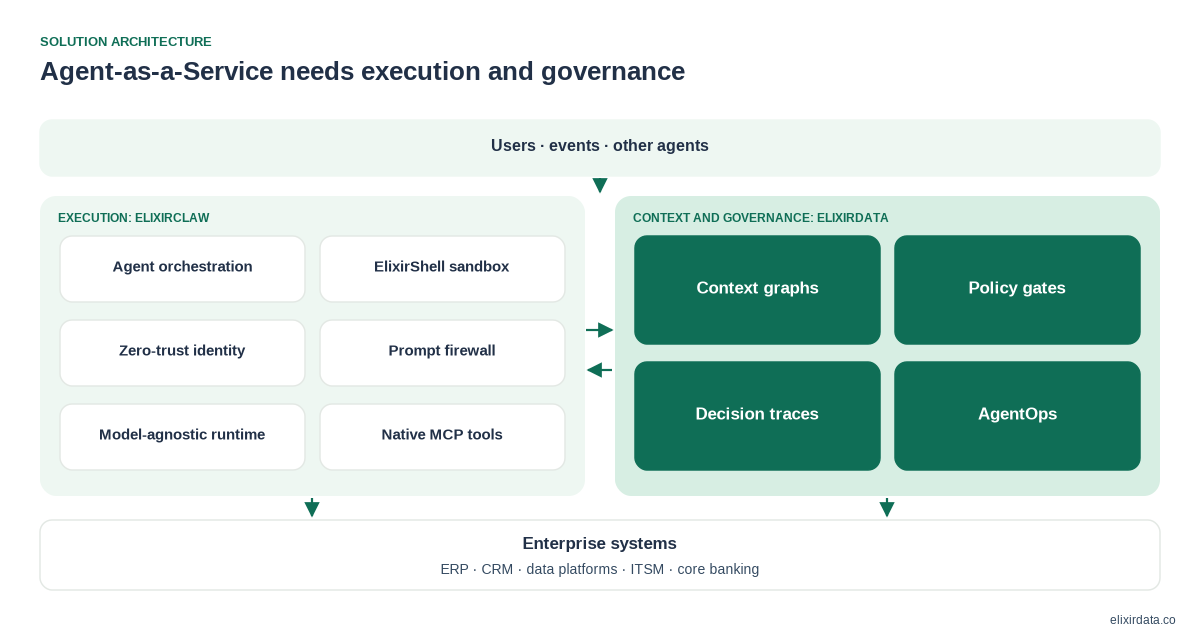
What Is the Enterprise Agent Stack? ElixirData + ElixirClaw
Solving the Two Clocks Problem requires two capabilities that work in concert but serve fundamentally different purposes:
| Layer | ElixirData (Context OS) | ElixirClaw (Agent Computing Platform) |
|---|---|---|
| Core function | Decision infrastructure — the governed context layer | Agent runtime — execution and orchestration |
| What it provides | Context Graphs, Decision Traces, Business Ontology, Trust Benchmarks | Agent lifecycle, sub-agent orchestration, tool execution, sandboxed compute |
| Clock it serves | Clock 2 — Governance Speed | Clock 1 — Execution Speed |
| Primary users | CISOs, compliance teams, enterprise architects | Developers, ML engineers, platform teams |
| Analogy | The nervous system — sensing, interpreting, governing | The musculature — planning, acting, executing |
What Is ElixirData? The Context OS for Enterprise AI
ElixirData is a Context Operating System — the decision infrastructure layer that sits between enterprise data sources and the agents that reason over them. It is not a database, a data lake, or an analytics tool. It compiles decision-grade context from systems of record, enforces policy and authority before commit, and generates audit-ready decision traces.
The core architectural principle: autonomy must be bounded, explainable, and trusted in production.
Context Graphs
Enterprise knowledge is not flat. It is a graph of entities, relationships, and constraints that change over time. ElixirData maintains a living Context Graph — a versioned, time-aware representation of every entity, relationship, and condition — that agents query in real-time. This ensures every decision is grounded in current, semantically consistent enterprise state rather than raw database queries.
Decision Traces
Every agent decision — from the initial prompt to the final action — is recorded as an immutable Decision Trace. Not just what happened, but why: what context was available, what alternatives were considered, what policy constraints were evaluated. Decision Traces are structured audit artifacts that map directly to compliance controls, regulatory obligations, and legal defensibility requirements. (For a complete field-by-field breakdown, see Anatomy of a Decision Trace.)
Business Ontology
A shared semantic model that resolves context confusion across systems. When an agent in the CRM says "customer" and an agent in the billing system says "account," the Business Ontology maps them to the same governed entity — with provenance, access controls, and temporal validity. This creates a canonical, conflict-free operational reality across all agents.
Decision Boundaries
Configurable limits on agent autonomy. Which decisions can an agent make independently? Which require human approval? Which are prohibited entirely? Decision Boundaries implement Progressive Autonomy — agents earn trust through demonstrated reliability, not by default. Dual-gate governance evaluates constraints before reasoning commits and again before actions execute — the same deterministic enforcement pattern described in the governed agent runtime architecture.
Trust Benchmarks
Quantified metrics for agent reliability. Every agent's decision accuracy, context freshness, and compliance adherence is tracked continuously. Trust Benchmarks feed back into Decision Boundaries — agents that perform well earn broader autonomy; agents that drift get constrained automatically. This closed-loop feedback, powered by real execution data, drives 10–17% quarterly accuracy improvements through what ElixirData calls Agentic Context Engineering.
FAQ:
What is a Context OS? A Context OS is the foundational infrastructure layer that manages how AI agents interact with enterprise systems, data, and decisions. It compiles decision-grade context, enforces governance before execution, and produces audit-ready evidence — ensuring AI autonomy is bounded, explainable, and trusted. Learn more about Context OS →
What is a governed agent runtime, and why does Agent-as-a-Service need one?
A governed agent runtime is the control layer between agent frameworks and enterprise systems. It turns non-deterministic agent reasoning into deterministic, auditable execution: every action gets governed context, passes a policy and authority check, runs through controlled tools and leaves a decision trace.
For Agent-as-a-Service, this is the difference between a demo and a service a regulated customer can buy. When an agent acts inside a customer’s systems, the provider has to show what the agent was allowed to do, what it did and why.
The full definition, the five execution primitives and the runtime loop are covered in What is a governed agent runtime?
Governed Agentic Actions: Multi-Agent Coordination Within Boundaries
When agents collaborate, delegate, and orchestrate across teams and systems, coordination without governance creates compound risk. Authority can leak through delegation chains, cross-domain actions can bypass team oversight, and orchestration happens without policy enforcement.
ElixirData's Governed Agentic Actions layer addresses this through:
- Scoped Delegation: When agents delegate to other agents, authority is computed as the intersection of both authority scopes. Further delegation narrows the scope further, creating a mathematically bounded authority chain that prevents privilege escalation.
- Action Type System: Every possible action has a type with required authority, preconditions, and policy constraints. Actions outside the type system do not exist.
- Contextual Escalation: When an action exceeds an agent's authority, it escalates with full context — not a generic "approval needed" request.
- Multi-Agent Orchestration: Agent workflows across departments and systems are governed as a unit, with each step constrained by the workflow's authority scope.
- Rollback and Recovery: If a multi-step workflow fails at any point, governed rollback reverses previously completed steps safely.
- Real-Time Execution Monitor: Agent actions are visible in real-time — context compiled, policy evaluated, authority verified, and outcomes produced as they happen.
Enterprise Agent Operations (AgentOps)
At scale, enterprises need fleet-level visibility and control over their agent deployments:
- Agent Registry: A complete, queryable inventory of every AI agent in the enterprise — with identity, authority scope, owner, team, model provider, framework, and version. This is RBAC for machines. (For more on why machine-grade access control matters, see Agent Identity and RBAC.)
- AgentOps Monitoring: Real-time tracking of boundary violations, policy drift, performance degradation, decision volume, compliance rate, and resource consumption. Anomalous behavior triggers alerts. One-click rollback.
- Agent Identity and Access: Scoped access to exactly what each task requires. Per-agent identity with metadata, authority definitions, threshold limits, and escalation path mapping.
- Evaluation and Optimization: Agent actions are visible and auditable with built-in monitoring, detailed logs, and continuous performance trending.
FAQ:
What is a governed agent runtime? A governed agent runtime is the control layer that turns nondeterministic agent reasoning into deterministic, auditable execution. It provides five execution primitives — deterministic context compilation, policy and authority enforcement, tool execution control, decision traces, and feedback loops — ensuring every agent action is allowed, provable, and reversible before it commits.
What Is ElixirClaw? The Agent Computing Platform
ElixirClaw is where agents live, execute, and scale. It is the runtime that makes autonomous agents production-grade — with the performance of a developer framework and the controls of an enterprise platform.
Agent Orchestration Engine
The orchestrator defines agent hierarchies with parent-child relationships, decomposes goals into tasks, assigns them to specialized sub-agents, and synthesizes results. It supports dynamic task decomposition, parallel and sequential execution, built-in conflict resolution, and real-time execution traces.
ElixirShell: Sandboxed Compute
Each agent gets its own ephemeral compute environment — isolated filesystem, package management, code execution, and optional GPU acceleration. Environments spin up in milliseconds and auto-tear-down after task completion. No cross-agent contamination. No shared state leakage.
Zero-Trust Agent Identity
Every agent operates within a cryptographically enforced trust boundary: per-action authentication with scoped tokens, mTLS between all services, SPIFFE/SPIRE for identity federation, and OPA for policy-as-code. No implicit permissions — ever. (See Agent Identity and RBAC for the full argument on why machine-grade access control is non-negotiable.)
Prompt Firewall
Real-time injection detection, PII redaction, and content policy enforcement at the prompt boundary. Adversarial inputs are blocked before they reach the agent's reasoning loop — addressing the exact attack vector demonstrated in the OpenClaw prompt-injection research.
Model-Agnostic Runtime
Swap between any LLM — GPT, Claude, Llama, Gemini, Nemotron, or custom fine-tuned models. The platform adapts. No vendor lock-in on the inference layer.
Native MCP and Tool Execution
CLI, MCP servers, REST APIs, shell commands — agents call tools directly with structured I/O, error handling, retry logic, and full audit trails flowing back to ElixirData's Decision Traces.
FAQ:
What is ElixirClaw? ElixirClaw is an agent computing platform that provides sandboxed execution, zero-trust identity, model-agnostic runtime, prompt firewall, and native tool execution for production-grade autonomous agents.
How Does the Agent Decision Loop Work?
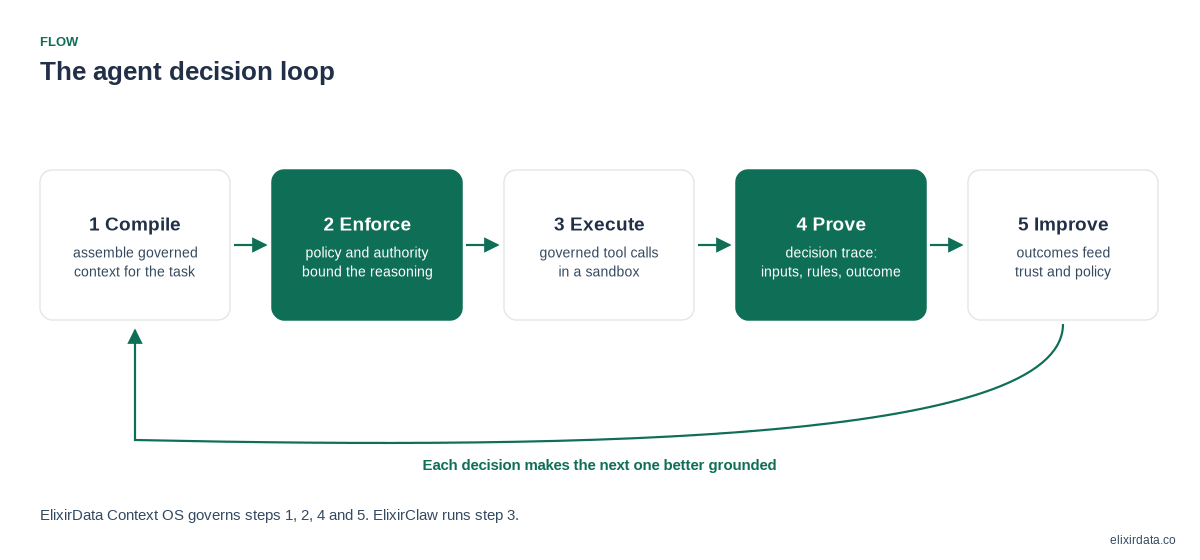
The power of the ElixirData + ElixirClaw stack is in the closed loop between context and execution. This loop maps directly to the governed agent runtime's canonical six-step execution loop:
Step 1 — Context Assembly (Compile)
Before an agent reasons, ElixirData assembles the relevant context from the Context Graph — current state, historical decisions, applicable policies, and trust boundaries. Ambiguous requests become explicit decision candidates. The agent queries governed context, not raw databases.
Step 2 — Bounded Reasoning (Enforce)
ElixirClaw's agent runtime processes the task within Decision Boundaries set by ElixirData. Versioned context is assembled, policies are applied, risk thresholds evaluated, and authority verified. The agent plans, reasons, and selects actions — but only within the autonomy envelope defined for its trust level. Actions are deterministically approved, escalated, modified, or blocked.
Step 3 — Governed Execution
Actions are executed through ElixirClaw's tool execution layer with Zero-Trust identity. Every tool call is authenticated, authorized, and logged. The Prompt Firewall screens all inputs and outputs.
Step 4 — Decision Trace Capture (Prove)
The complete decision path — context assembled, reasoning steps, actions taken, results observed — is written to ElixirData as an immutable Decision Trace. Provenance, policy evaluations, and authority checks become instantly auditable evidence.
Step 5 — Trust Feedback (Improve)
Decision outcomes update the agent's Trust Benchmarks in ElixirData. Agents that perform well see their Decision Boundaries expand. Agents that drift see them contract. This is Progressive Autonomy — earned, not assumed.
The Closed Loop: Context → Reasoning → Execution → Trace → Trust Feedback → Updated Context. This loop runs continuously. Both clocks — execution and governance — tick together. That is what makes it enterprise-grade.
FAQ:
How do Context OS and the governed agent runtime work together? Context OS is the operating layer that manages enterprise context and decision boundaries. The governed agent runtime (Build Agents) is the execution layer powered by Context OS that enforces those boundaries at runtime. Together they form the closed loop between governance and execution.
How Should Enterprises Deploy Agent Infrastructure?
Enterprise agents must run where the data lives — not where the vendor prefers. The platform supports three deployment models, each with full ElixirData integration:
| Dimension | Managed Cloud (Essential) | VPC / Hybrid (Growth) | On-Prem / Air-Gapped (Enterprise) |
|---|---|---|---|
| Best for | Fast experimentation, cloud-native orgs | Regulated industries, data sovereignty | Defense, intelligence, critical infrastructure |
| Data residency | Multi-region (US, EU, APAC, ME) | Your VPC, your region | Your hardware, your facility |
| Control plane | Fully managed | Shared (platform + customer) | Fully customer-managed |
| Data plane | Isolated tenant | Customer-owned VPC | Air-gapped, zero egress |
| Identity | SAML / OIDC SSO | BYOK + mTLS + VPN | SPIFFE/SPIRE + HSM |
| GPU support | On-demand | Customer GPUs + platform scheduling | Bare metal GPU allocation |
| Setup time | < 5 minutes | Terraform / Helm | Dedicated SE engagement |
| SLA | 99.99% | Custom | Mission-grade |
Compliance Posture
The platform maintains SOC 2 Type II certification (audited annually), ISO/IEC 27001, 27017, 27018, and 27701 certifications, CSA STAR compliance, GDPR compliance for EU data processing, HIPAA compliance with BAA availability for healthcare deployments, and FedRAMP authorization in progress for U.S. federal agencies.
FAQ:
Can enterprise AI agents run in air-gapped environments? Yes. The platform supports on-prem and air-gapped deployment with full data sovereignty, SPIFFE/SPIRE identity federation, HSM integration, bare-metal GPU allocation, and zero egress.
Where Does This Matter Most? Priority Industry Verticals
Banking and Financial Services
Autonomous agents processing loan applications, flagging fraud, and reconciling transactions must operate within strict regulatory boundaries. Decision Traces provide the audit trail regulators require. Decision Boundaries ensure no agent approves a transaction beyond its autonomy envelope. In BFSI, a fast agent that cannot explain its decisions is a liability, not an asset.
Defense and Intelligence
Air-gapped environments demand zero-trust by default and mission-critical decision latency. On-prem deployment with SPIFFE/SPIRE identity federation and bare-metal GPU allocation is purpose-built for classified environments. Context Graphs provide the situational awareness layer that defense applications demand.
Healthcare and Life Sciences
Patient data sovereignty, HIPAA compliance, and clinical decision support that must be explainable. Business Ontology resolves the semantic confusion between EMR systems, lab systems, and claims platforms. The Prompt Firewall enforces PII redaction at every boundary.
Semiconductor and Manufacturing
SCADA systems, OPC-UA protocols, and real-time sensor data feeding autonomous process control agents. Sub-agent orchestration handles the parallel execution demands of manufacturing lines. Context Graphs maintain the digital twin that bridges physical systems and agent reasoning.
Energy and Utilities
Grid management agents operating across SCADA, weather data, demand forecasting, and regulatory compliance simultaneously. The Two Clocks Problem is measured in seconds here: agents must execute fast enough to manage load balancing while governance verifies every switching decision against safety policies.
FAQ:
Which industries benefit most from a governed agent runtime? Banking, defense, healthcare, manufacturing, and energy — any sector where autonomous agents make decisions with regulatory, financial, safety, or operational consequences that require audit trails and governance enforcement.
Why a Platform, Not a Framework?
The market is full of agent frameworks — OpenClaw, CrewAI, AutoGen, LangGraph — each excellent for Clock 1: fast execution, clever orchestration, flexible tool use. As ElixirData's analysis documents, agent frameworks aren't enough for enterprise production because they were never designed to provide governance and execution control.
But enterprises do not deploy frameworks. They deploy platforms.
| Dimension | Agent Framework | Agent Platform (ElixirData + ElixirClaw) |
|---|---|---|
| Identity | Inherited from environment | Zero-Trust per-agent identity (SPIFFE, mTLS, scoped tokens) |
| Memory governance | Unmanaged vector stores | Context Graphs with temporal validity and access controls |
| Audit trail | Application logs | Immutable Decision Traces with full reasoning provenance |
| Autonomy control | Hardcoded logic or none | Progressive Autonomy with configurable Decision Boundaries |
| Security boundary | Process-level isolation | Cryptographic trust boundaries with Prompt Firewall |
| Deployment | Developer laptop, single cloud | Managed Cloud, VPC, On-Prem, Air-Gapped |
| Compliance | DIY | SOC 2, ISO 27001, GDPR, HIPAA, FedRAMP (in progress) |
| Who governs decisions | No one (or the developer) | Decision Infrastructure — Decision Boundaries, Trust Benchmarks, Escalation Policies |
The differentiator is the answer to one question: When an agent makes a decision, who governs it?
If the answer is "no one" or "the developer," it is a framework. If the answer is "the enterprise's decision infrastructure," it is a platform.
FAQ:
What is the difference between an agent framework and an agent platform? An agent framework provides execution tooling for developers. An agent platform adds governed identity, decision traces, policy enforcement, progressive autonomy, and enterprise-grade compliance — providing the governed agent runtime that gives the organization control over what agents are allowed to decide.
Conclusion: The Agent Era Demands Both Execution and Governance
Jensen Huang's slide at GTC 2026 was not a prediction. It was a description of what is already happening. Enterprise IT is migrating from SaaS to Agent-as-a-Service. The $700 billion enterprise software market is restructuring around autonomous agents that consume tokens, not seats.
The organizations that will lead this transition are not the ones deploying the fastest agents. They are the ones deploying agents with the clearest decision boundaries, the most complete audit trails, and the most deliberate approach to earned autonomy.
Enterprise systems are excellent at recording what happened. They almost never capture why an action was allowed — or whether it should have executed at all. That missing reasoning is where enterprise AI fails. A Context OS closes this gap by compiling decision-grade context, enforcing authority before execution, and producing evidence by construction. A governed agent runtime operationalizes this into deterministic, auditable execution that satisfies security teams, compliance teams, legal teams, and the CFO.
The enterprises that master context will define the AI era.
ElixirData provides the truth. ElixirClaw provides the action. Together, they are the enterprise stack for the Agent-as-a-Service era — where autonomous agents operate at the speed of execution and the rigor of governance, simultaneously. Both clocks ticking. Neither compromised.
Frequently asked questions
What is Agent-as-a-Service?
A delivery model in which a provider sells work done by AI agents rather than seats in software that people operate. Because the agent acts inside the customer’s systems, the provider is accountable for what it does.
Why do AI agents need a governed runtime?
Agent reasoning is non-deterministic. A governed runtime checks every action against policy and authority before it runs and records a decision trace, so each action can be explained and audited.
How do ElixirClaw and ElixirData work together?
ElixirClaw runs and orchestrates agents in sandboxed, identity-bound environments. ElixirData Context OS supplies governed context, enforces policy gates and keeps a decision trace for every action.