In brief
The best way to compare bank AI agent governance tools is by what they control, not by brand: identity, gateways and guardrails, policy enforcement, context and decision records, governance and compliance workflow, observability, and model risk tools each cover a different part of the problem, and no single category covers all of it. Pick by the gaps in your agents’ controls, then check each product’s current capabilities yourself.
Written for: bank CIOs, CISOs, AI platform leads and the risk and procurement teams drawing up a shortlist of agent governance tools.
Disclosure: ElixirData publishes this comparison and sells Context OS, which sits in category 4 below. We’ve described every category, including ours, by what it’s designed to do and where it stops. We haven’t named other vendors here, because we haven’t verified their current claims from their own pages. Treat our category notes as a starting checklist, not a verdict.
Why compare by category instead of by vendor?
Vendor lists go out of date quickly, and they hide the real choice. A bank doesn’t pick “the best tool.” It picks which controls to buy, which to build and which it already owns.
Take a simple example. An identity platform you already run may handle agent credentials well. A guardrail product may filter what an agent says. Neither one, by itself, decides before an action runs whether the action is allowed under policy, or keeps a record an auditor can use months later. Those are different jobs, and the tools that do them come from different categories.
The same reasoning sits behind our eight controls for bank AI agents. This page maps tool categories onto those controls.
What should a bank test in any agent governance tool?
Agree the tests before you compare products, and run the same ones on every tool you shortlist. Five cover most of the risk: whether a forbidden action is stopped before it runs, whether an over-limit action waits for a named approver, whether a decision from months ago can be rebuilt from its record, whether the agent can change its own limits, and whether the tool works with the systems you already run.
Our comparison of bank AI governance platforms sets out each test in detail, with what a good answer looks like.
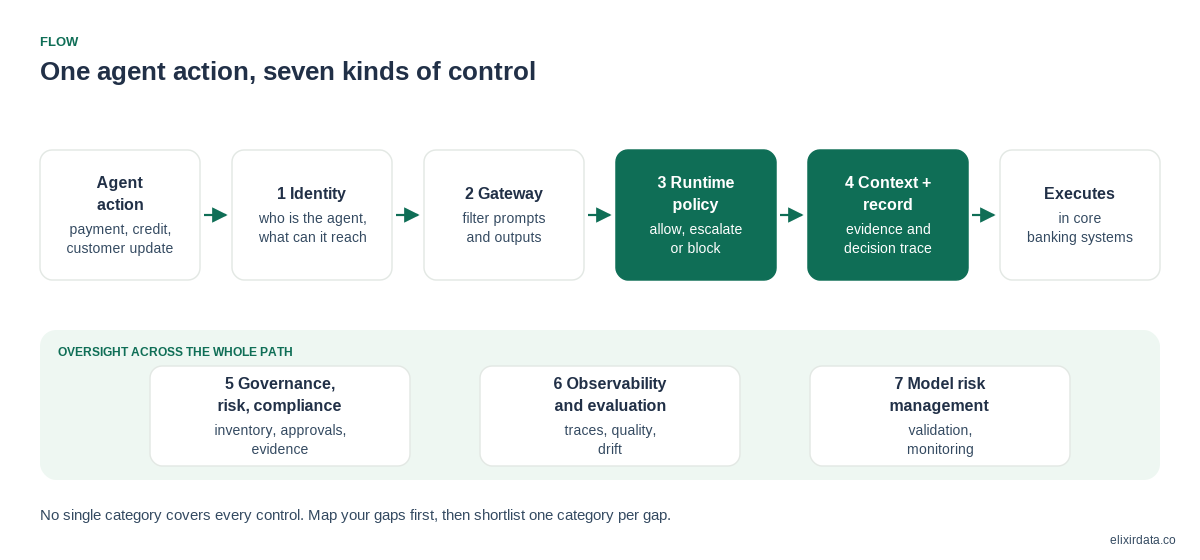
What are the seven categories of bank AI agent governance tools?
1. Non-human identity and access management
Designed to: give each agent its own identity, issue short-lived credentials and limit what it can reach.
Where it stops: it decides whether an agent can connect to a system. It doesn’t usually judge whether a specific action, with specific data, is allowed under a bank policy.
Ask: can every action in a log be tied to one agent and one accountable owner? NIST says it’s researching agent authentication and identity infrastructure [Source 1], so expect this area to keep moving.
2. AI gateways and guardrails
Designed to: sit between users, agents and models, filtering prompts and responses and applying rules to model and tool calls.
Where it stops: a gateway sees traffic passing through it. It may not know the business context of a decision or keep a decision record that maps to a bank’s evidence needs.
Ask: does it check tool calls and actions, or only text going in and out?
3. Runtime policy enforcement
Designed to: evaluate each proposed action against written policy before it runs, and allow, deny or escalate it.
Where it stops: a policy engine is only as good as the policies and the inputs it’s given. Without trusted context, it can enforce the wrong rule correctly.
Ask: which policy and which version was evaluated, and where is that recorded? See runtime policy enforcement for AI agents.
4. Decision-grade context and decision records
Designed to: give agents governed context (with lineage, classification and freshness) and record each decision with its inputs, rules, approvals and outcome.
Where it stops: it adds the decision layer. It doesn’t replace identity, network or application security, and it relies on those systems to establish who the agent is and what it can connect to.
Ask: can you trace each input in a sample decision back to its source and see how current it was? This is the category where ElixirData’s Context OS sits. See the Context OS platform page.
5. AI governance, risk and compliance platforms
Designed to: keep an inventory of AI systems, run risk assessments, route approvals and organise evidence against frameworks and regulations.
Where it stops: many work as a system of record and workflow. They may document controls rather than enforce them at the moment an agent acts.
Ask: does the platform enforce anything at runtime, or does it record what teams say they’ve done?
6. Observability and evaluation
Designed to: trace agent runs, test behaviour, detect drift and surface failures.
Where it stops: observing an action isn’t the same as preventing it. Traces help you investigate, and they usually need a policy layer to stop things in advance.
Ask: can it trigger a pause or escalation, and how quickly?
7. Model risk management tools
Designed to: inventory models, support validation and track findings.
Where it stops: US interagency guidance issued in April 2026 (SR 26-2) says generative AI and agentic AI models are not within its scope [Source 2]. Model risk tooling may still be useful for the models agents call, but it doesn’t govern what agents do.
Ask: does the tool treat an agent’s actions as in scope, or only the model’s outputs?
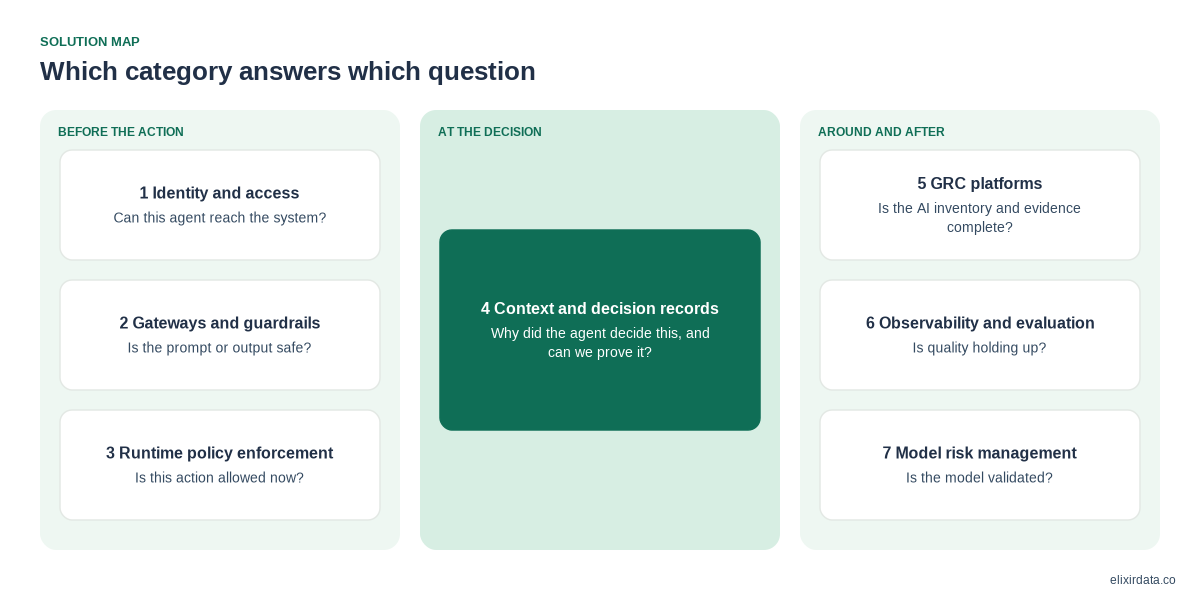
How do the seven categories compare?
This is our reading of what each category is typically designed to address. Check each product, because coverage varies.
- Identity (1): strongest on who the agent is and what it can reach.
- Gateways (2): strongest on filtering what flows between agents, users and models.
- Policy enforcement (3): strongest on allow, deny or escalate before an action runs.
- Context and decision records (4): strongest on the quality of inputs and the evidence of each decision.
- Governance and compliance (5): strongest on inventory, assessments, approvals workflow and mapping to frameworks.
- Observability (6): strongest on seeing what happened and spotting drift.
- Model risk (7): strongest on validating the models themselves.
Most banks end up combining three or four of these. The question is which gaps are largest for your riskiest agents.
Which regulations should drive the shortlist?
The rules that apply depend on where the bank operates and what each agent does, so confirm scope with your compliance and legal teams. Four reference points shape most shortlists in 2026:
- United States: SR 26-2 (17 April 2026) superseded SR 11-7 and leaves generative and agentic AI models outside its scope [Source 2], so banks need agent policies of their own.
- United Kingdom: the PRA’s SS1/23 sets five model risk principles, and its 23 April 2026 version adds a sub-principle on the risks of AI used in modelling [Source 3].
- European Union: Regulation (EU) 2026/1744 moved the Annex III high-risk obligations to 2 December 2027 [Source 4]. Check with counsel how each use case is classified.
- Frameworks: the NIST AI Risk Management Framework and ISO/IEC 42001 are the usual reference points for an AI management system.
For the executive view of these regimes, see AI agent governance for banks.
How should a bank build a shortlist?
- Start with your riskiest agents. The ones that move money, decide credit or touch customer data set the bar.
- Run our eight-control test against what you own. Mark each control as covered, partly covered or missing. Many banks find identity is covered and policy checks before action are not.
- Map the gaps to categories. One category per major gap.
- Demand a demonstration on your data. Use the five tests above in a pilot, not a slide deck.
- Check integration, not just features. A good tool that can’t read your systems or write to your records won’t get used.
- Ask about independence. Governance that the agent can edit isn’t governance.
Also see our guide to decision-grade context for AI agents for what good context looks like.
Where does Context OS fit?
ElixirData Context OS, a XenonStack product, sits in category 4 and overlaps category 3. It checks each agent action against policy and authority before it runs, and keeps a decision trace for every decision: the inputs and sources used, the rules applied, who approved it and what happened. Agents receive governed context through context graphs.
It works alongside your identity, network and application security rather than replacing them. Evaluate it if your biggest gap is proving why an agent acted; if the gap is identity or monitoring, start with categories 1 or 6.
Frequently asked questions
What are AI agent governance tools?
They’re software that controls or evidences what AI agents do: identity, filtering, policy enforcement, context and decision records, compliance workflow, observability and model risk tooling.
Is there one tool that covers all bank AI agent governance?
Probably not. Each category covers different controls, and most banks combine several. Check any claim of full coverage against the tests above.
How is an AI gateway different from policy enforcement?
A gateway filters traffic between users, agents and models. Policy enforcement decides whether a specific proposed action is allowed under policy before it runs, and records the decision.
Do model risk tools cover AI agents?
Not necessarily. The April 2026 US interagency guidance says generative and agentic AI models are outside its scope, so banks need their own agent policies [Source 2].
What should a bank ask any governance vendor?
Ask them to show a blocked action, an approval, a reconstructed decision, proof the agent can’t alter its own limits, and how it fits your existing systems.
Sources
- NIST, AI Agent Standards Initiative: https://www.nist.gov/artificial-intelligence/ai-agent-standards-initiative
- Federal Reserve, SR 26-2 (17 April 2026) and attachment: https://www.federalreserve.gov/supervisionreg/srletters/sr2602.htm and https://www.federalreserve.gov/supervisionreg/srletters/SR2602.pdf
- Bank of England, PRA SS1/23: https://www.bankofengland.co.uk/prudential-regulation/publication/2023/may/model-risk-management-principles-for-banks-ss
- White & Case, “EU AI Omnibus enters into force, amending the AI Act” (secondary source): https://www.whitecase.com/insight-alert/eu-ai-omnibus-enters-force-amending-ai-act
- NIST, AI Risk Management Framework: https://www.nist.gov/itl/ai-risk-management-framework
Talk to us: Book a demo