The context platforms that AI agents use today fall into two groups. Atlan, DataHub, Snowflake Horizon Context, Databricks Unity Catalog with Genie, Fluree, Microsoft Fabric IQ, Glean and Collibra give agents governed business context: what data means, where it came from and who may see it. A Context OS such as ElixirData governs what an agent is allowed to do with that context, checking policy and authority before each action and recording the decision.
Most enterprises will run one or more of the platforms below and still need a decision layer on top. This comparison shows what each one is built for, what it holds, how agents reach it and where it enforces policy, so you can see which combination your agents need before they touch customers, money or regulated data.
Updated 27 November 2026. Product details are taken from each vendor's own documentation, linked in the Sources section. Features change quickly, so confirm availability with each vendor before you buy.
What is a context platform for AI agents?
A context platform gives an AI agent trusted business meaning at the moment it reasons: definitions, metrics, lineage, ownership, quality and permissions. Without it, an agent guesses what "revenue" or "active customer" means from raw tables, and the answer is only as good as the guess.
Almost every platform in this comparison now exposes that context through the Model Context Protocol (MCP), so any MCP-compatible agent can call it. The real differences are in what the platform holds, which estate it is built around, and where it applies policy.
How do the leading context platforms compare?
| Vendor | Best for | What it holds | Agent interfaces | Where policy is enforced |
|---|---|---|---|---|
| Atlan | Cross-platform metadata context for people and agents | Metadata: definitions, lineage, policies, semantic models | Hosted MCP server; REST APIs and SDKs | Atlan personas and policies; source permissions for live queries |
| DataHub | An open-source metadata graph with agent access | Metadata: lineage, ownership, quality, glossary, docs | Open-source and managed MCP; GraphQL and REST | DataHub policies; MCP tokens scoped to the user |
| Snowflake Horizon Context | Snowflake-centric estates | Semantic views over warehouse data, plus catalog metadata | Managed MCP server (GA); Cortex Agents and Analyst | Snowflake RBAC, masking and row access policies |
| Databricks Unity Catalog + Genie | Lakehouse-first teams on Unity Catalog | Metric views, semantics and context Genie learns | Genie One MCP (GA); Genie APIs | Unity Catalog grants, row filters and column masks |
| Fluree | Governed, cited answers from business data | The business facts, as a governed knowledge graph | MCP server; SPARQL, openCypher, GraphQL, JSON-LD | Inside the database, on every fact |
| Microsoft Fabric IQ | Microsoft estates with Power BI models in production | Ontology definitions bound to OneLake data | Data agents as MCP servers; ontology MCP (preview) | OneLake security and source RLS, OLS and CLS, as the user |
| Glean | Knowledge work across SaaS apps and documents | An index of content, people and activity, with permissions | Managed MCP server; APIs; A2A | Source ACLs mirrored into the index |
| Collibra | Governance-led programmes that include AI controls | Glossary, catalog metadata, lineage, policies, AI registry | MCP server; REST and Java APIs | Collibra permissions; grants pushed down to platforms |
| ElixirData | Governing what agents may do, with audit-ready proof | Context Graph, policies, authority and Decision Traces | MCP and APIs; works with any agent runtime | At the point of action: before the agent reasons and before it executes |
Which context platform should you choose?
Answer three questions in order: where does your governed data live, how do you want to run your context layer, and will your agents take actions? The first two questions pick your context platform. The third tells you whether you also need a decision layer.
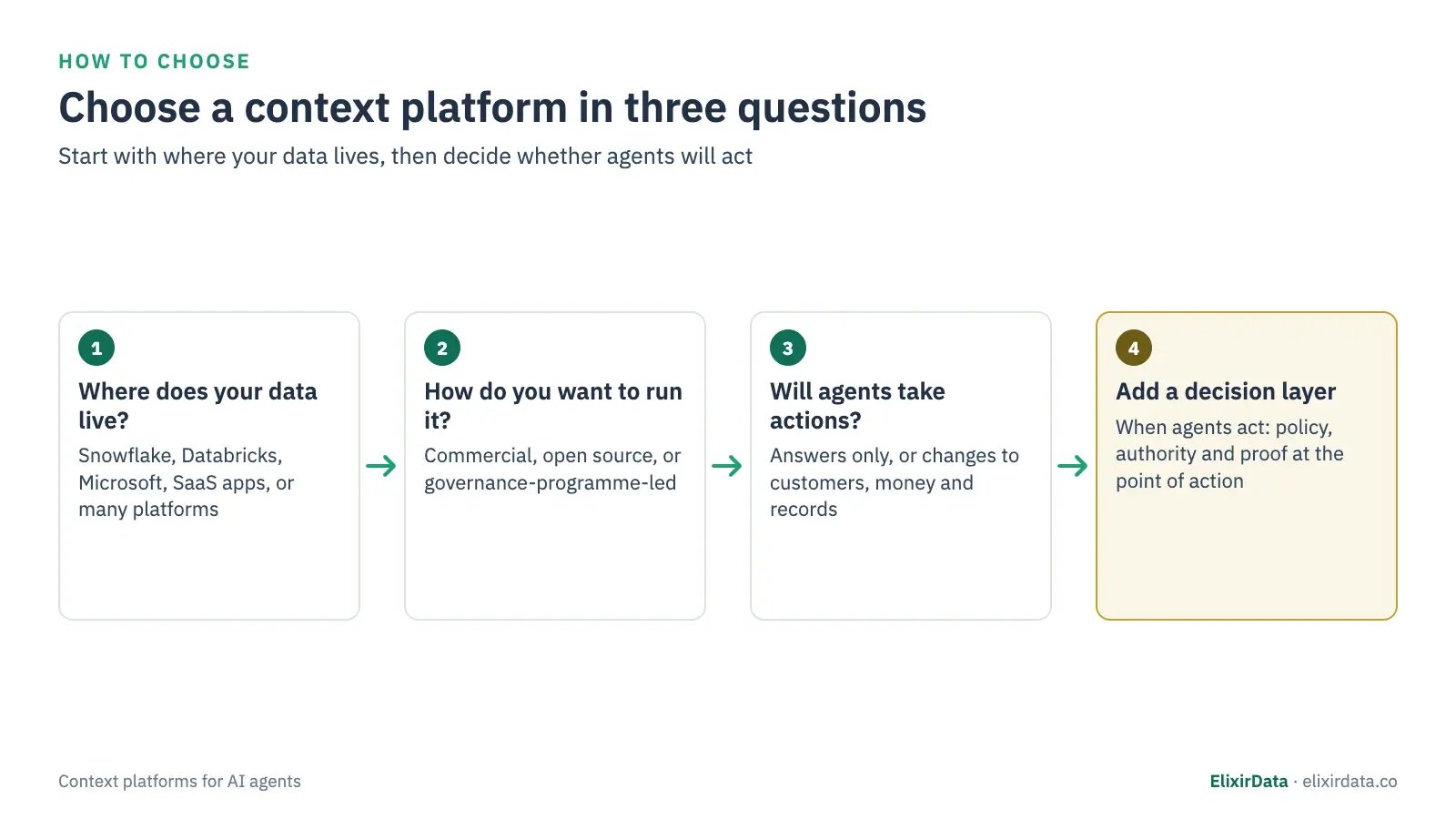
Question 1: Where does most of your governed data live?
| If most of your governed data is in... | Start with | Why |
|---|---|---|
| Snowflake | Snowflake Horizon Context | Semantic views and policies sit next to the data, with a managed MCP server |
| Databricks, on Unity Catalog | Unity Catalog + Genie | Metric views and Unity Catalog permissions apply to every agent request |
| Microsoft Fabric, with Power BI models | Microsoft Fabric IQ | Ontology bound to OneLake; queries run as the user (check which parts are in preview) |
| SaaS apps and documents, not tables | Glean | A permission-aware index of content, people and activity |
| A knowledge graph of business facts | Fluree | Policy enforced on every fact, with cited answers |
| Several platforms at once | Atlan, DataHub or Collibra | One metadata context layer across all of them. Go to question 2 |
Question 2: If you run several platforms, how do you want to run the context layer?
| If you want... | Choose |
|---|---|
| A commercial, hosted context layer across many data platforms | Atlan |
| Open source you can self-host, or a managed cloud option | DataHub |
| A formal governance programme with an AI registry and policies pushed down to platforms | Collibra |
Question 3: Will your agents take actions?
| If your agents will... | What you need |
|---|---|
| Only answer questions and summarise data | The context platform you chose above is usually enough |
| Update records, approve exceptions, change limits or trigger payments | Add a decision layer, such as ElixirData, to check policy and authority before each action and record the decision |
| Operate in a regulated industry, such as banking, insurance or healthcare | Add a decision layer that produces decision traces your auditors and regulators can review |
Quick picks
- "We are all-in on Snowflake and want agents to answer metric questions." Snowflake Horizon Context.
- "Our lakehouse runs on Databricks and Unity Catalog." Unity Catalog + Genie.
- "We run Microsoft Fabric and Power BI everywhere." Microsoft Fabric IQ.
- "We have Snowflake, Databricks and SaaS tools, and want one context layer." Atlan, or DataHub if you prefer open source.
- "Governance and AI risk sit with a central data office." Collibra.
- "Our staff need agents that search across documents and apps." Glean.
- "We need cited answers computed from governed business facts." Fluree.
- "Our agents will act on customers, money or regulated data." Keep your context platform and add ElixirData as the decision layer.
Most large enterprises end up with two layers: one context platform that matches their data estate, and one decision layer that governs what agents may do. Choosing the first does not rule out the second.
Where is policy enforced in each platform?
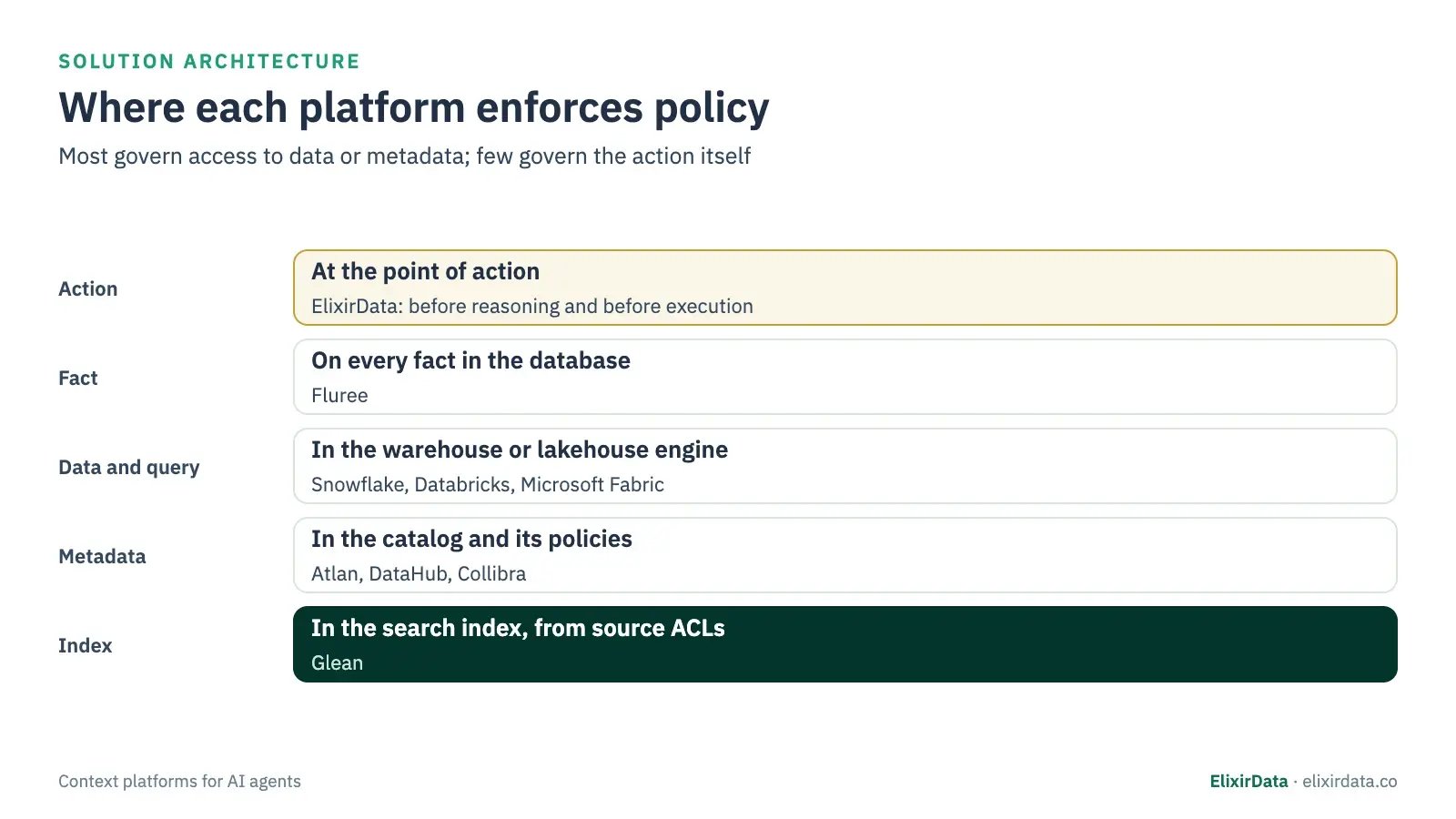
The last column of the table is the one that matters most once agents start acting. Every platform here respects permissions, but at different points: in a search index, in a catalog, inside the warehouse or lakehouse engine, on each fact in a database, or at the moment an agent tries to act.
Access controls decide what an agent can see. They do not decide whether a refund, a limit change or a supplier payment is allowed, who must approve it, or what evidence an auditor will need later.
What does each platform do best?
Atlan
Atlan is a metadata and governance platform that serves context to agents through a hosted MCP server, so answers stay grounded in the definitions, lineage and permissions already set in Atlan. It was named a Leader in the 2026 Gartner Magic Quadrant for Data and Analytics Governance Platforms. It suits teams that want one context layer across many data platforms. See our Atlan vs ElixirData comparison.
DataHub
DataHub is an open-source metadata graph. Its MCP server runs managed on DataHub Cloud or self-hosted with DataHub Core, giving agents lineage, ownership, quality and documentation. It suits engineering-led teams that want open source and control over where the metadata graph runs.
Snowflake Horizon Context
Horizon Context brings semantic views and catalog metadata together for Snowflake estates. The Snowflake-managed MCP server became generally available in November 2025, and Snowflake enforces role access, masking and row access policies at the query engine. Some newer Horizon Context features, such as Semantic Studio and external metadata connectors, are still in preview. It is the natural choice when most governed data already lives in Snowflake.
Databricks Unity Catalog and Genie
Databricks grounds agents in Unity Catalog metric views and the semantics Genie learns. The Genie One MCP server became generally available in September 2026, with Unity Catalog permissions applied to every request. It fits lakehouse-first teams already standardised on Unity Catalog.
Fluree
Fluree stores business facts as a governed knowledge graph, with policy enforced inside the database on every fact. It offers a native MCP server and supports SPARQL, openCypher, GraphQL and JSON-LD on the same engine. It suits teams that want cited, permission-aware answers computed from the facts themselves.
Microsoft Fabric IQ
Fabric IQ binds ontology definitions to OneLake data, so agents reason in business terms. Fabric data agents can be reached as MCP servers, and an ontology MCP server is in preview. Queries run as the user under OneLake security and source row, object and column security. It fits Microsoft estates with Power BI semantic models in production.
Glean
Glean indexes content, people and activity across SaaS apps and documents, mirroring each source's permissions into the index. Its managed MCP server and A2A server run every request as the signed-in user. It suits knowledge work rather than structured data questions. See our Glean vs ElixirData comparison.
Collibra
Collibra is a governance-led platform covering glossary, catalog, lineage, policies and an AI registry. Its MCP server connects any MCP client to governed metadata, and Collibra can push access grants down to data platforms. It suits organisations that run AI governance as part of a formal data governance programme.
Why is context not the same as permission to act?
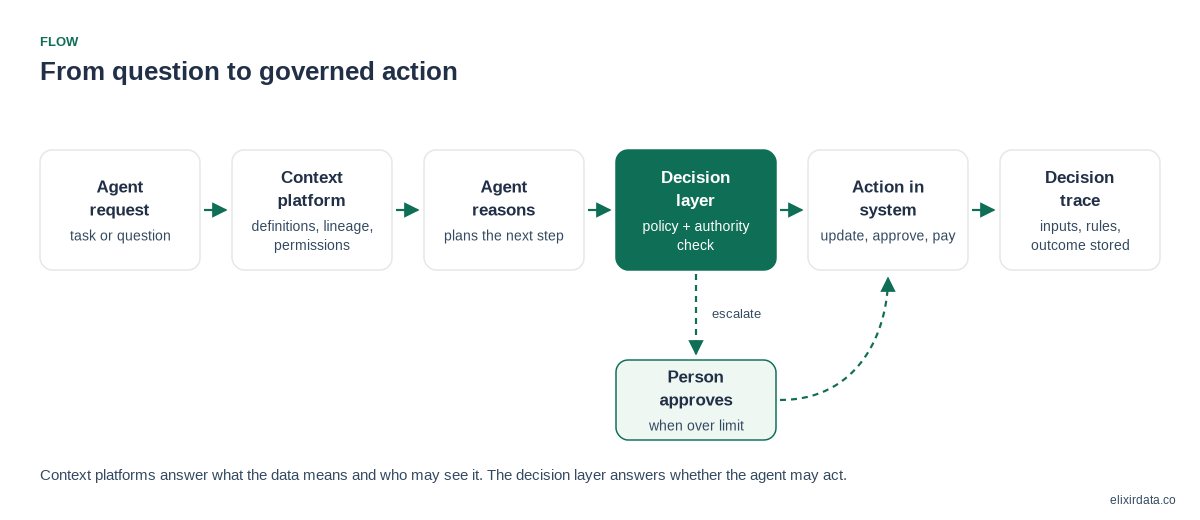
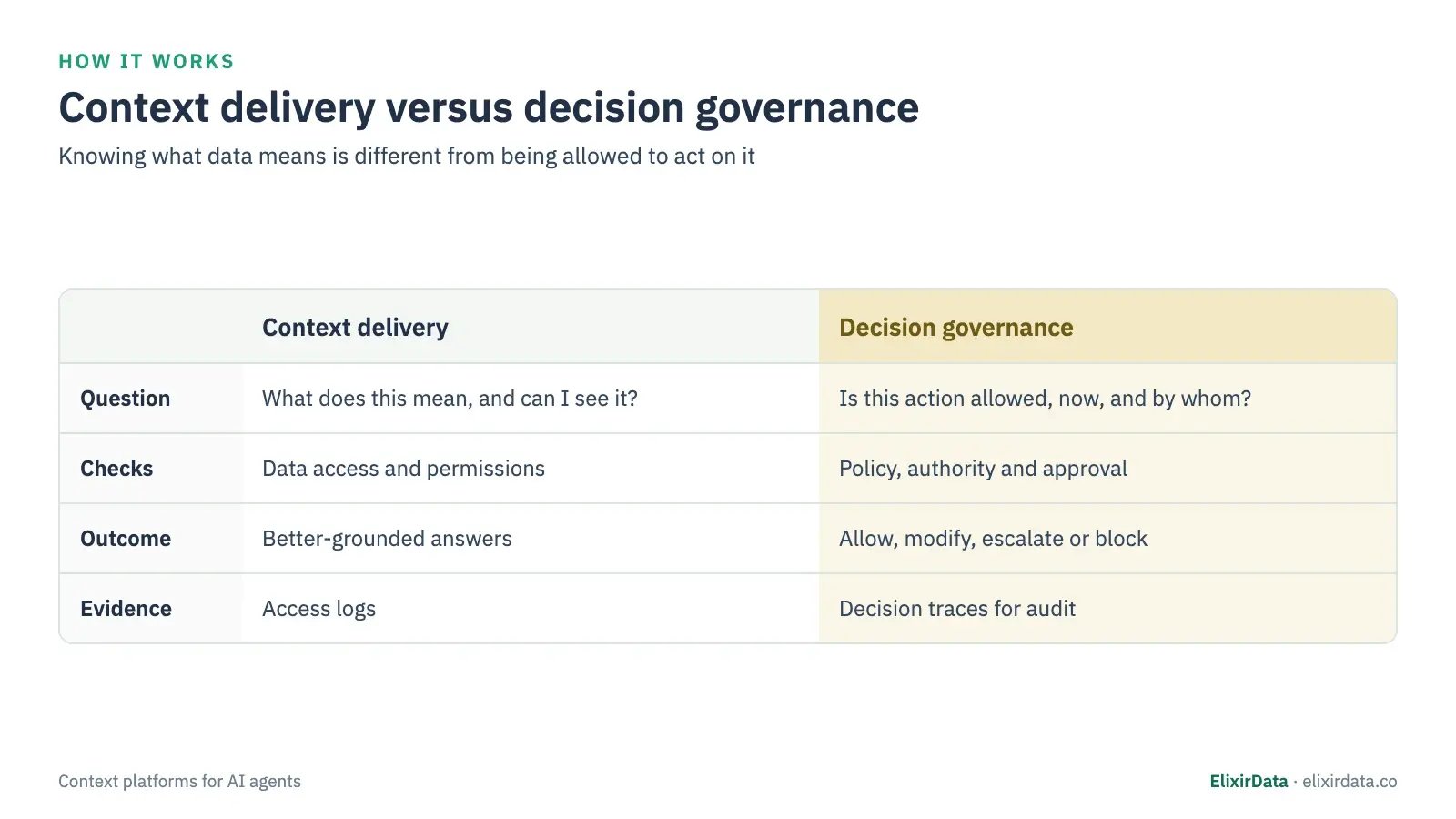
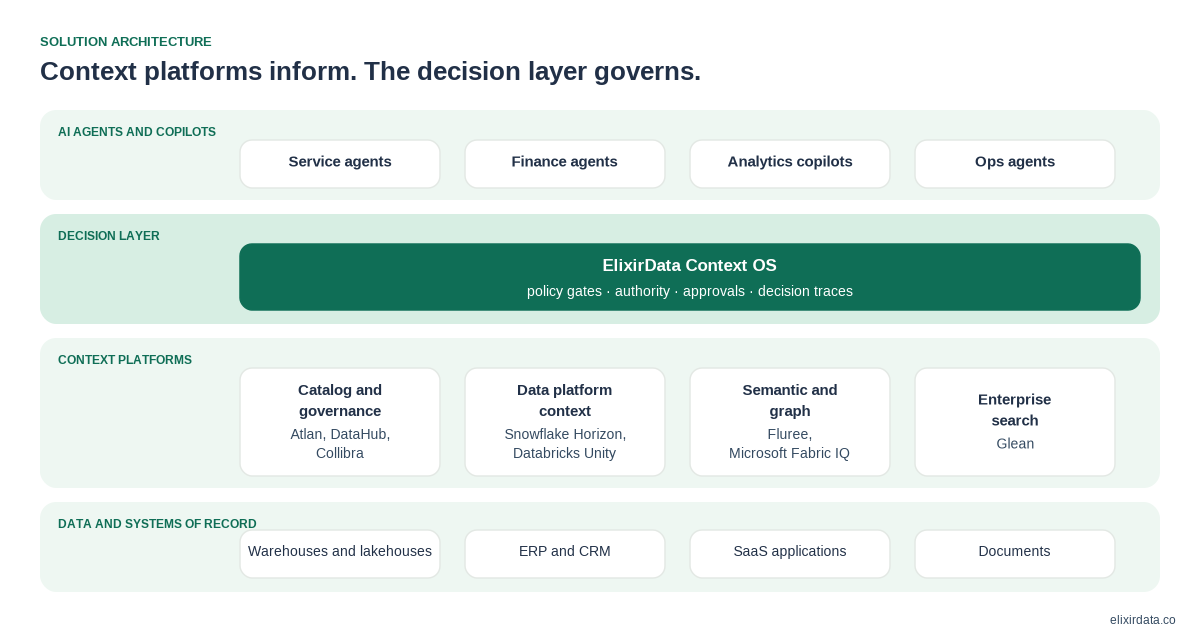
Context platforms answer "what does this mean, and can I see it?" Once an agent can update records, approve exceptions or trigger payments, a second question appears: "is this action allowed, right now, by whom, and can we prove it later?"
That second question needs policy, authority and approval checks at the point of action, plus a record of each decision that an auditor or regulator can review. This is the gap a decision layer fills. It does not replace the context platforms above; it uses their context and adds the controls they were not designed to provide.
Where does ElixirData fit?
ElixirData is a Context OS: the decision layer for governed AI agents. It compiles business context into a Context Graph, checks each consequential action against policy and authority before the agent reasons and again before it executes, and then allows, modifies, escalates to a named approver or blocks the action. Every outcome is written to a Decision Trace with the inputs, policy version, authority and result.
ElixirData is designed to work alongside the platforms in this comparison, consuming the context they already hold. Deployment options include SaaS, customer VPC, on-premises, hybrid and edge. Learn more on the Context OS platform page.
Disclosure: ElixirData publishes this article and sells Context OS. Evaluate every option, including ours, against the same criteria.
Related reading
- Which Platforms Give AI Agents Governed Business Context?
- Context OS vs Catalog, Semantic Layer and Knowledge Graph
- Atlan vs ElixirData: Context Layer or Decision Layer?
- Glean vs ElixirData: Who Approves What Your AI Agents Do?
Frequently asked questions
What is the best context platform for AI agents?
There is no single best choice. The right platform depends on where your governed data lives: Snowflake, Databricks or Microsoft estates usually start with their native option, while multi-platform estates often choose Atlan, DataHub or Collibra. Agents that take consequential actions also need a decision layer.
Do all of these platforms support MCP?
Yes, each offers MCP access, but maturity varies. Snowflake's managed MCP server and Databricks' Genie One MCP are generally available, while Microsoft's Fabric IQ ontology MCP server is in preview. Check the current status with each vendor.
Is ElixirData a replacement for a data catalog or semantic layer?
No. ElixirData governs what agents are allowed to do and records each decision. It is designed to use the context held in your catalog, semantic layer or knowledge graph rather than replace it.
Why are access controls not enough for AI agents?
Access controls decide what an agent can see. They do not decide whether a specific action is allowed, who must approve it, or what evidence is kept. Those checks need to happen at the point of action.
Sources
- Atlan: Remote MCP overview
- Atlan: Leader in the 2026 Gartner Magic Quadrant for Data and Analytics Governance Platforms
- DataHub: MCP server
- Snowflake: Managed MCP server general availability
- Snowflake: Horizon Context
- Databricks: Managed MCP servers
- Fluree: FlureeDB
- Microsoft: Consume ontology as an MCP server
- Glean: MCP security, data flow and permissions
- Collibra: MCP server