In brief
The best way to govern AI agents at a bank is to cover five jobs, not to buy one product: agent identity and access, runtime policy enforcement, decision records, human oversight, and model risk management. Most vendors do one or two of these well, so compare by job, then test each on your own agents.
This guide is for risk, compliance and technology leaders at banks who need to decide how to control what an AI agent does, not just which platform sits around it. Disclosure: ElixirData publishes this and sells one option in it, Context OS. We name other vendors only where their own pages back the claim.
Why compare approaches instead of platforms?
Our earlier post, Best Bank AI Governance Platforms Compared for 2026, sorts vendors by the layer they sell. This one starts from the agent's action. An agent that issues a refund, updates a customer record or calls a payment tool is making a decision a bank has to explain later. The useful question is which control stands between the agent and that action, and what it leaves behind as evidence.
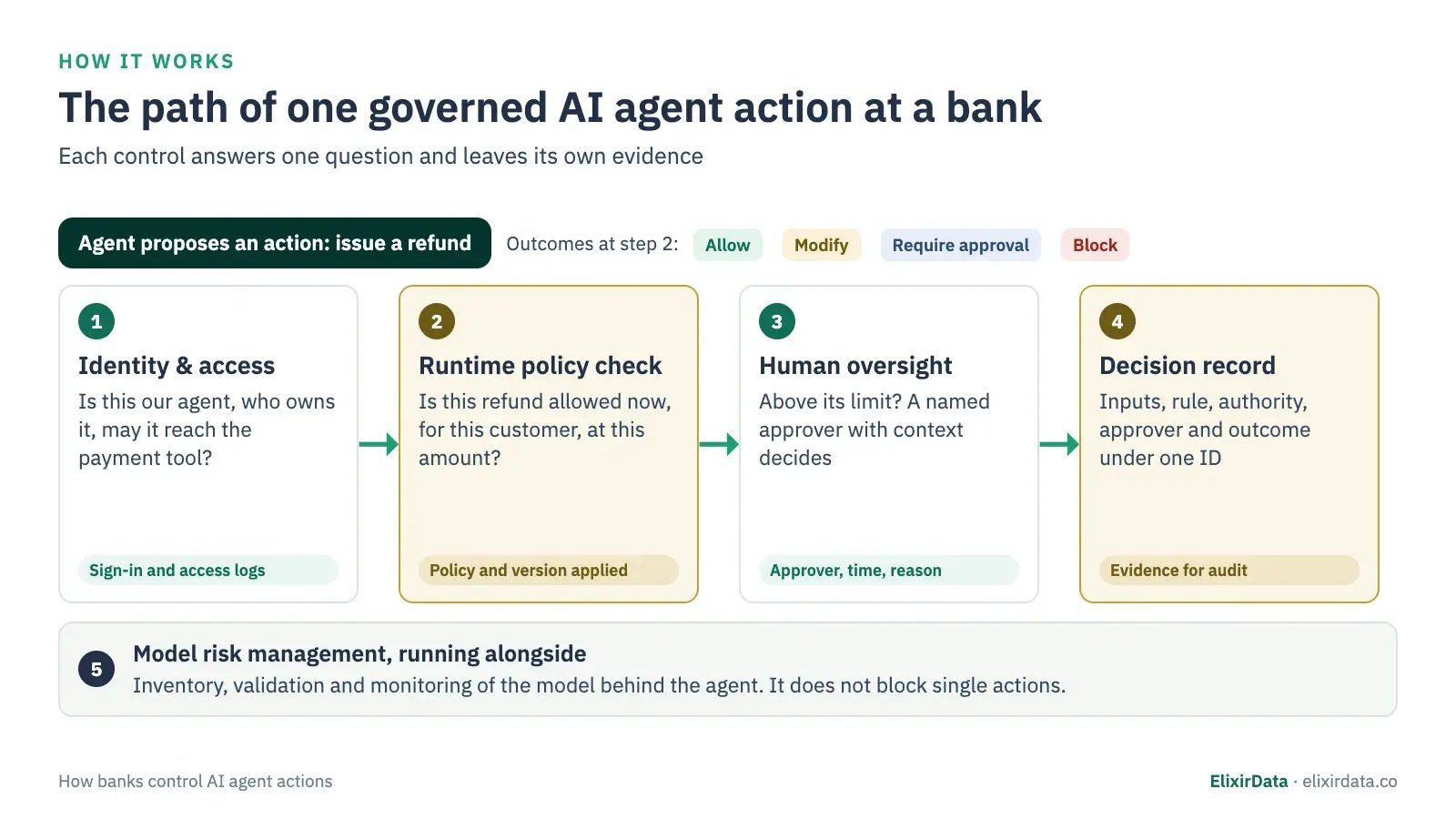
For a bank, a governed action has six answers: who the agent is, what it may reach, which policy was checked before it ran, who approved anything above its limit, what was recorded, and how the model behind it was validated and monitored. Each answer comes from a different control.
How do the five approaches compare?
The table is a summary. Vendor claims are paraphrased from each vendor's own page, linked in the sections below and in the Sources list. They show what the vendor says, not what we tested.
| Approach | Question it answers | Where it usually stops | Vendors checked on their own pages | Evidence it leaves |
|---|---|---|---|---|
| Agent identity and access | Who is this agent, who owns it, what can it connect to? | Decides whether an agent can connect, not whether one specific action fits bank policy | Okta, Microsoft Entra Agent ID | Sign-in and access logs, ownership, revocation history |
| Runtime policy enforcement | Is this action allowed, right now, with this data? | Only as good as the policies and context it is given | Context OS (ours); Okta describes policy controls at the tool-call level | Policy checked, version, result: allow, modify, escalate or block |
| Decision records | Can we reconstruct why the agent acted? | Records a decision, doesn't prevent a bad one on its own | Context OS (ours) | Inputs, rule applied, authority, approver, outcome under one ID |
| Human oversight | Could a named person see, change or stop it? | Fails if the approver has no context, time or authority | None verified (a process choice, not a product) | Approver identity, context shown, time taken, reason |
| Model risk management | Was the model validated, inventoried and challenged? | Existing US guidance excludes agentic AI, and inventories don't block actions | Credo AI | Inventory, risk assessments, validation reports, policy mapping |
What does agent identity and access cover?
Identity gives every agent its own credential, a human owner and limited access, so you can find it, restrict it and switch it off. According to its site, Okta for AI Agents assigns "verified identities with clear human owners," enforces "least-privilege policies across each agent connection," puts "identity, policy, and audit controls in the path of every tool call," and includes a kill switch to revoke access (Okta).
According to Microsoft's documentation, Entra Agent ID extends Entra to AI agents with agent identities, adaptive access policies, and logging of agent authentication and activity (Microsoft Learn). The page also says some Entra security features for agents depend on Microsoft Agent 365, so check licensing for your tenant.
Where it fits: every bank needs this first. Where it stops: an identity check tells you the agent may call the payment tool. It doesn't tell you whether this particular payment, for this customer, at this amount, was allowed.
What is runtime policy enforcement?
This is a check that runs before the action executes and returns a decision: allow, modify, require approval or block. It's the control that turns a written policy into something the agent can't skip. The test is simple. Ask a vendor to show you a blocked action, an approved action and an allowed action live, each with its record.
Okta's page describes policy controls at the tool-call level, which is one place to enforce. ElixirData's Context OS page describes dual-gate enforcement, before reasoning and before execution, with policy "compiled into the decision path." That's our own claim about our own product, so treat it as a starting point for your test, not proof. Credo AI's page lists "planned enforcement integration" with CI/CD, CASBs and API gateways, which suggests enforcement there is still on the roadmap, so ask what is live today. We found no other vendor page that we could verify for in-path enforcement of bank agent actions, so we haven't named any.
Where it stops: a gate is only as good as the policy and the data feeding it. Stale or conflicting inputs produce confident wrong decisions.
Why do decision records matter more than logs?
A log tells you a call happened. A decision record tells you what the agent saw, which rule applied, who had authority, who approved an exception and what came out. Examiners and internal audit ask those questions in that order. Keep the output the agent actually produced, because a rerun uses today's model, data and policy and can't explain yesterday's decision.
According to ElixirData's Context OS page, Decision Traces record the "context consumed, policy evaluated, authority verified, and outcome generated." Our guides on AI agent audit trails for bank compliance and Decision Traces cover the fields in more detail.
What makes human oversight real?
A person near the system isn't oversight. It counts when the person has authority to say no, the context to judge, the time to do it, and a record of what they decided. Approval thresholds decide which actions need a person: low-risk actions can run alone, higher-risk ones go to a named approver, and the hardest cases escalate.
No vendor sells oversight on its own, so this row has no vendors, only a design choice. Our guide to human oversight in AI agent decisions covers the three models and the evidence to keep.
On timing: under the EU AI Act as amended by Regulation (EU) 2026/1744, the high-risk obligations, including the human oversight rules in Article 14, apply from 2 December 2027 for Annex III systems and 2 August 2028 for Annex I systems. The EBA's November 2025 factsheet notes that creditworthiness assessment is classed as high-risk. It doesn't say every agent a bank runs is high-risk, so classify your own use cases.
How does model risk management apply to agents?
This is where bank leaders most often assume cover that isn't there.
United States. SR 11-7 is no longer the current text. The Federal Reserve's SR 26-2, dated 17 April 2026, says it supersedes and replaces SR 11-7. Footnote 3 of the attached guidance says generative AI and agentic AI models are "not within the scope of this guidance." Its ideas, such as a model inventory and effective challenge by independent reviewers, are still sensible habits for agents, but you can't point to SR 26-2 as the rulebook for them.
United Kingdom. The PRA's SS1/23 applies to UK-incorporated banks, building societies and PRA-designated investment firms with internal model approval. The Bank of England page says it covers models "regardless of technology" and refers to managing AI risks in modelling techniques such as machine learning. The current version was published and took effect on 23 April 2026. We found nothing on the page that sets agent-specific requirements.
European Union. The EBA's mapping of the AI Act against EU banking and payments rules (21 November 2025) reported no significant contradictions and described the AI Act as complementary to existing rules. It isn't guidance or a supervisory expectation. Read it as a mapping exercise, not a new rulebook for agents.
Tooling here is mostly about inventory and evidence. According to its site, Credo AI offers a "centralized inventory of every AI system, including agents, models, apps, and shadow AI," an agentic risk assessment library, and pre-built policy packs for the EU AI Act, NIST AI RMF, ISO 42001 and SOC 2 (Credo AI). That helps you document and assess. It isn't, by its own description, a runtime gate on each action.
Where does Context OS fit?
Context OS is ElixirData's decision harness for enterprise AI agents: context, governance and memory for every AI decision. In the five jobs above it covers runtime policy enforcement and decision records. Per its page, it also has an Agent Registry and Trust Graduation stages that move an agent from Shadow to Supervised, Bounded and Full Autonomy.
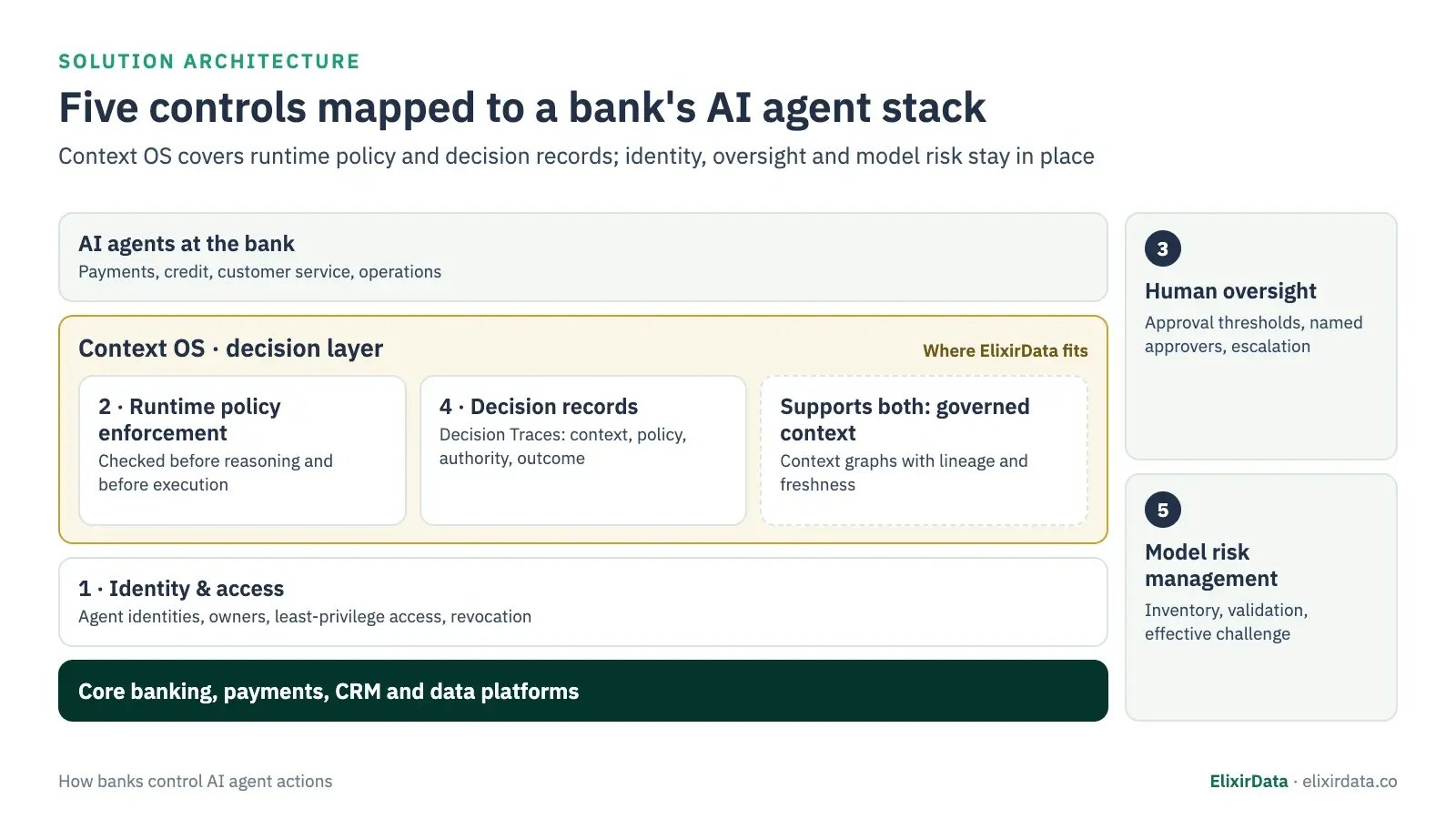
It fits when your gap is deciding, before an action runs, whether it's allowed and being able to prove it afterwards. It doesn't fit as a replacement for your identity provider, your model validation function, or your regulator-facing model inventory. You'd run it alongside those. We haven't named customers or results here because we have none we can verify for this post.
How should a bank choose?
- Start with the gap. Map your current agents to the six answers above. Where you can't answer, that's your first purchase.
- Fix identity first. If agents share service accounts, nothing downstream is reliable.
- Ask for a live blocked action. Any enforcement claim should show allow, approve and block cases with a record for each.
- Check the oversight design, not just the tool. Who approves, with what context, in how much time?
- Don't lean on model risk guidance you haven't read. Confirm with legal and compliance whether SR 26-2, SS1/23 or the AI Act reaches the agent in question.
- Recheck vendor pages before you buy. Features move, and some claims above describe plans.
Related reading on bank AI agent governance
- AI Agent Governance for Banks in 2026: A Practical Guide
- The Complete Guide to Bank AI Agent Controls
- Best Bank AI Governance Platforms Compared for 2026
Frequently asked questions
What is AI agent governance for banks?
It's the set of controls over what an agent does: its identity and access, policy checks before action, records of each decision, human oversight, and model risk management. It focuses on actions, not just the model.
Does SR 11-7 cover AI agents?
SR 11-7 has been superseded by SR 26-2 (17 April 2026), and SR 26-2's footnote 3 says generative and agentic AI are outside its scope. Check with your regulator and counsel on how they expect agents to be governed.
Does the PRA's SS1/23 apply to AI agents?
It applies to models regardless of technology and mentions AI risk in modelling, but it applies to firms with internal model approval and, as far as we could see, sets no agent-specific rules.
Is identity management enough to govern agents?
No. Identity controls which systems an agent can reach. It doesn't judge whether a specific action was allowed under bank policy or record why it was taken.
When do EU high-risk AI rules apply to banks?
For Annex III systems, from 2 December 2027, and for Annex I systems, from 2 August 2028, after Regulation (EU) 2026/1744. Whether a given agent is high-risk depends on its use.
Which vendor is best?
None covers all five jobs. Okta and Microsoft Entra Agent ID address identity, Credo AI addresses inventory and assessment, and Context OS, which we sell, addresses runtime policy and decision records. Weigh our view accordingly.
Book a Context Workshop
Map one bank agent decision end to end in half a day: the policy it must pass, who approves it and the record it leaves. Book a Context Workshop
Sources
-
Okta, Okta for AI Agents.
-
Microsoft Learn, What is Microsoft Entra Agent ID (page dated 24 June 2026).
-
Credo AI, Product.
-
ElixirData, Context OS.
-
Federal Reserve, SR 26-2, Revised Guidance on Model Risk Management, 17 April 2026, and attached guidance.
-
Bank of England, PRA SS1/23, Model risk management principles for banks (current version 23 April 2026).
-
European Banking Authority, AI Act implications for the EU banking sector, 21 November 2025.
-
European Union, Regulation (EU) 2026/1744 (Digital Omnibus on AI).
Disclosure: This article is published by XenonStack, which develops ElixirData, a platform with pre-action policy checks.