A manufacturing data intelligence platform connects ERP, MES, SCADA and document data, aligns definitions, tracks quality and lineage, and uses a ContextGraph to give AI agents trusted, time-aware context for downtime, quality and governed plant decisions.
Why is manufacturing data integration not enough?
A paint line can stop while its alarm sits in SCADA, its work order in a maintenance system, its production schedule in MES and its operating procedure in a document library. Each source describes part of the event. An engineer investigating the stoppage needs to connect the affected asset, shift, batch, recent maintenance and relevant procedure before deciding what to check next.
Data integration moves and transforms those records; warehouses and lakehouses make them available for analysis. Manufacturing AI also needs to resolve which equipment and product records refer to the same operation, when readings were valid, which source is authoritative and what actions the agent may recommend. The context must stay current as production state changes.
The broader market points in this direction. Databricks presents a unified data and AI platform with governance. Snowflake describes an internal semantic layer that gives people and agents consistent business definitions. Microsoft Research uses graph-structured knowledge to retrieve themes and relationships across a corpus. These approaches solve different problems; together they show why manufacturers need governed meaning and connected evidence around their data.
See how Context OS governs AI agent decisions
Context OS maintains the manufacturing ContextGraph that gives plant agents trusted evidence and bounded authority.
What does a manufacturing data intelligence platform do?
A manufacturing data intelligence platform connects industrial and enterprise sources, aligns their definitions, records quality and lineage, models relationships among assets, materials, people and processes, and retrieves relevant evidence for analytics and AI. It should preserve event sequence and policy context so a recommendation can be traced back to the source state that produced it.
The difference is easiest to see as a progression:
-
Data integration answers: Can we connect and move the data?
-
Data management answers: Can we organize, govern and trust the data?
-
Knowledge representation answers: What does this data mean, and how is it related?
-
Context intelligence answers: What is relevant right now, for this entity, process, event or decision?
-
Enterprise AI answers: Given trusted context, what should we explain, recommend, predict or do next?
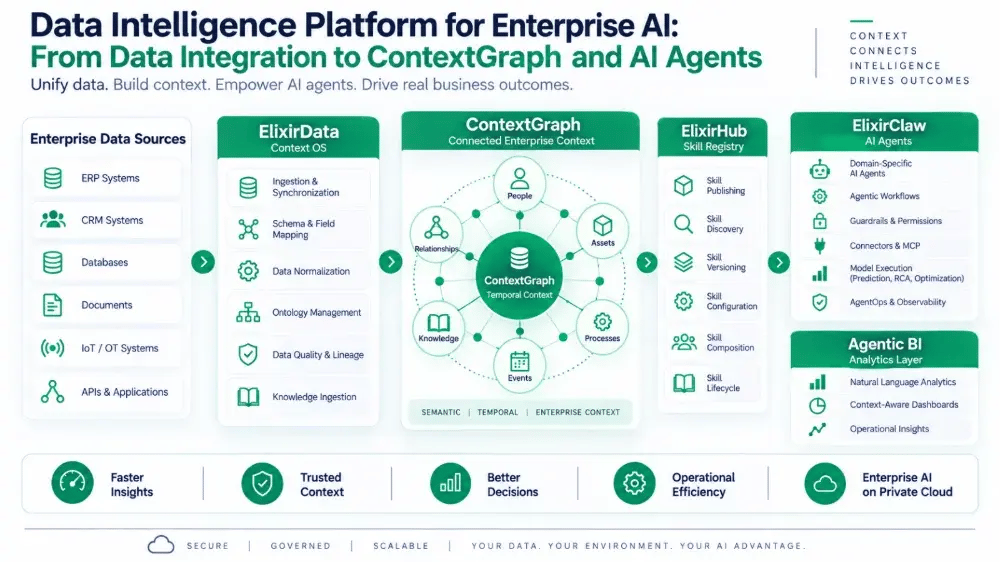
In this architecture, ElixirData maintains the ContextGraph by ingesting and synchronizing records, mapping source fields, resolving entities, managing ontology, preserving time and lineage, and retrieving task-specific context. Its context layer for AI explains how that foundation serves agents without giving them unrestricted access to raw systems.
Why does ContextGraph matter on the shop floor?
A knowledge graph can represent that a production line contains a machine, a machine processes a batch and a batch uses a material supplied under a contract. A ContextGraph adds the current operating state, event history, source evidence, applicable procedure and permissions that matter to an investigation or decision.
ContextGraph connects the semantic model to time and action. An agent should know which alarm preceded an outage, which work order was open at that moment, which procedure version applied and whether a proposed response requires approval. Neo4j explains the distinction between connected graphs, knowledge graphs and situation-aware context graphs; ElixirData gives a manufacturing example in its guide to context and decision graphs.
Consider the question, “Why is this supplier putting production at risk?” A document search may return a supplier review. A ContextGraph can connect that supplier to late deliveries, affected materials, dependent plants, open purchase orders, quality events, contract terms and qualified alternatives. The agent can then explain the likely operational impact with links to evidence rather than summarizing one document.
How does ElixirData build manufacturing context?
The capabilities below turn fragmented plant and enterprise records into a context model that an agent can query for a particular asset, event or decision. Each depends on maintained source mappings and checks for quality and freshness.
|
Capability |
What it does |
Why it matters for AI |
|
Ingestion & synchronization |
Connects structured, unstructured, streaming and operational sources. |
Agents can reason across the enterprise instead of one isolated repository. |
|
Schema & field mapping |
Aligns source-specific structures to a consistent model. |
Reduces ambiguity when the same concept appears under different names. |
|
Normalization |
Standardizes formats, identifiers and representations. |
Improves comparability and reliable retrieval. |
|
Ontology management |
Defines domain entities, concepts and relationships. |
Gives AI a shared vocabulary for business meaning. |
|
ContextGraph + temporal context |
Connects people, assets, processes, documents and events over time. |
Lets agents understand dependencies, sequence, state and history. |
|
Knowledge ingestion |
Brings policies, documents and domain knowledge into the context layer. |
Adds evidence and institutional knowledge beyond transactional tables. |
|
Data quality & lineage |
Tracks trust, provenance and data health. |
Allows AI outputs to be grounded in traceable sources. |
|
Context retrieval & memory |
Returns relevant enterprise context for downstream consumers. |
Provides agents with situation-aware context while avoiding unrestricted data exposure. |
How does context reach manufacturing agents and analytics?
ElixirData serves the evidence and relationships. ElixirHub holds reusable skills, ElixirClaw runs governed agent workflows and Agentic BI presents insights. Keeping those responsibilities explicit helps teams test retrieval, approval and execution separately.
ElixirHub registers reusable skills, such as investigating a recurring fault, compiling a shift handover or checking a supplier exception. A skill packages a repeatable method that an authorized agent can invoke; its existence does not grant access to a plant system.
ElixirClaw runs agents and governs their use of tools, connectors and models. A workflow can retrieve context, ask for a diagnosis, check permissions, route a recommendation for human review, execute an approved action and record the outcome. Prediction, forecasting or root-cause models can be exposed as tools where appropriate, subject to the same controls.
Agentic BI turns shared definitions and context into natural-language analytics and operational views. It can show why a plant metric changed and link the answer to underlying equipment, events and sources. Execution authority remains with the governed workflow.
Get the Executive Blueprint for governed enterprise AI
A practical guide for CIOs, CAIOs and risk leaders on moving AI agents from pilot to production without losing control of context or decisions.
How does agentic analytics support plant decisions?
A dashboard can show rising scrap or declining throughput, but an engineer still has to correlate the trend with batches, equipment, shifts and maintenance. Context-aware analytics starts from that question, applies consistent metric definitions and retrieves the related events before presenting an explanation.
Snowflake describes semantic views that sit between physical tables and downstream users so humans and agents can query consistent facts and metrics. In a plant, the same discipline helps define downtime, yield or quality consistently across lines. ElixirData extends that shared meaning with asset relationships, temporal state and source evidence.
Teams can ask which alarms and maintenance actions preceded repeated line stops, which batches share a defect signature, or whether late materials will affect a scheduled run. The answer should identify the records and time windows used, so a plant owner can verify it.
How do private cloud deployment and OT boundaries work?
Manufacturers may need plant data to remain within approved networks or regions. A private cloud or customer-controlled deployment can place the context service near governed data sources. OT connections, network segmentation and write permissions still need to be designed for each site.
A model running in a private environment does not by itself make a plant action safe. Agent access should be scoped to the task, with policy checks, observability, auditable tool calls and human approval for consequential changes. Operators remain responsible for the validated control and safety procedures that govern equipment.
This gives teams a way to choose where data and models run, retain lineage to PLC, SCADA, MES and enterprise sources, and distinguish a recommendation from an authorized action. XenonStack describes a broader manufacturing agent operating model in its article on agentic AI for manufacturing.
Which manufacturing outcomes should be measured?
Start with a baseline for a specific plant decision. Track investigation time, mean time to repair, scrap or rework, answer accuracy across systems and the proportion of actions completed within policy. Connector or graph-node counts describe implementation size; they do not establish operational value. Useful outcome categories include:
-
Faster information access: less time spent searching across systems, documents and dashboards.
-
More consistent decisions: shared semantic definitions and contextual evidence reduce conflicting interpretations.
-
Lower investigation effort: connected data and relationships shorten the path from symptom to probable cause.
-
Reusable institutional knowledge: policies, prior decisions, incidents and domain expertise become retrievable context instead of disappearing into silos.
-
Safer AI actions: agents operate with explicit permissions, decision boundaries, source lineage and human approval where required.
-
Faster scaling of AI use cases, a shared context layer can serve multiple agents and analytics experiences rather than rebuilding data preparation for every project.
An AWS and Mahindra AI paint-shop example connected SCADA, MES, downtime, energy and engineering information in an industrial data fabric and knowledge graph. AWS reports a 20% reduction in mean time to repair and a 30% reduction in time to deploy the approach to other shop floors for that implementation. Those results belong to the cited project and should not be treated as a general forecast.
What is a practical manufacturing adoption path?
Start with one costly recurring question, such as why a paint line stopped or which batch is at risk. Bring the process owner, maintenance lead and data team together to specify the evidence needed and the action boundary before building the first graph.
-
Choose one decision domain: Start with asset reliability, quality investigation, supplier risk or a production exception.
-
Map the minimum context: Identify assets, batches, events, documents, policies, approvers and source systems needed to investigate it.
-
Model identity and time: Resolve asset and batch identifiers across systems; preserve event order, effective dates and changing status.
-
Check data and access: Validate source quality, lineage, freshness and role-specific permissions before an agent relies on retrieved context.
-
Pilot insight and action: Compare a context-aware analytical answer with a supervised agent workflow using the same evidence.
-
Measure the baseline: Track investigation time, decision accuracy, workflow cycle time, policy adherence and operator adoption.
-
Expand carefully: Reuse validated entities and retrieval patterns for adjacent plants or decisions after owners confirm the results.
From connected data to governed plant decisions
A durable manufacturing AI capability depends on more than a model. It depends on maintained definitions for assets and operations, evidence about what happened and clear authority over the next action.
A data intelligence platform can bring that evidence into a shared ContextGraph. ElixirData maintains the context, ElixirHub registers reusable skills, ElixirClaw runs governed workflows and Agentic BI presents the operational analysis. The value should be tested against a plant-level decision and its baseline.
Start with a repeated cross-system investigation. Validate the source mappings, event sequence and applicable procedures with plant owners. Give agents only the context and authority needed for the task, then measure whether their recommendations save time without weakening oversight.
Take the next step
Download the Executive Blueprint, or talk to our team about a manufacturing data intelligence platform.
ElixirData: Frequently Asked Questions
-
What is a data intelligence platform for manufacturing?
It connects plant and enterprise data, aligns business meaning, traces quality and lineage, and gives analytics and AI agents the evidence needed for a specific operational question. -
How does ContextGraph connect ERP MES and SCADA data?
It resolves shared entities such as assets, batches and work orders, then links transactions, operational events and documents with timestamps and source references. The mappings must be maintained as systems and processes change. -
Is ContextGraph the same as a knowledge graph?
A knowledge graph represents entities and relationships. A ContextGraph also includes the relevant state, event sequence, evidence, policies and permissions for a particular decision. -
Does ContextGraph replace a lakehouse or data integration platform?
No. Integration and storage remain useful for moving, organizing and analyzing data. ContextGraph connects their records and definitions so an agent can retrieve a coherent business situation. -
Can an AI agent change a PLC setpoint automatically?
Any control-system action needs explicit authorization, validated safety boundaries and the required operator approval. The context layer can support investigation, while the execution workflow enforces who may act and records what happened.